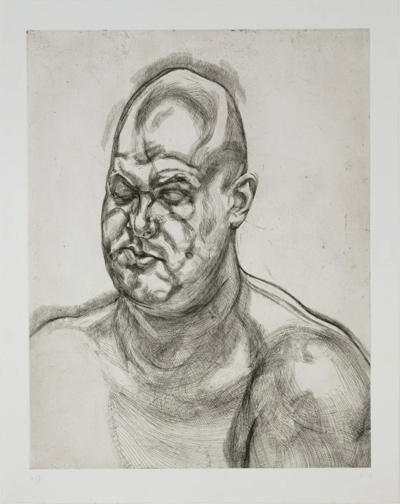
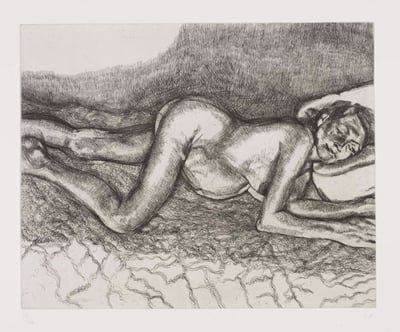
Large Head is a commanding etching by Lucian Freud from 1993, showcasing the artist’s extraordinary mastery of the intaglio medium. The portrait depicts a heavyset male figure rendered with Freud’s characteristic unflinching scrutiny, every fold of flesh and contour of muscle built up through dense, overlapping layers of crosshatched lines. The monumental scale of the head dominates the composition, conveying an almost sculptural physicality that distinguishes Freud’s graphic work. The artist’s meticulous attention to the play of light across skin surfaces creates a remarkable sense of three-dimensional presence. This artist’s proof, signed with Freud’s initials, exemplifies his reputation as one of the twentieth century’s greatest figurative printmakers.
Lucian Freud (Germany/UK, 1922–2011) was a master of figurative painting known for his unflinching, intimate portraits. Using thick impasto and meticulous detail, he captured the physical and psychological essence of his subjects, redefining contemporary portraiture.
EtchingEtching is a technique where a design is created on a metal surface by using a strong acid or mordant to eat away the unprotected parts of the metal, leaving the desired pattern in relief (intaglio). In modern art and manufacturing, different chemicals may be used depending on the material being etched.
Large Head is a commanding etching by Lucian Freud from 1993, showcasing the artist’s extraordinary mastery of the intaglio medium. The portrait depicts a heavyset male figure rendered with Freud’s characteristic unflinching scrutiny, every fold of flesh and contour of muscle built up through dense, overlapping layers of crosshatched lines. The monumental scale of the head dominates the composition, conveying an almost sculptural physicality that distinguishes Freud’s graphic work. The artist’s meticulous attention to the play of light across skin surfaces creates a remarkable sense of three-dimensional presence. This artist’s proof, signed with Freud’s initials, exemplifies his reputation as one of the twentieth century’s greatest figurative printmakers.
Lucian Freud (Germany/UK, 1922–2011) was a master of figurative painting known for his unflinching, intimate portraits. Using thick impasto and meticulous detail, he captured the physical and psychological essence of his subjects, redefining contemporary portraiture.
I paint people not because of what they are like, not exactly in spite of what they are like, but how they happen to be.
- Lucian Freud
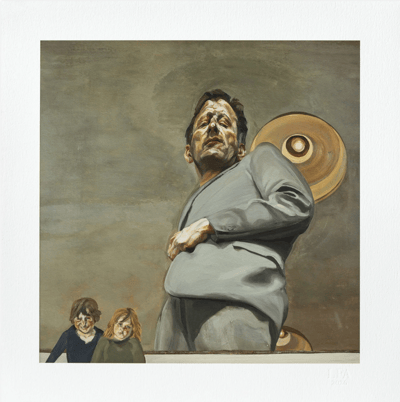
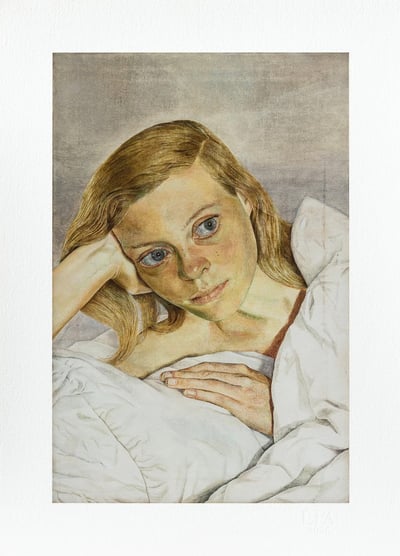
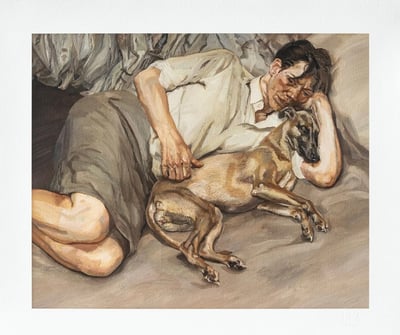
Lucien Freud was a German born painter, who grew up in England. He is highly regarded as one of the most important painters of portraits in the 20th century. His paintings reflect his reputation for being a very private man, as his subject matter primarily includes his family and friends. Freud is known to have painted using live models, and requiring very long and difficult sitting times with them. What resulted from the modeling sessions are paintings which have been described as somber, psychological interpretations of his relationships with his models. Lucien Freud was Sigmund Freud’s grandson. It is thought that Lucien’s paintings display an intensity derived from the comprehension Lucien gained of his subject’s physical and mental conditions during hours of modeling sessions. He required hundreds of hours to complete a nude painting, beginning with a charcoal drawing, adding paint to a small area, painting an initial version of the model’s head, and then returning to it after a lengthy time of interaction with the model. Lucien’s early works are influenced by German Expressionism and Surrealism. His portraits often depict his subjects in unusual settings, though retain the realism of figurative style even though abstract painting was extremely popular during the years he was working as an artist. Freuds work is admired for the wide range of flesh tones he created, using accumulated layers of thick impasto paint to focus on the textures of flesh and its colors. He focused on painted partial or full nudes for his mature works; such as Girl with a White Dog (1951-52). He referred to his work as autobiographical; painted purely about the places, people and things he cared about most. (Artist website)
Modern Realism is an art style that depicts subjects as they exist in reality. Emerging after the development of abstract art, Modern Realism combines traditional realistic representation with modern techniques and approaches. Artists in this style focus on painting or drawing everyday life, portraying realistic subjects with a contemporary perspective.