
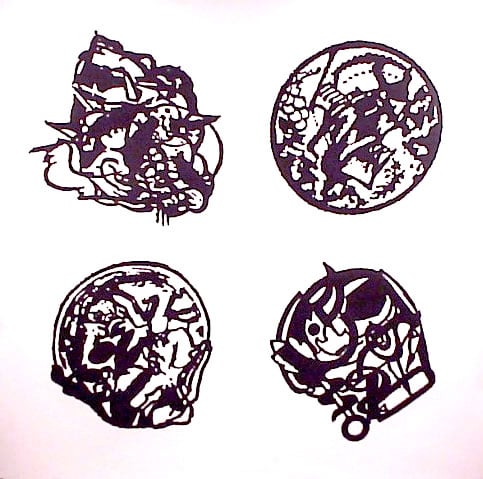
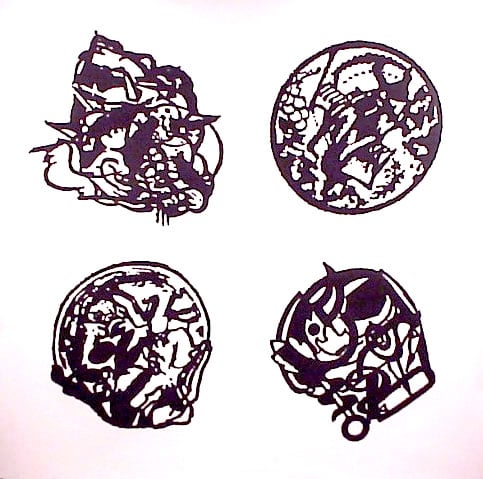
// Four Cancer Logos by Peter Nagy, a lithograph created in 1988, reflects the artist's exploration of symbolism, abstraction, and the impact of commercial imagery on perception. This piece features four circular, intricate designs that appear to blend organic and mechanical forms. Rendered in stark black and white, each logo resembles distorted emblems, possibly evoking cells or microscopic forms, while also suggesting industrial elements. The ambiguous forms invite viewers to interpret their connection to the title Cancer, which could hint at themes of mutation, industrial pollution, or societal issues related to commercialization and consumer culture. With only 30 prints in this edition, this work is a rare and thought-provoking commentary on modern life’s entanglement with corporate and environmental influences.
Artwork Copyright © Peter NagyPeter Nagy (USA, 1959) is an American artist and gallerist known for his post-conceptual art and significant contributions to the contemporary art scene. In 1982, he co-founded Gallery Nature Morte in New York's East Village, which became a pivotal space for conceptual and pop art. In 1992, Nagy relocated to New Delhi, India, where he revived Nature Morte, playing a crucial role in promoting contemporary Indian artists on the global stage.Peter Nagy (USA, 1959) is an American artist and gallerist known for his post-conceptual art and significant contributions to the contemporary art scene. In 1982, he co-founded Gallery Nature Morte in New York's East Village, which became a pivotal space for conceptual and pop art. In 1992, Nagy relocated to New Delhi, India, where he revived Nature Morte, playing a crucial role in promoting contemporary Indian artists on the global stage.
Artwork Copyright © Peter NagyFour Cancer Logos, 1988
Form
Medium
Size
- Inches
- Centimeters
Edition
Price
- USD
- EUR
- GBP
- CHF
- Authenticity Guaranteed
- Insured Shipping
- Online Since 2005
●Inventory 3228
●Signed
●Comes with gallery invoice and certificate
●Sell Us a Similar Artwork. Learn more.
// Four Cancer Logos by Peter Nagy, a lithograph created in 1988, reflects the artist's exploration of symbolism, abstraction, and the impact of commercial imagery on perception. This piece features four circular, intricate designs that appear to blend organic and mechanical forms. Rendered in stark black and white, each logo resembles distorted emblems, possibly evoking cells or microscopic forms, while also suggesting industrial elements. The ambiguous forms invite viewers to interpret their connection to the title Cancer, which could hint at themes of mutation, industrial pollution, or societal issues related to commercialization and consumer culture. With only 30 prints in this edition, this work is a rare and thought-provoking commentary on modern life’s entanglement with corporate and environmental influences.
Artwork Copyright © Peter NagyPeter Nagy (USA, 1959) is an American artist and gallerist known for his post-conceptual art and significant contributions to the contemporary art scene. In 1982, he co-founded Gallery Nature Morte in New York's East Village, which became a pivotal space for conceptual and pop art. In 1992, Nagy relocated to New Delhi, India, where he revived Nature Morte, playing a crucial role in promoting contemporary Indian artists on the global stage.Peter Nagy (USA, 1959) is an American artist and gallerist known for his post-conceptual art and significant contributions to the contemporary art scene. In 1982, he co-founded Gallery Nature Morte in New York's East Village, which became a pivotal space for conceptual and pop art. In 1992, Nagy relocated to New Delhi, India, where he revived Nature Morte, playing a crucial role in promoting contemporary Indian artists on the global stage.
Artwork Copyright © Peter Nagy- Recently Added
- Price (Low-High)
- Price (High-Low)
- Year (Low-High)
- Year (High-Low)

Peter Nagy
Four Cancer Logos, 1988
Limited Edition Print
Lithograph
USD 1,800
Related Artists

Artwork by SH Raza
What is Contemporary art from India?
Contemporary art from India dates from 1985 to the present, marking the post-liberalization era. During this period, artists have felt free to create independently of traditional Hindu or social conventions. They often incorporate distinctly Indian materials and objects in their work, reflecting a blend of modern ideas and cultural heritage.

Peter Nagy
Four Cancer Logos, 1988
111 x 111 cm


