
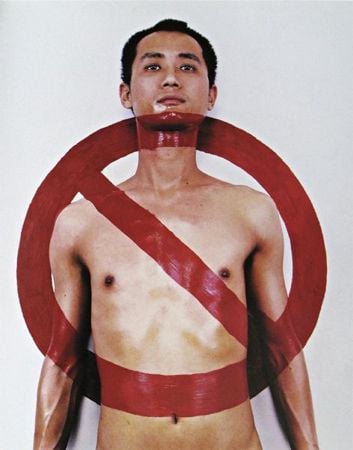
colour coupler print
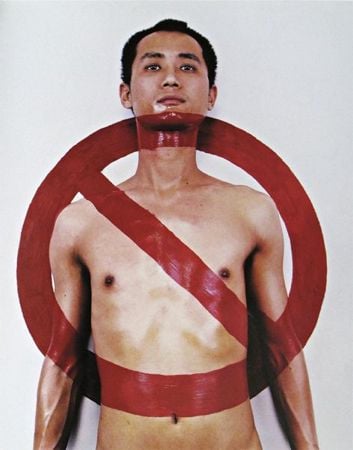
Qiu Zhijie's Tattoo 3 is a provocative digital print that explores themes of identity, censorship, and self-expression. The artwork features a young man with a red prohibition symbol painted around his neck and torso, creating an impactful visual that evokes restriction and societal control. The stark contrast of the red against the subject’s skin intensifies the feeling of confinement, suggesting a symbolic commentary on the limitations imposed by external forces on personal freedom. Created in 2000, this piece reflects Zhijie's exploration of Chinese contemporary society and the often complex relationship between individual identity and societal expectations. Limited to an edition of 10, Tattoo 3 is a powerful statement on autonomy and resistance.
Artwork Copyright © Qiu ZhijieQiu Zhijie (China, 1969) is a conceptual artist and calligrapher known for his interdisciplinary works combining traditional Chinese art forms with contemporary themes. His Mapping series transforms historical and philosophical concepts into intricate cartographic art. Qiu’s practice bridges past and present, addressing identity, memory, and cultural continuity through performance, installation, and ink art.
Artwork Copyright © Qiu ZhijieTattoo 3, 2000
Form
Medium
Size
- Inches
- Centimeters
Edition
Price
Available works →
- Authenticity Guaranteed
- Insured Shipping
- Online Since 2005
●
●Inventory 1543
●Signed
●Comes with gallery invoice and certificate
●Sell Us a Similar Artwork. Learn more.
colour coupler print
Qiu Zhijie's Tattoo 3 is a provocative digital print that explores themes of identity, censorship, and self-expression. The artwork features a young man with a red prohibition symbol painted around his neck and torso, creating an impactful visual that evokes restriction and societal control. The stark contrast of the red against the subject’s skin intensifies the feeling of confinement, suggesting a symbolic commentary on the limitations imposed by external forces on personal freedom. Created in 2000, this piece reflects Zhijie's exploration of Chinese contemporary society and the often complex relationship between individual identity and societal expectations. Limited to an edition of 10, Tattoo 3 is a powerful statement on autonomy and resistance.
Artwork Copyright © Qiu ZhijieQiu Zhijie (China, 1969) is a conceptual artist and calligrapher known for his interdisciplinary works combining traditional Chinese art forms with contemporary themes. His Mapping series transforms historical and philosophical concepts into intricate cartographic art. Qiu’s practice bridges past and present, addressing identity, memory, and cultural continuity through performance, installation, and ink art.
Artwork Copyright © Qiu Zhijie- Recently Added
- Price (Low-High)
- Price (High-Low)
- Year (Low-High)
- Year (High-Low)
Qiu Zhijie
Tattoo 3, 2000
Limited Edition Print
Digital Print on paper
Currently Not Available
Related Artists

Artwork by Eduardo Kac
What is New Media Art?
New Media Art is a genre that includes all artworks created using new technologies, such as computer graphics, digital art, virtual art, internet art, computer animation, video games, 3D printing, and robotics. This genre often explores themes related to mass media, telecommunications, and digital electronics. The methods for presenting New Media Art range from installations and performances to virtual and conceptual art


Qiu Zhijie
Tattoo 3, 2000
100 x 79 cm


