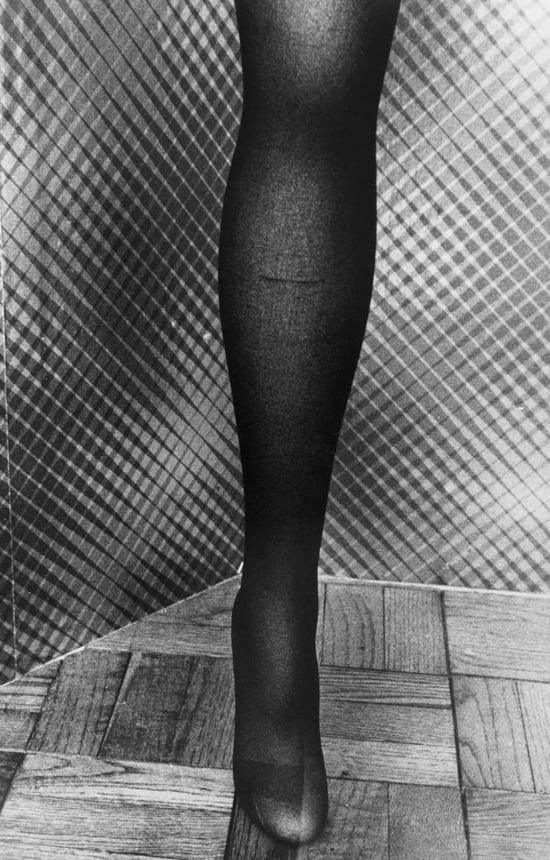
Stocking (from In Situ) by Ralph Gibson, created in 1970, is a striking gelatin silver print that captures the sensual and textural qualities of a single leg clad in a dark stocking. Positioned against a patterned background, the leg extends gracefully, with the foot slightly raised, drawing attention to the smooth silhouette and the delicate play of light across the fabric. Gibson’s use of high contrast accentuates the tonal depth of the stocking, creating a tactile quality that emphasizes texture and form. The juxtaposition of the patterned backdrop with the leg’s clean line adds a subtle layer of abstraction, inviting viewers to focus on the composition's elegance and simplicity.
Ralph Gibson (United States, 1939) is an American photographer renowned for his high-contrast black-and-white images that blend surrealism and abstraction. His work often features geometric elements and explores the interplay between light and shadow. Gibson has published over 40 photobooks and received numerous awards, including the Guggenheim Fellowship.
Gelatin Silver PrintA silver gelatin print is a type of photographic print made using the silver process. In this process, photographic materials such as black and white films and printing papers are coated with a light-sensitive emulsion of silver salts suspended in gelatin. This emulsion is applied to a support, which could be flexible plastic, glass, resin-coated paper, or baryta paper. The materials are light-sensitive and remain stable under normal storage conditions, making them ideal for long-term preservation.
Stocking (from In Situ) by Ralph Gibson, created in 1970, is a striking gelatin silver print that captures the sensual and textural qualities of a single leg clad in a dark stocking. Positioned against a patterned background, the leg extends gracefully, with the foot slightly raised, drawing attention to the smooth silhouette and the delicate play of light across the fabric. Gibson’s use of high contrast accentuates the tonal depth of the stocking, creating a tactile quality that emphasizes texture and form. The juxtaposition of the patterned backdrop with the leg’s clean line adds a subtle layer of abstraction, inviting viewers to focus on the composition's elegance and simplicity.
Ralph Gibson (United States, 1939) is an American photographer renowned for his high-contrast black-and-white images that blend surrealism and abstraction. His work often features geometric elements and explores the interplay between light and shadow. Gibson has published over 40 photobooks and received numerous awards, including the Guggenheim Fellowship.
First you study photography, then you practice photography, then you serve photography, and finally one becomes photography.
- Ralph Gibson
Ralph Gibson (b. 1939 USA) is an acclaimed American photographer known for his striking black-and-white photography that blends surrealism, abstraction, and the human form. Gibson's work is characterized by its strong contrasts, geometric compositions, and a focus on the interplay of light and shadow, often creating a sense of mystery and ambiguity. He has a unique ability to capture the sensuality of everyday objects and scenes, transforming the mundane into the extraordinary. Gibson’s photographic style is both minimalist and richly textured, often evoking narratives that are open to interpretation. His books, such as The Somnambulist and Déjà-vu, are considered classics in photographic literature. Throughout his career, Gibson has consistently pushed the boundaries of photography, making a significant impact on the medium and influencing generations of photographers with his distinctive vision. (Artist website)
Sometimes referred to as Conceptualism, this is an art form where the idea(s) or concept(s) behind the work take precedence over material concerns and traditional aesthetics. Many conceptual artworks can be created by anyone simply by following written instructions. The concept or idea is the most essential aspect of the artwork.