Vintage Chromogenic print, AP, with annotation in pencil on mat recto (print can be removed from the mat) - with second annotation on the verso. The work has some condition issues - please email for more info.
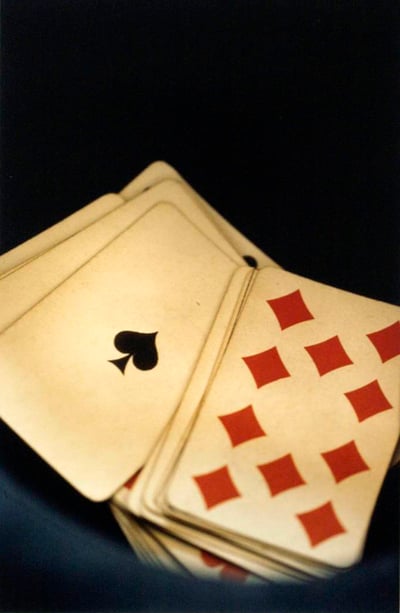
Cards (from L' Histoire de France) by Ralph Gibson, produced in 1991, is a vintage chromogenic print that captures the evocative simplicity of a deck of playing cards. The composition features a small stack of worn, sepia-toned cards, with the spade and diamond suits prominently visible, against a dark, shadowed background. Gibson’s choice of close-up framing and subtle lighting infuses the ordinary subject with a mysterious, almost cinematic atmosphere, prompting reflections on themes of chance, fate, and the passage of time. The worn texture of the cards and the muted palette enhance a sense of nostalgia, characteristic of Gibson's photographic exploration of iconic symbols.
Ralph Gibson (United States, 1939) is an American photographer renowned for his high-contrast black-and-white images that blend surrealism and abstraction. His work often features geometric elements and explores the interplay between light and shadow. Gibson has published over 40 photobooks and received numerous awards, including the Guggenheim Fellowship.
C-PrintA C-type print, also known as a chromogenic print, is a photographic print made from a color negative or slide. The print is created on chromogenic paper, which contains three emulsion layers, each sensitized to a different primary color. After exposure, the paper is processed in a series of chemical baths, where each layer reacts to the chemicals to produce the final image. C-type prints are known for their rich color depth and are widely used in fine art and commercial photography.
Vintage Chromogenic print, AP, with annotation in pencil on mat recto (print can be removed from the mat) - with second annotation on the verso. The work has some condition issues - please email for more info.
Cards (from L' Histoire de France) by Ralph Gibson, produced in 1991, is a vintage chromogenic print that captures the evocative simplicity of a deck of playing cards. The composition features a small stack of worn, sepia-toned cards, with the spade and diamond suits prominently visible, against a dark, shadowed background. Gibson’s choice of close-up framing and subtle lighting infuses the ordinary subject with a mysterious, almost cinematic atmosphere, prompting reflections on themes of chance, fate, and the passage of time. The worn texture of the cards and the muted palette enhance a sense of nostalgia, characteristic of Gibson's photographic exploration of iconic symbols.
Ralph Gibson (United States, 1939) is an American photographer renowned for his high-contrast black-and-white images that blend surrealism and abstraction. His work often features geometric elements and explores the interplay between light and shadow. Gibson has published over 40 photobooks and received numerous awards, including the Guggenheim Fellowship.
First you study photography, then you practice photography, then you serve photography, and finally one becomes photography.
- Ralph Gibson
Ralph Gibson (b. 1939 USA) is an acclaimed American photographer known for his striking black-and-white photography that blends surrealism, abstraction, and the human form. Gibson's work is characterized by its strong contrasts, geometric compositions, and a focus on the interplay of light and shadow, often creating a sense of mystery and ambiguity. He has a unique ability to capture the sensuality of everyday objects and scenes, transforming the mundane into the extraordinary. Gibson’s photographic style is both minimalist and richly textured, often evoking narratives that are open to interpretation. His books, such as The Somnambulist and Déjà-vu, are considered classics in photographic literature. Throughout his career, Gibson has consistently pushed the boundaries of photography, making a significant impact on the medium and influencing generations of photographers with his distinctive vision. (Artist website)
Sometimes referred to as Conceptualism, this is an art form where the idea(s) or concept(s) behind the work take precedence over material concerns and traditional aesthetics. Many conceptual artworks can be created by anyone simply by following written instructions. The concept or idea is the most essential aspect of the artwork.