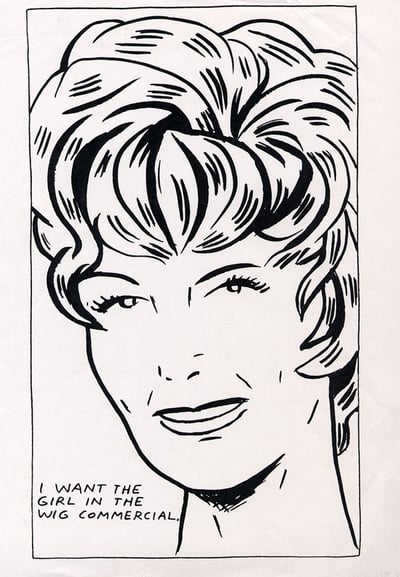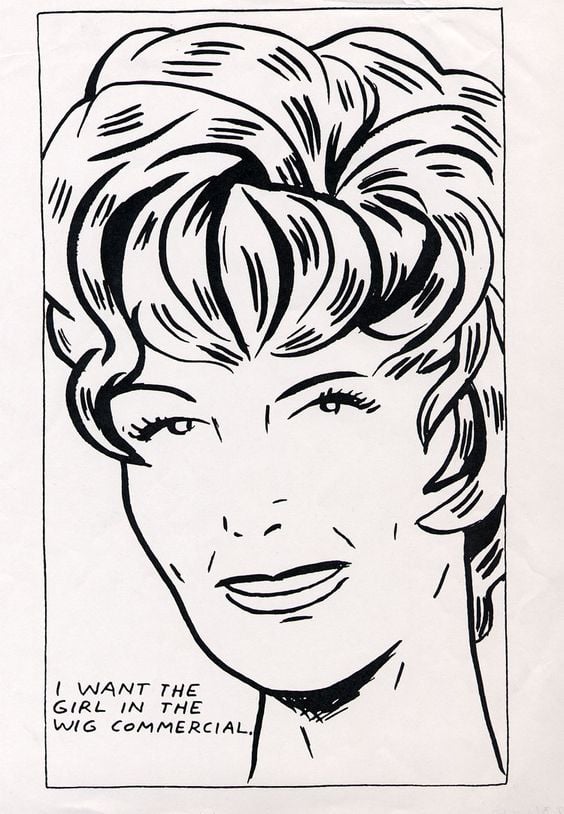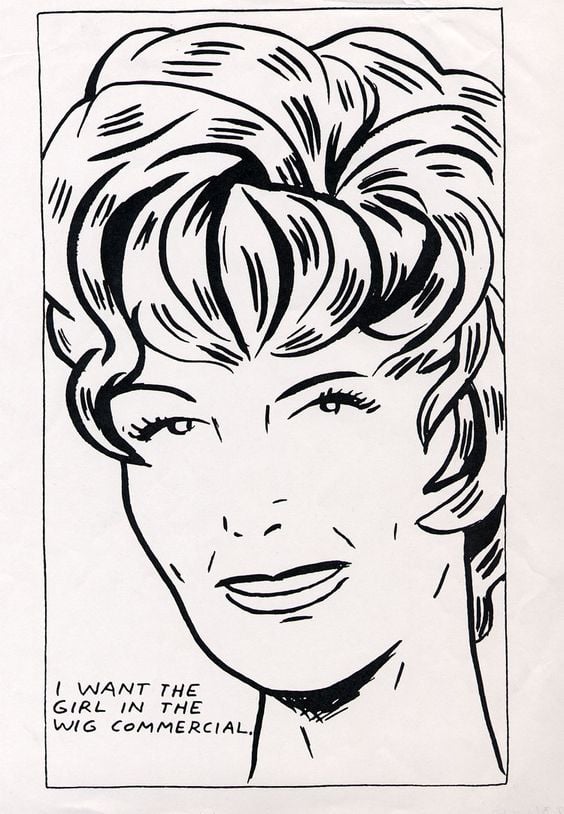
// I Want To Be The Girl In The Wig Commercial by Raymond Pettibon is a 1989 lithograph that captures a sense of irony and cultural commentary through minimalistic line art. The piece features a black-and-white drawing of a woman's face, rendered in Pettibon’s characteristic comic-book style, with bold lines and simplified details. The text below her face reads, I want the girl in the wig commercial, a statement that adds a layer of humor and critique. The artwork reflects Pettibon's exploration of media influence and the superficiality of commercial imagery, subtly mocking the allure and idealization perpetuated by advertising. This piece invites viewers to question the constructed personas and unrealistic aspirations that dominate popular culture, highlighting Pettibon’s critical yet playful approach to societal commentary.
Raymond Pettibon (USA, 1957) is a contemporary artist known for his graphic, text-laden drawings that merge pop culture, literature, and politics. Emerging from the punk rock scene, including designing for Black Flag, Pettibon’s works explore dark humor and subversion. His distinctive style is widely exhibited in galleries and museums worldwide.
Lithograph Lithography is a printing method based on the principle that water and oil do not mix. It can be used to print artwork or text onto paper or other suitable materials. Traditionally, an image was drawn with wax, fat, or oil onto a lithographic limestone surface or plate. Today, metal plates and other surfaces are also used in lithographic printing.
// I Want To Be The Girl In The Wig Commercial by Raymond Pettibon is a 1989 lithograph that captures a sense of irony and cultural commentary through minimalistic line art. The piece features a black-and-white drawing of a woman's face, rendered in Pettibon’s characteristic comic-book style, with bold lines and simplified details. The text below her face reads, I want the girl in the wig commercial, a statement that adds a layer of humor and critique. The artwork reflects Pettibon's exploration of media influence and the superficiality of commercial imagery, subtly mocking the allure and idealization perpetuated by advertising. This piece invites viewers to question the constructed personas and unrealistic aspirations that dominate popular culture, highlighting Pettibon’s critical yet playful approach to societal commentary.
Raymond Pettibon (USA, 1957) is a contemporary artist known for his graphic, text-laden drawings that merge pop culture, literature, and politics. Emerging from the punk rock scene, including designing for Black Flag, Pettibon’s works explore dark humor and subversion. His distinctive style is widely exhibited in galleries and museums worldwide.
Art comes after the fact, as a witness to certain things that have happened.
- Raymond Pettibon
Raymond Pettibon is a prolific contemporary American artist who is known for his drawings, which combine image and text and are often violent, ironic, and/or anti-authoritarian. Much of his illustration is political in nature, and uses black humor to critique contemporary culture. His primary medium is India ink on paper, and many of his works are black and white, although some are colored with watercolors, acrylics, pencils, gouache, or collage. His style is reminiscent of editorial cartoons, and is influenced by William Blake, Edward Hopper, and Francisco Goya. Raymond Pettibon got his start in the punk rock scene in the 1970s, and has created album covers, posters and other ephemera for bands such as Black Flag and Sonic Youth. Since 1978, he has produced limited edition photocopy booklets of his work, which he calls "Superflux Pubs," and from 1981 to 1986 he published his illustrations as an independent magazine,Tripping Corpse. Raymond Pettibon has been the recipient of a number of awards, including the Bucksbaum Award in 2004 and the University of Vienna's Oscar Kokoschka Prize in 2010. (Artist website)
Lettrism is an art form that uses letters, words, and symbols to create artwork. The movement was established in Paris in the 1940s and later gained popularity in the 1950s in America. Lettrisme is the French spelling of the movement's name, derived from the French word for letter.