

Archival pigment print - Edition of 25 + 10 A.P. - Signed and numbered on the front
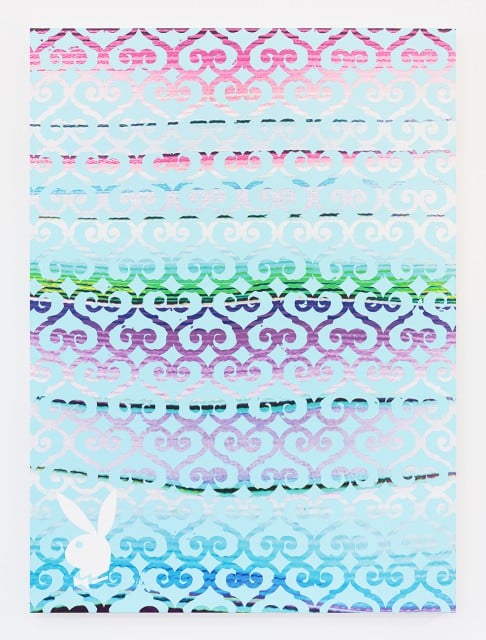
Canyons II by Richard Phillips, a limited edition pigment print from 2015, features a layered design of vibrant, repeating patterns and colors. The artwork showcases Phillips' distinct approach to combining pop culture elements with high-art aesthetics. Horizontal bands of ornate, swirling motifs in various colors—pink, purple, blue, and green—create a sense of rhythm and depth. Amidst these intricate patterns, a subtle white silhouette of the Playboy bunny logo appears at the lower edge, adding a playful, iconic touch. The contrast between decorative patterns and the pop culture symbol invites viewers to ponder the intersections of commercial imagery and artistic expression. Limited to 25 prints with an additional 10 artist proofs, this work is signed and numbered, marking it as both a collectible and a statement on contemporary visual culture.
Artwork Copyright © Richard PhillipsRichard Phillips (USA, 1962) is a contemporary artist renowned for his large-scale photorealistic paintings that critique media and celebrity culture. Drawing from fashion, advertising, and pornography, his works often feature close-up portraits of women, exploring themes of sexuality and power. Phillips's art is exhibited globally, including at the Museum of Modern Art in New York and Tate Modern in London.
Artwork Copyright © Richard PhillipsCanyons II, 2015
Form
Medium
Size
- Inches
- Centimeters
Edition
Price
Available works →
- Authenticity Guaranteed
- Insured Shipping
- Online Since 2005
●
●Inventory 3167
●Signed
●Comes with gallery invoice and certificate
●Sell Us a Similar Artwork. Learn more.
Archival pigment print - Edition of 25 + 10 A.P. - Signed and numbered on the front
Canyons II by Richard Phillips, a limited edition pigment print from 2015, features a layered design of vibrant, repeating patterns and colors. The artwork showcases Phillips' distinct approach to combining pop culture elements with high-art aesthetics. Horizontal bands of ornate, swirling motifs in various colors—pink, purple, blue, and green—create a sense of rhythm and depth. Amidst these intricate patterns, a subtle white silhouette of the Playboy bunny logo appears at the lower edge, adding a playful, iconic touch. The contrast between decorative patterns and the pop culture symbol invites viewers to ponder the intersections of commercial imagery and artistic expression. Limited to 25 prints with an additional 10 artist proofs, this work is signed and numbered, marking it as both a collectible and a statement on contemporary visual culture.
Artwork Copyright © Richard PhillipsRichard Phillips (USA, 1962) is a contemporary artist renowned for his large-scale photorealistic paintings that critique media and celebrity culture. Drawing from fashion, advertising, and pornography, his works often feature close-up portraits of women, exploring themes of sexuality and power. Phillips's art is exhibited globally, including at the Museum of Modern Art in New York and Tate Modern in London.
Artwork Copyright © Richard Phillips- Recently Added
- Price (Low-High)
- Price (High-Low)
- Year (Low-High)
- Year (High-Low)

Richard Phillips
Canyons II, 2015
Limited Edition Print
Pigment print
Currently Not Available
Related Artists


Artwork by Shepard Fairey
What is appropriation?
Appropriation in art involves using pre-existing images or objects with little or no modification. This technique has played a significant role across various art forms, including visual arts, music, performance, and literature. In visual arts, appropriation refers to the practice of adopting, sampling, recycling, or borrowing elements—or even entire forms—of existing visual culture, integrating them into new works to create meaning or critique.

Richard Phillips
Canyons II, 2015
101.6 x 76.2 cm


