

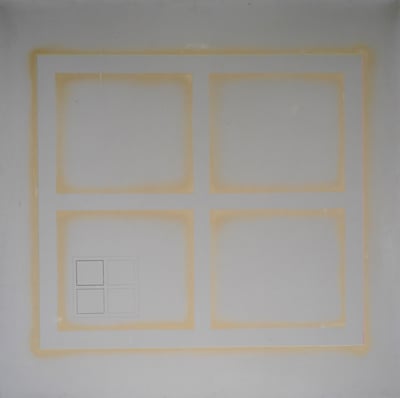
// Four Dimensions Exist in One Dimension by Shusaku Arakawa, created in 1965, is a contemplative acrylic painting that explores geometric abstraction through simplicity and subtle gradients. The canvas is dominated by a four-part grid, softened with faint yellow edges, suggesting the blending of boundaries or dimensions. Within one quadrant, a smaller, more intricate grid emphasizes a layered concept of space and multiplicity, drawing the viewer’s attention to the relationship between parts and wholes. Arakawa’s approach evokes ideas of perception, spatial relationships, and the philosophy of dimensional existence, inviting introspection on how we perceive boundaries and dimensions.
Artwork Copyright © Shusaku ArakawaShusaku Arakawa (Japan, 1936–2010) was a visionary artist and architect whose work challenged conventional perceptions of space and existence. Co-creator of 'reversible destiny' architecture, he blended conceptual art with experimental design to provoke thought about life and mortality. Arakawa’s groundbreaking works, often in collaboration with Madeline Gins, continue to influence contemporary art and architecture.
Artwork Copyright © Shusaku ArakawaFour dimensions exist in one dimension, 1965
Form
Medium
Size
- Inches
- Centimeters
Edition
Price
- Authenticity Guaranteed
- Insured Shipping
- Online Since 2005
●Inventory 9842
●Signed
●Comes with gallery invoice and certificate
●Sell Us a Similar Artwork. Learn more.
// Four Dimensions Exist in One Dimension by Shusaku Arakawa, created in 1965, is a contemplative acrylic painting that explores geometric abstraction through simplicity and subtle gradients. The canvas is dominated by a four-part grid, softened with faint yellow edges, suggesting the blending of boundaries or dimensions. Within one quadrant, a smaller, more intricate grid emphasizes a layered concept of space and multiplicity, drawing the viewer’s attention to the relationship between parts and wholes. Arakawa’s approach evokes ideas of perception, spatial relationships, and the philosophy of dimensional existence, inviting introspection on how we perceive boundaries and dimensions.
Artwork Copyright © Shusaku ArakawaShusaku Arakawa (Japan, 1936–2010) was a visionary artist and architect whose work challenged conventional perceptions of space and existence. Co-creator of 'reversible destiny' architecture, he blended conceptual art with experimental design to provoke thought about life and mortality. Arakawa’s groundbreaking works, often in collaboration with Madeline Gins, continue to influence contemporary art and architecture.
Artwork Copyright © Shusaku Arakawa- Recently Added
- Price (Low-High)
- Price (High-Low)
- Year (Low-High)
- Year (High-Low)
Shusaku Arakawa
Four dimensions exist in one dimension, 1965
Painting
Acrylic on canvas
USD 105,000 - 130,000

Shusaku Arakawa
Natural History, 1969
Limited Edition Print
Serigraph
Currently Not Available
Related Artists



Artwork by Miles Aldridge
What is contemporary art?
Contemporary art refers to avant-garde or innovative art created in the recent past or present day. The exact starting point of contemporary art varies depending on the institution, often tied to the founding year of museums or galleries that showcase the style. Contemporary art is characterized by its focus on current ideas, diverse media, and the exploration of new concepts and techniques.


Shusaku Arakawa
Four dimensions exist in one dimension, 1965
127 x 127 cm


