

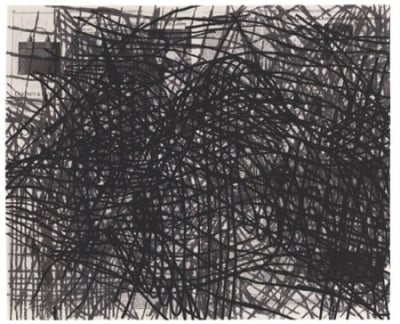
This pigmented digital output print was created by the artist in 2001. Signed in pencil and numbered, from the edition of 100 measuring 28.25 x 33 in. (71.8 x 83.8 cm.). Published by Art of the Twentieth Century, NY.
This untitled piece by Terry Winters, part of the Doctors of the World portfolio, showcases a dense network of black lines in a chaotic, yet organized flow across the paper. Created as a limited edition digital print in 2001, this work highlights Winters' fascination with organic patterns and systems. The interwoven lines seem to reference natural structures like neural networks or mycelium, hinting at complexity and connection beneath the surface. The overlapping layers evoke a sense of depth and movement, drawing the viewer into a visual maze. Published by Art of the Twentieth Century, New York, this piece is signed and numbered in pencil, from an edition of 100, adding to its exclusivity and collectability.
Artwork Copyright © Terry WintersTerry Winters (USA, 1949) is a painter and printmaker known for his abstract works that explore organic forms, networks, and systems. His compositions, often characterized by complex layers and intricate textures, evoke scientific imagery and natural patterns. Winters’ work bridges the gap between abstraction and representation, engaging viewers in a dialogue between art and nature.
Artwork Copyright © Terry WintersUntitled (From the Doctors of the World portfolio) , 2001
Form
Medium
Size
- Inches
- Centimeters
Edition
Price
Available works →
- Authenticity Guaranteed
- Insured Shipping
- Online Since 2005
●
●Inventory 2138
●Signed
●Comes with gallery invoice and certificate
●Sell Us a Similar Artwork. Learn more.
This pigmented digital output print was created by the artist in 2001. Signed in pencil and numbered, from the edition of 100 measuring 28.25 x 33 in. (71.8 x 83.8 cm.). Published by Art of the Twentieth Century, NY.
This untitled piece by Terry Winters, part of the Doctors of the World portfolio, showcases a dense network of black lines in a chaotic, yet organized flow across the paper. Created as a limited edition digital print in 2001, this work highlights Winters' fascination with organic patterns and systems. The interwoven lines seem to reference natural structures like neural networks or mycelium, hinting at complexity and connection beneath the surface. The overlapping layers evoke a sense of depth and movement, drawing the viewer into a visual maze. Published by Art of the Twentieth Century, New York, this piece is signed and numbered in pencil, from an edition of 100, adding to its exclusivity and collectability.
Artwork Copyright © Terry WintersTerry Winters (USA, 1949) is a painter and printmaker known for his abstract works that explore organic forms, networks, and systems. His compositions, often characterized by complex layers and intricate textures, evoke scientific imagery and natural patterns. Winters’ work bridges the gap between abstraction and representation, engaging viewers in a dialogue between art and nature.
Artwork Copyright © Terry Winters- Recently Added
- Price (Low-High)
- Price (High-Low)
- Year (Low-High)
- Year (High-Low)
Terry Winters
Untitled (From the Doctors of the World portfolio) , 2001
Limited Edition Print
Digital Print on paper
Currently Not Available
Related Artists


Artwork by Eduardo Chillida
What is abstract art?
Abstract art uses form, shape, line, and color to create a visual experience without attempting to represent external reality. The composition exists independently of the world's visual references, focusing on expressing ideas and emotions through non-representational means.

Terry Winters
Untitled (From the Doctors of the World portfolio) , 2001
71.9 x 83.8 cm


