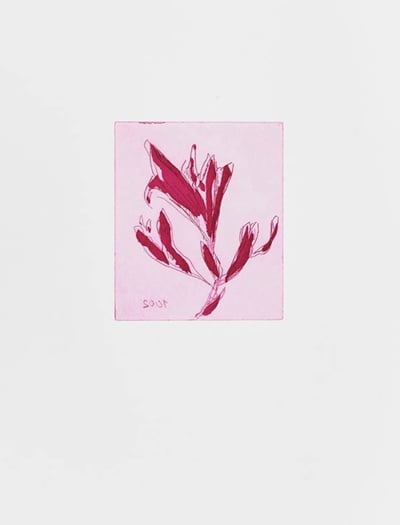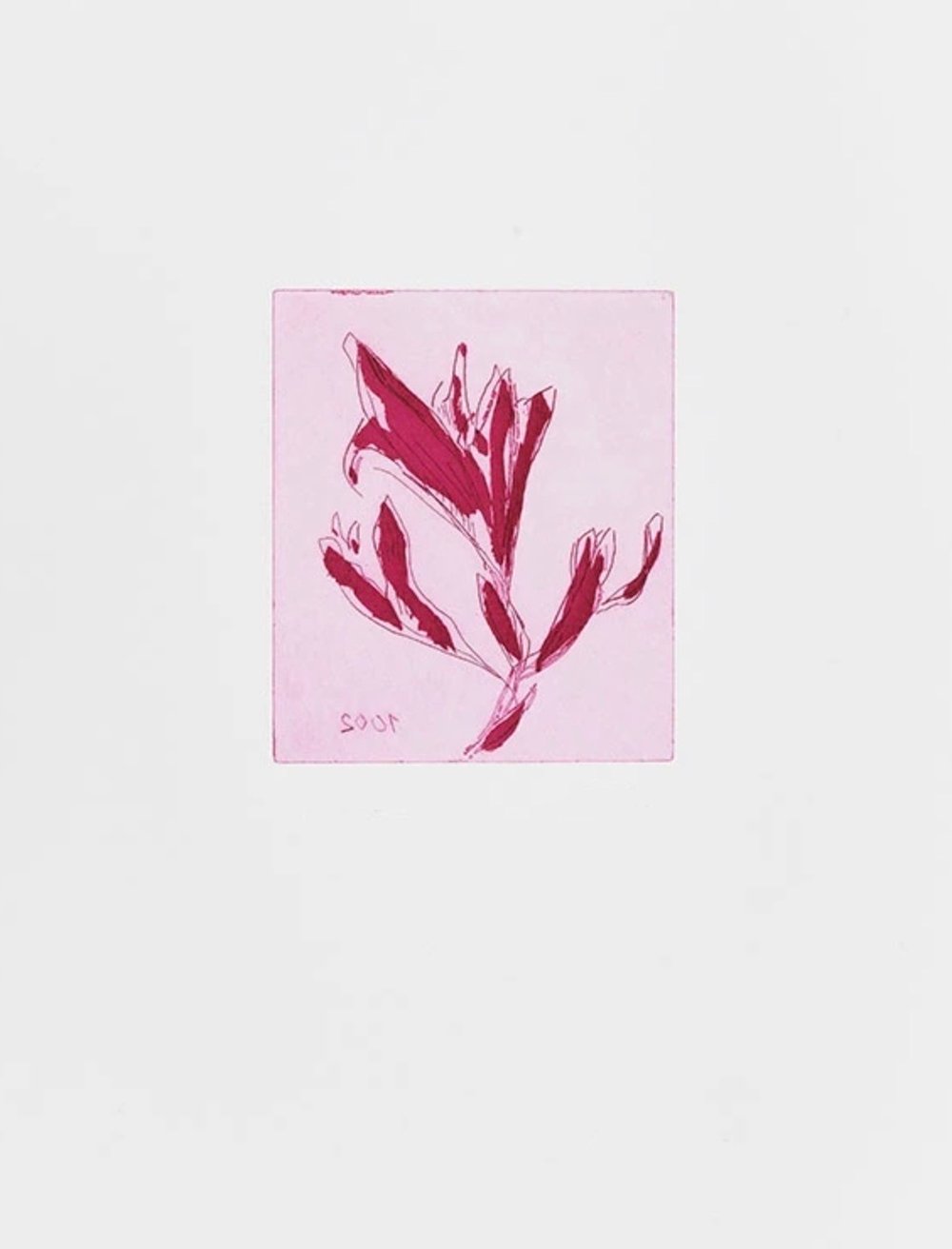
// Thomas Schütte’s Flowers (2001) is a delicate drypoint print that captures a minimalist representation of a floral form. Rendered in shades of deep red on a pale pink background, the flower appears stylized yet organic, with simple lines that give it a gentle, almost fragile quality. The small scale of the piece and its limited detail invite close inspection, drawing attention to the artist's careful line work and the soft contrast between colors. This limited edition print reflects Schütte’s skill in conveying emotion and subtle beauty through simplicity, creating a quiet, contemplative work that feels intimate and introspective.
Thomas Schütte (Germany, 1954) is a contemporary artist renowned for his diverse body of work, including sculptures, architectural models, and drawings. His art often explores themes of human condition and societal structures. Schütte's notable achievements include winning the Golden Lion at the 2005 Venice Biennale.
DrypointDrypoint is an intaglio printmaking technique where an image is incised onto a plate using a sharp, pointed tool, typically a needle made of metal or diamond. Traditionally, copper plates were used, but today zinc, plexiglass, or acetate are also common. Drypoint is easier for drawing artists to master compared to engraving, as the needle technique resembles drawing with a pencil rather than the more complex burin used in engraving.
// Thomas Schütte’s Flowers (2001) is a delicate drypoint print that captures a minimalist representation of a floral form. Rendered in shades of deep red on a pale pink background, the flower appears stylized yet organic, with simple lines that give it a gentle, almost fragile quality. The small scale of the piece and its limited detail invite close inspection, drawing attention to the artist's careful line work and the soft contrast between colors. This limited edition print reflects Schütte’s skill in conveying emotion and subtle beauty through simplicity, creating a quiet, contemplative work that feels intimate and introspective.
Thomas Schütte (Germany, 1954) is a contemporary artist renowned for his diverse body of work, including sculptures, architectural models, and drawings. His art often explores themes of human condition and societal structures. Schütte's notable achievements include winning the Golden Lion at the 2005 Venice Biennale.
I’m not here to write, I’m here to be mad.
- Thomas Schutte
Thomas Schutte is a German contemporary artist. His work is extremely diverse and ranges from early architectural installations to small scale figures. Thomas Schutte’s creations include; monuments, banners, photographs, flags and an extensive set of watercolors. Thomas's early work was mostly architectural models. Through the years he became preoccupied with the human condition as well as the cultural, social and political elements affecting everyday lives. His representation of those themes came to life through his sculptures, prints, watercolors, photographs and drawings. Thomas Schutte used figuration as the focal point of expression. His well-known series of three monumental-scale figures cast in aluminum is called, Large Ghosts. These figures explore the expressive potential of the human figure. In the early 2000's, Thomas Schutte started a series of small sculptures showing men stuck in mud. He created seventeen versions of these and called them, Grosse Geister. They were created in three different editions with three sculptures in each. Each of the editions used a different medium; steel, polished bronze and aluminum. No two of these sculptures are alike. In 2009 Thomas had a six-meter high bronze sculpture, Mann im Matsch installed in his home town Oldenburg. Thomas Schutte has his art on exhibit throughout the United States and Europe. He presented a solo exhibit at the Museo de Arte Renia Sofia Institute and the Haus der kunst in Munich. Schutte has also exhibited at major institutions such as the Los Angeles County Museum of Art and the Stedelijk Museum in Amsterdam.
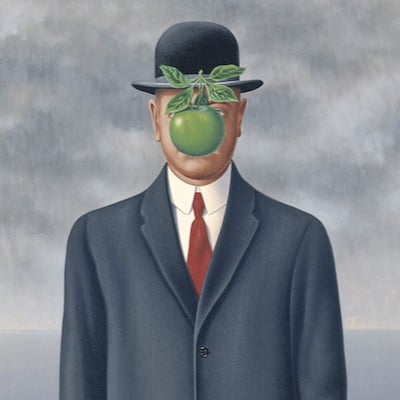
Surrealism began in the 1920s as an art and literary movement with the goal of revealing the unconscious mind and unleashing the imagination by exploring unusual and dream-like imagery. Influenced by Sigmund Freud’s theories of psychoanalysis, Surrealist artists and writers sought to bring the unconscious into rational life, blurring the lines between reality and dreams. The movement aimed to challenge conventional perceptions and express the irrational aspects of the human experience.