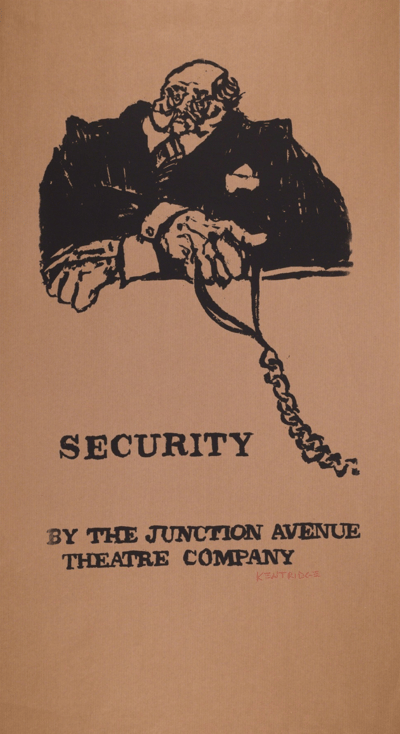
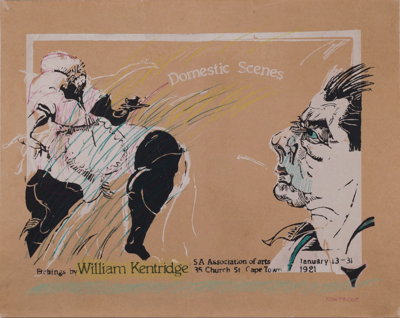
Silkscreen poster. Ref: Siebrits 245
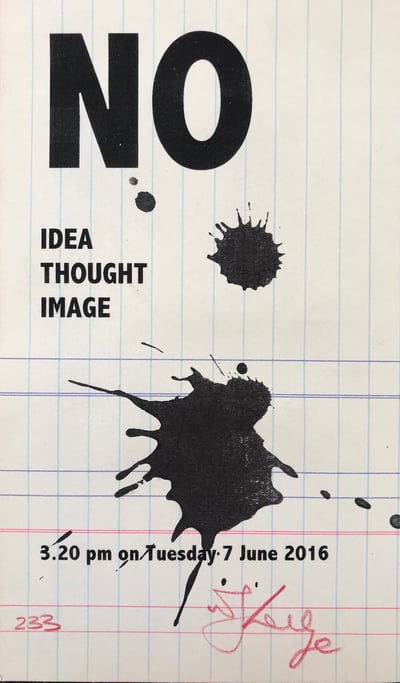
In the mid-1970s, William Kentridge produced posters for the Junction Avenue Theatre Company, printing approximately 20–30 impressions of each.
Few examples survive, and even fewer are signed by the artist, as is the present work.
A muscular, wild-eyed Dionysus commands the composition in this rare silkscreen poster for the Junction Avenue Theatre Company's production of The Bacchae, one of William Kentridge's earliest and most sought-after printed works. Produced in the early 1980s when Kentridge was still forging the visual language that would define his career, the poster channels the raw expressive power of South African protest art into the mythic violence of Euripides' tragedy. With only 20 to 30 impressions printed and very few surviving, this signed example is an exceptional document of the artist's formative years. It stands at the crossroads of theatre, politics and printmaking that would characterise Kentridge's entire oeuvre.
William Kentridge (South Africa, 1955) is a globally acclaimed artist renowned for his expressive charcoal animations, installations, and performances. His work often explores themes of memory, politics, and history, particularly in relation to apartheid. Combining drawing, film, and theater, Kentridge creates powerful narratives that engage with social and historical complexities.
Silkscreen Silkscreen is a printmaking method that uses a screen made of silk or other mesh fabric. The screen is treated with a substance that blocks ink in certain areas, allowing ink to pass through only in the desired sections. Each color in the print requires a separate screen.
Silkscreen poster. Ref: Siebrits 245
In the mid-1970s, William Kentridge produced posters for the Junction Avenue Theatre Company, printing approximately 20–30 impressions of each.
Few examples survive, and even fewer are signed by the artist, as is the present work.
A muscular, wild-eyed Dionysus commands the composition in this rare silkscreen poster for the Junction Avenue Theatre Company's production of The Bacchae, one of William Kentridge's earliest and most sought-after printed works. Produced in the early 1980s when Kentridge was still forging the visual language that would define his career, the poster channels the raw expressive power of South African protest art into the mythic violence of Euripides' tragedy. With only 20 to 30 impressions printed and very few surviving, this signed example is an exceptional document of the artist's formative years. It stands at the crossroads of theatre, politics and printmaking that would characterise Kentridge's entire oeuvre.
William Kentridge (South Africa, 1955) is a globally acclaimed artist renowned for his expressive charcoal animations, installations, and performances. His work often explores themes of memory, politics, and history, particularly in relation to apartheid. Combining drawing, film, and theater, Kentridge creates powerful narratives that engage with social and historical complexities.
I am only an artist, my job is to make drawings not to make sense.
- William Kentridge
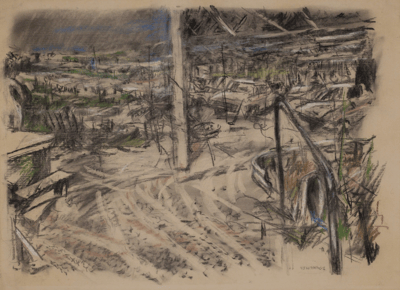
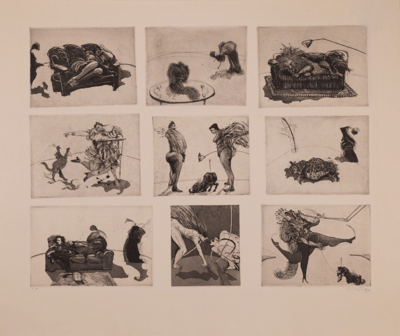
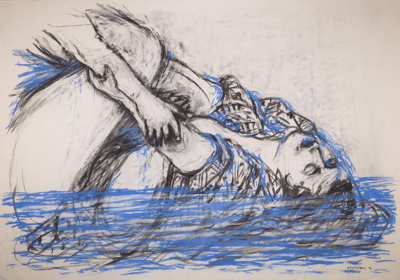
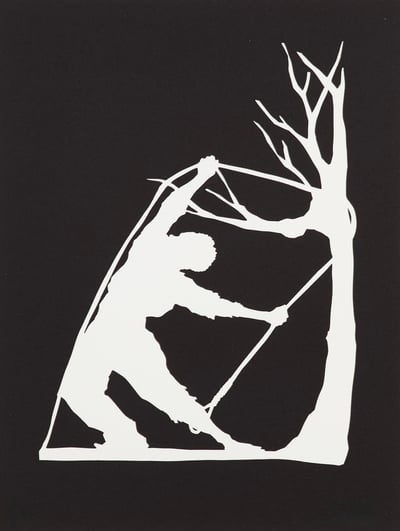
William Kentridge is an artist from South Africa who is best known for his animated films. He also produces prints, drawings and sculptures. His work first started to come to prominence in the early 1970's and he is still producing works of art today, with sculptures that he had created being unveiled in 2012 and 2013. William Kentridge’s animations are not made in the more traditional way of having each scene on a separate print. Instead the changes to the images in the animation are made by making alterations to the same sheet of paper. This creates something quite unique, as it is sometimes possible to still see previous scenes which have been erased as you watch the animation. This single piece of paper is then displayed as a piece of art in its own right. Even though it is William Kentridge’s animated films that he is most well known for, drawing and printmaking are still the foundation of all his other artworks. Although his works don't contain abstract thoughts and emotions, he does not believe that the things that he draws have to be completely accurate. He does however always produce his drawings based on something tangible that he has observed. William Kentridge usually uses bronze for his sculpting work, and his first public sculpture was unveiled in his home town of Johannesburg in 2012, with another one soon appearing in Naples in the same year. In 2013 he created Rebus, which was unique in the fact that two distinct images could be seen, depending on the angle that you were viewing it.
Animation is the process of displaying a sequence of static images in rapid succession to create the illusion of movement. Each image, or frame, is slightly altered from the previous one, particularly in the moving parts, so when shown together, they form a continuous motion. Traditionally, illustrators drew each frame by hand to produce this effect.