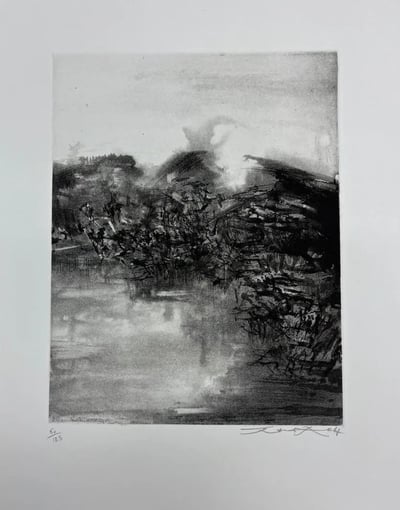
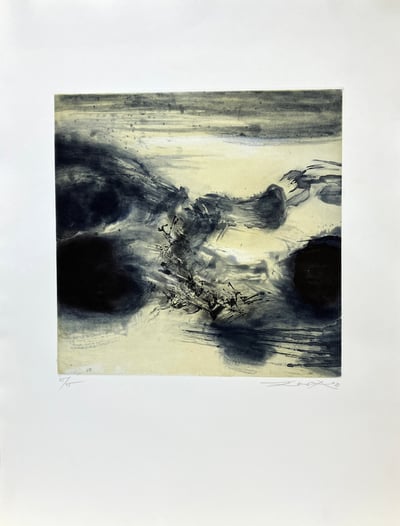
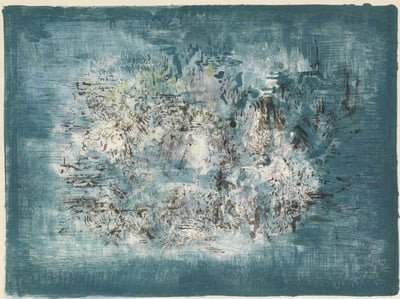
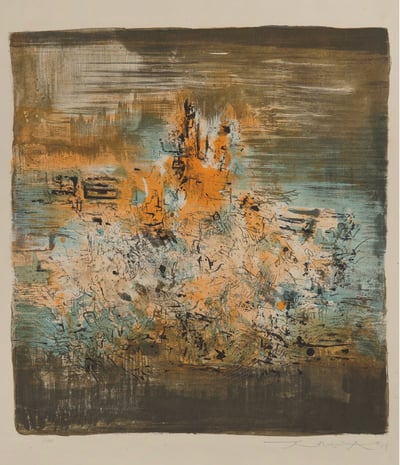
Etching on wove paper.
Countersigned in pencil, lower right, and dated '94.
Plate size: 35 × 28 cm. Image size: 29.5 × 21 cm.
Printed by Atelier Lacourière et Frélaut, Paris.
Published by Bibliophiles de France, Paris.
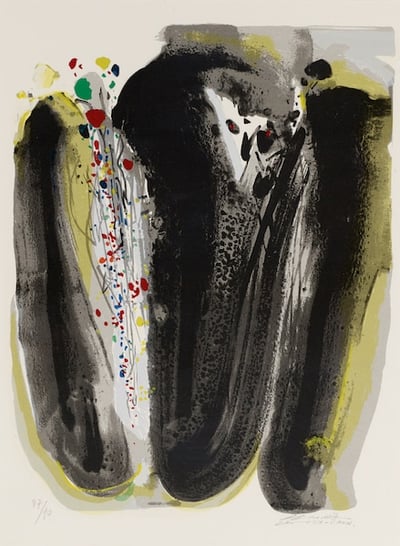
A tempest of ink unfolds across the sheet as bold, sweeping washes collide with delicate splatter and fine calligraphic traces. Zao Wou-Ki's etching for the Sonnets de Shakespeare portfolio channels the emotional intensity of the Bard's verse into pure gestural abstraction, bridging Chinese ink traditions with European printmaking. The composition surges from a dense upper register into an open, breathing expanse below, evoking the lyrical tension between passion and restraint. From an edition of 30, printed by Atelier Lacourière et Frélaut, this is a superb example of Zao's late graphic mastery.
Zao Wou-Ki (China/France, 1920–2013) was a renowned painter whose work blends Eastern and Western aesthetics, known for his abstract landscapes and vibrant color palettes. Combining Chinese calligraphic influences with European modernism, Zao’s paintings evoke a sense of lyrical abstraction and spirituality. His works remain celebrated in both Asian and Western art circles.
EtchingEtching is a technique where a design is created on a metal surface by using a strong acid or mordant to eat away the unprotected parts of the metal, leaving the desired pattern in relief (intaglio). In modern art and manufacturing, different chemicals may be used depending on the material being etched.
Etching on wove paper.
Countersigned in pencil, lower right, and dated '94.
Plate size: 35 × 28 cm. Image size: 29.5 × 21 cm.
Printed by Atelier Lacourière et Frélaut, Paris.
Published by Bibliophiles de France, Paris.
A tempest of ink unfolds across the sheet as bold, sweeping washes collide with delicate splatter and fine calligraphic traces. Zao Wou-Ki's etching for the Sonnets de Shakespeare portfolio channels the emotional intensity of the Bard's verse into pure gestural abstraction, bridging Chinese ink traditions with European printmaking. The composition surges from a dense upper register into an open, breathing expanse below, evoking the lyrical tension between passion and restraint. From an edition of 30, printed by Atelier Lacourière et Frélaut, this is a superb example of Zao's late graphic mastery.
Zao Wou-Ki (China/France, 1920–2013) was a renowned painter whose work blends Eastern and Western aesthetics, known for his abstract landscapes and vibrant color palettes. Combining Chinese calligraphic influences with European modernism, Zao’s paintings evoke a sense of lyrical abstraction and spirituality. His works remain celebrated in both Asian and Western art circles.
I believe that all painters are realists for themselves. They are abstract for other people.
- Zao Wou-Ki
Zao Wou-Ki was an abstract painter and émigré to France from Beijing, China. He worked during the post-war period in Europe to create a synthesis of artistic aesthetics from both West and East in his art. He made a home in Paris in 1948 and became a French citizen in 1962. Zao Wou-Ki believed that his artwork reflected the struggle of expressing both his Chinese origins and the influences of Paris and European art traditions. His painting sales reached at least $90 million by the year 2011. Zao Wou-Ki created drawings and paintings that many have said were stylistically similar to that of Abstract Expressionists. He also said that Cezanne, Matisse and Picasso were artists who influenced his works. After 1959, he began to paint only abstracts and stopped naming his works with descriptions. Instead, he used the date of the completed work as its name. He created several works in the form of diptychs and triptychs. One is “01.04.66”. Another is “27.08.82”. These oils on canvas exhibit a visual struggle between order and chaos, which some liken to Daoism. Some describe his use of large areas of color as bringing the world of his imagination into being. In addition to oils on canvas, Zao Wou-Ki also created drawings using India ink or watercolor on paper. These early works have the sensibility of Chinese calligraphy and brush painting in that they are structurally balanced, with movement created by lines and brushstrokes painted with precise intention. However, they also are infused with the abstract expressionist freedom to use space and improvisational placements of dots and lines in complement to and regard for space and composition. Throughout his life, his art was a merging of training and life experiences from the Eastern and Western cultures which were part of his innermost self. (Artist website)
Abstract Expressionism is an art movement that emerged in the United States during the 1940s and 1950s. Characterized by large, abstract canvases, the movement emphasized spontaneous, expressive brushwork and the use of color and form to convey emotion rather than represent reality. Artists like Jackson Pollock, Mark Rothko, and Willem de Kooning are key figures in this movement. Abstract Expressionism marked a shift in the art world, making New York City a center of the international art scene.