

Eberhard Havekost
Eberhard Havekost (Germany, 1967–2019) was a German painter recognized for his photorealistic yet abstracted depictions of contemporary life. His works explored themes of perception, media influence, and the blurred boundaries between reality and technology. Havekost's art challenged viewers to question visual authenticity in an age dominated by digital imagery.
© Eberhard Havekost. All rights reserved.
- Recently Added
- Price (Low-High)
- Price (High-Low)
- Year (Low-High)
- Year (High-Low)
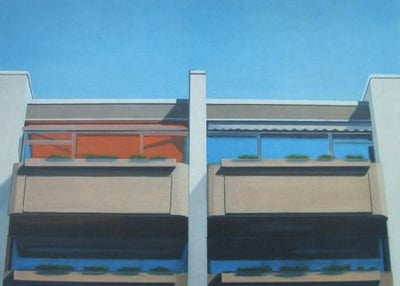
Eberhard Havekost
Vier Kabinen, 2000
Limited Edition Print
Lithograph
Currently Not Available
No sold works to show.
The point of departure for my paintings is an emotional quality or a factuality. In other words, something I can feel.
- Eberhard Havekost
- Eberhard Havekost
The contemporary German painter Eberhard Havekost uses multimedia images as the basis for his work. Havekost takes clips from television, videos and magazines, formulates computer images of the shots and uses them as a template for his paintings. His creations explore themes such as politics, nature and people. Some of his more notable pieces include the 1998 work 'Kontakt,' 'Car Park,' from 2001 and 'Shelf,' which he completed in 2002. Eberhard Havekost has been compared to fellow German Visual Artist Gerhard Richter. Eberhard Havekost interned to be a stonemason, but later attended and graduated from the Hochschule fur Bildende Kunste (Academy of Fine Art) in Dresden, Germany after being awarded the prestigious Schmidt-Rotluft Scholarship. Havekost's exhibitions have been on display in galleries across the United States and Europe. In addition, his works have appeared in Museums like the Denver Art Museum and the museum of Modern Art (MoMA) in New York City. In 2016, Havekost's art will be featured at the Anton Kern Gallery in New York. Early in his career, Havekost received the Dorothy Van Staten Art Award. Since 2010, Eberhard Havekost has been a Professor at the Kunstakademie (Art Academy) of Dusseldorf, Germany.
Related Artists


Related Articles
News, Popular, Collecting, Artists - August 12, 2026
In Minor Keys: Finding Intimacy and Identity at the 61st Venice Biennale — and in Your Collection
Explore how Koyo Kouoh’s 61st Venice Biennale vision, In Minor Keys, is shifting contemporary collecting toward quiet introspection, memory, and personal identi…Read More
 Artwork by Ellsworth Kelly
What is Colour Field Painting?
Colour Field Painting is an abstract style characterized by large areas of a single color or simple, solid colors. The term was first used in the 1950s to describe the work of three American Abstract Expressionist painters—Barnett Newman, Mark Rothko, and Clyfford Still. Their work emphasized the emotional power of color and the creation of vast, meditative…
Explore »

