
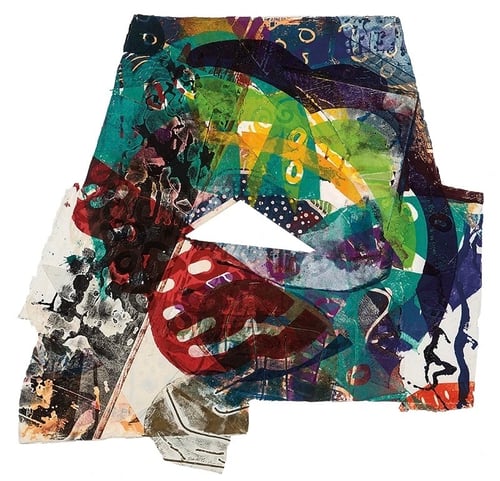
Sam Gilliam
Sam Gilliam (United States, 1933–2022) was an American abstract painter and sculptor associated with the Washington Color School. Renowned for his innovative 'drape paintings,' he removed canvases from traditional stretchers, suspending them to create dynamic, sculptural forms. Gilliam's work challenged conventional boundaries between painting and sculpture, influencing generations of artists.
© Sam Gilliam. All rights reserved.
- Recently Added
- Price (Low-High)
- Price (High-Low)
- Year (Low-High)
- Year (High-Low)

Sam Gilliam
Purple Antelope Space Squeeze, 1987
Limited Edition Print
Mixed Media
USD 15,000
No sold works to show.
The work itself determines the way it will go. You have to listen to it.
- Sam Gilliam
- Sam Gilliam
Sam Gilliam is an American artist best known for his abstract paintings, which are often composed of brightly-colored fabric draped in various ways.
Gilliam first gained recognition in the 1960s for his innovative use of found materials, such as discarded clothing and pieces of cloth, which he would then manipulate into geometric shapes. Gilliam's work is often associated with the Color Field and Lyrical Abstraction movements, both of which emphasize the use of color and brushwork to create a sense of harmony and emotional resonance.
In recent years, Gilliam has begun experimenting with new mediums, including video and photography. However, his signature style remains recognizable regardless of the medium he is working in.
Recent solo exhibitions of Gilliam's work have been held at the Corcoran Gallery of Art in Washington, D.C., and the Museum of Contemporary Art in Los Angeles.
Gilliam has been the recipient of numerous awards and honors over the course of his career, including a Guggenheim Fellowship and the National Endowment for the Arts Visual Artist Fellowship. His work can be found in the collections of many prestigious institutions, such as the Museum of Modern Art in New York and the Tate Gallery in London. Gilliam's art has been praised for its ability to transcend traditional boundaries, both stylistically and thematically.
As one critic has noted, "Gilliam's art is about freedom-the freedom to explore, to experiment, and to create art that is at once beautiful and thought-provoking." This commitment to pushing the boundaries of art has made Gilliam one of the most important figures in American art today.
Gilliam first gained recognition in the 1960s for his innovative use of found materials, such as discarded clothing and pieces of cloth, which he would then manipulate into geometric shapes. Gilliam's work is often associated with the Color Field and Lyrical Abstraction movements, both of which emphasize the use of color and brushwork to create a sense of harmony and emotional resonance.
In recent years, Gilliam has begun experimenting with new mediums, including video and photography. However, his signature style remains recognizable regardless of the medium he is working in.
Recent solo exhibitions of Gilliam's work have been held at the Corcoran Gallery of Art in Washington, D.C., and the Museum of Contemporary Art in Los Angeles.
Gilliam has been the recipient of numerous awards and honors over the course of his career, including a Guggenheim Fellowship and the National Endowment for the Arts Visual Artist Fellowship. His work can be found in the collections of many prestigious institutions, such as the Museum of Modern Art in New York and the Tate Gallery in London. Gilliam's art has been praised for its ability to transcend traditional boundaries, both stylistically and thematically.
As one critic has noted, "Gilliam's art is about freedom-the freedom to explore, to experiment, and to create art that is at once beautiful and thought-provoking." This commitment to pushing the boundaries of art has made Gilliam one of the most important figures in American art today.
Related Artists


Related Articles
News, Popular, Collecting, Artists - August 12, 2026
In Minor Keys: Finding Intimacy and Identity at the 61st Venice Biennale — and in Your Collection
Explore how Koyo Kouoh’s 61st Venice Biennale vision, In Minor Keys, is shifting contemporary collecting toward quiet introspection, memory, and personal identi…Read More
 Artwork by Wade Guyton
What is Digital Art?
Digital art refers to artistic practices or works that utilize digital technology as an essential component of both the creation and presentation process. Since the 1970s, various terms like multimedia and computer art have been used to describe this practice. Digital art is a subset of the broader category known as new media art, which has brought significa…
Explore »

