

collection of Victoria and Albert Museum, British Museum. LACMA
There has been considerable press about this work and the artist including Financial Times and WSJ and NY Times.
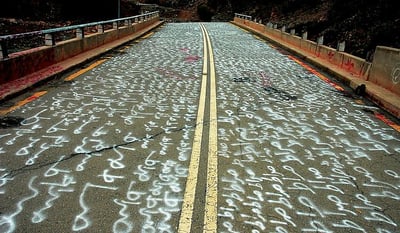
The Path by Abdulnasser Gharem is a powerful 2012 silkscreen print that captures a poignant moment from a bridge in southern Saudi Arabia, layered with symbolic meaning. The image documents the bridge where, in the early 1980s, villagers tragically lost their lives when the structure collapsed as they sought refuge during a flash flood. Gharem, in his work, spray-painted the word siraat across the bridge—a term meaning path, which in Islamic texts signifies the righteous path toward God. The repeated script on the weathered road emphasizes themes of destiny, faith, and the vulnerability of human constructions against nature’s force. This work, which appears in renowned collections including the Victoria and Albert Museum and the British Museum, speaks to collective memory, loss, and resilience.
Artwork Copyright © Abdulnasser GharemAbdulnasser Gharem (Saudi Arabia, 1973) is a Saudi Arabian artist and lieutenant colonel in the Saudi army. His conceptual art spans installation, performance, and painting, often addressing themes of authority and social issues. Notably, his installation 'Message/Messenger' set a record at auction in Dubai in 2011.
Artwork Copyright © Abdulnasser GharemThe Path, 2012
Form
Medium
Size
- Inches
- Centimeters
Edition
Price
Available works →
- Authenticity Guaranteed
- Insured Shipping
- Online Since 2005
●
●Inventory 4021
●Signed
●Comes with gallery invoice and certificate
●Sell Us a Similar Artwork. Learn more.
collection of Victoria and Albert Museum, British Museum. LACMA
There has been considerable press about this work and the artist including Financial Times and WSJ and NY Times.
The Path by Abdulnasser Gharem is a powerful 2012 silkscreen print that captures a poignant moment from a bridge in southern Saudi Arabia, layered with symbolic meaning. The image documents the bridge where, in the early 1980s, villagers tragically lost their lives when the structure collapsed as they sought refuge during a flash flood. Gharem, in his work, spray-painted the word siraat across the bridge—a term meaning path, which in Islamic texts signifies the righteous path toward God. The repeated script on the weathered road emphasizes themes of destiny, faith, and the vulnerability of human constructions against nature’s force. This work, which appears in renowned collections including the Victoria and Albert Museum and the British Museum, speaks to collective memory, loss, and resilience.
Artwork Copyright © Abdulnasser GharemAbdulnasser Gharem (Saudi Arabia, 1973) is a Saudi Arabian artist and lieutenant colonel in the Saudi army. His conceptual art spans installation, performance, and painting, often addressing themes of authority and social issues. Notably, his installation 'Message/Messenger' set a record at auction in Dubai in 2011.
Artwork Copyright © Abdulnasser Gharem- Recently Added
- Price (Low-High)
- Price (High-Low)
- Year (Low-High)
- Year (High-Low)
Abdulnasser Gharem
The Path, 2012
Limited Edition Print
Silkscreen
Currently Not Available
Related Artists



Artwork by Wang Guangyi
What is activist art?
Activist Art is a form of art created to address social and political issues. It often involves public engagement and works closely with communities to raise awareness or inspire change. While it can include elements of performance art, it is not limited to this form. Examples include creating and distributing social protest posters or organizing community-based art projects that highlight specific causes.


Abdulnasser Gharem
The Path, 2012
130 x 180 cm


