
Silkscreen on paper
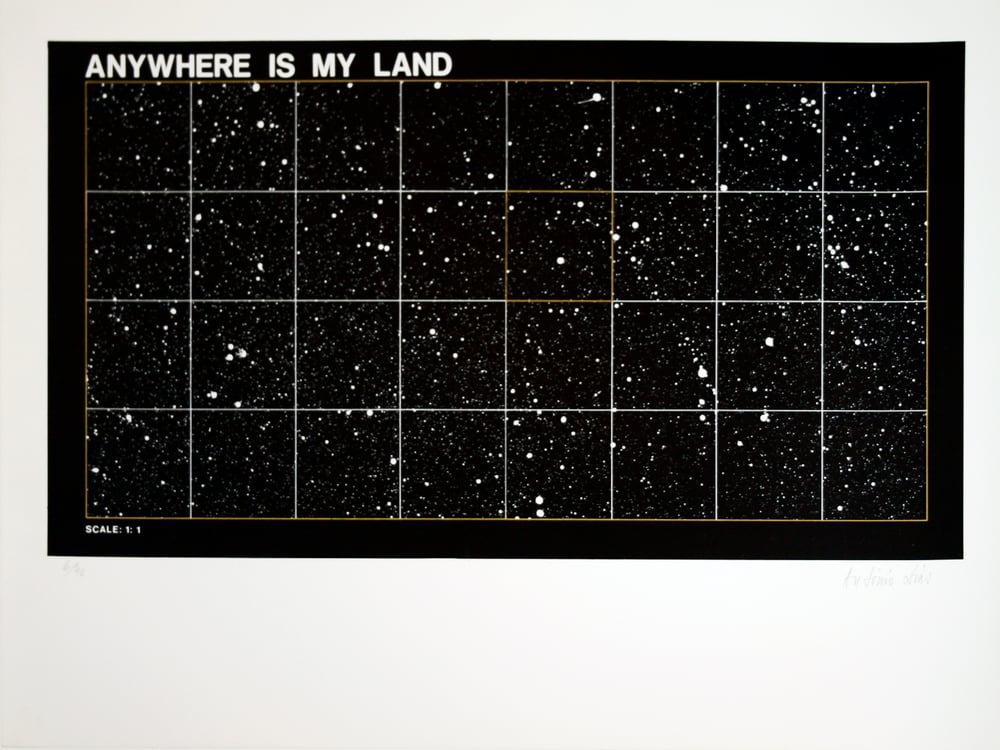
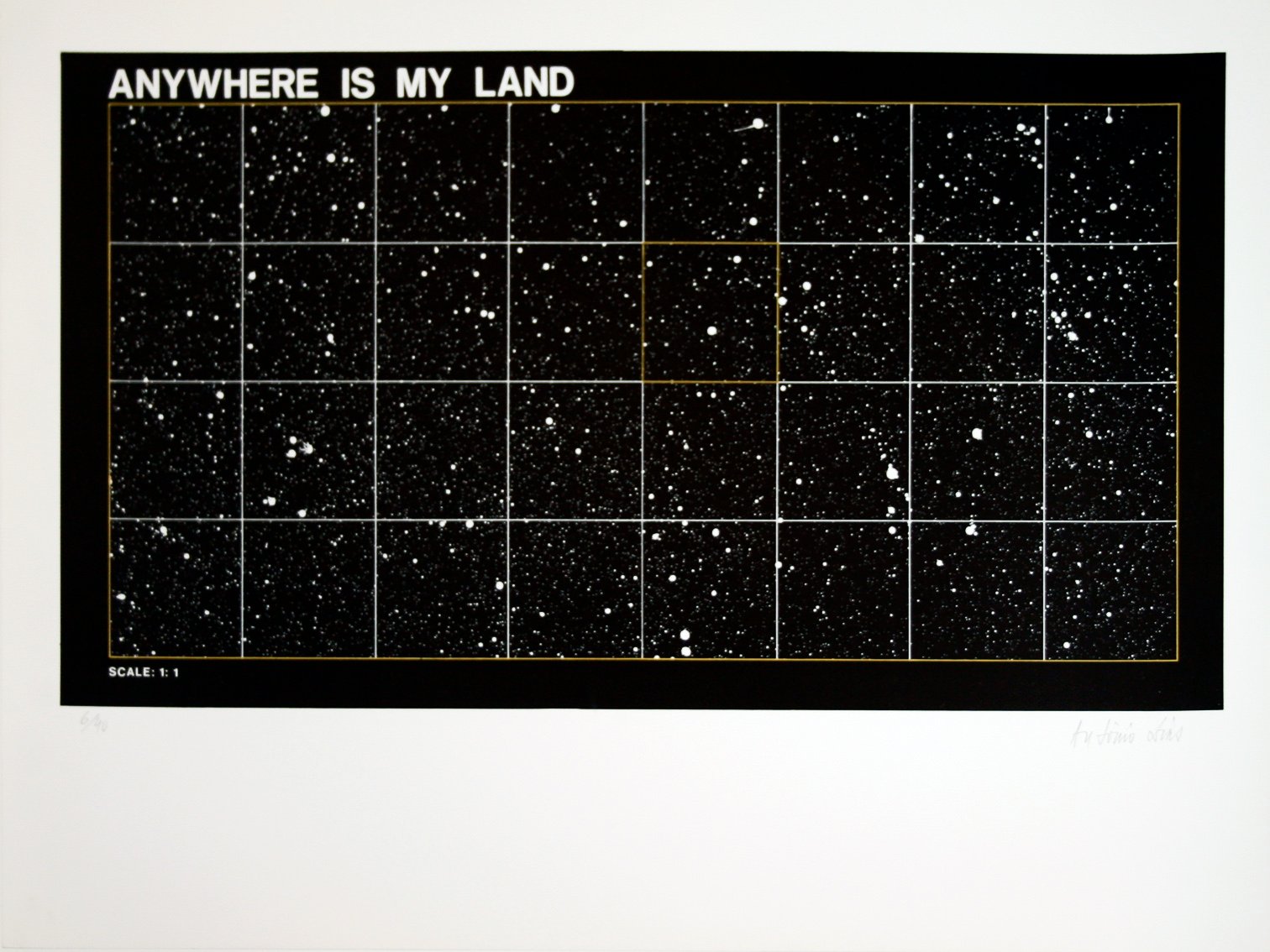
Anywhere is My Land by Antonio Dias, created in 1975, is a limited edition silkscreen print that reflects the artist’s engagement with political and conceptual art. Measuring 45 x 62 cm, the piece features a grid-like structure reminiscent of a star map or celestial chart. The black background is dotted with white specks, simulating stars or cosmic debris, while the title “ANYWHERE IS MY LAND” is boldly displayed at the top left, asserting a statement of universal belonging or borderlessness. The use of the grid suggests order and mapping, contrasting with the vast, chaotic appearance of the stars. Dias’s work challenges viewers to reflect on themes of territory, ownership, and identity, inviting a broader contemplation of freedom and space.
Artwork Copyright © Antonio DiasAntonio Dias (Brazil, 1944–2018) was a multifaceted artist whose work spanned painting, sculpture, and conceptual art. A prominent figure in the Tropicália movement, he critiqued political oppression and societal issues through his art. Dias's innovative use of materials and engagement with global art dialogues cemented his legacy in contemporary art.
Artwork Copyright © Antonio DiasAnywhere is My Land, 1975
Form
Medium
Size
- Inches
- Centimeters
Edition
Price
- USD
- EUR
- GBP
- CHF
- Authenticity Guaranteed
- Insured Shipping
- Online Since 2005
●Inventory 11142
●Signed
●Comes with gallery invoice and certificate
●Sell Us a Similar Artwork. Learn more.
Silkscreen on paper
Anywhere is My Land by Antonio Dias, created in 1975, is a limited edition silkscreen print that reflects the artist’s engagement with political and conceptual art. Measuring 45 x 62 cm, the piece features a grid-like structure reminiscent of a star map or celestial chart. The black background is dotted with white specks, simulating stars or cosmic debris, while the title “ANYWHERE IS MY LAND” is boldly displayed at the top left, asserting a statement of universal belonging or borderlessness. The use of the grid suggests order and mapping, contrasting with the vast, chaotic appearance of the stars. Dias’s work challenges viewers to reflect on themes of territory, ownership, and identity, inviting a broader contemplation of freedom and space.
Artwork Copyright © Antonio DiasAntonio Dias (Brazil, 1944–2018) was a multifaceted artist whose work spanned painting, sculpture, and conceptual art. A prominent figure in the Tropicália movement, he critiqued political oppression and societal issues through his art. Dias's innovative use of materials and engagement with global art dialogues cemented his legacy in contemporary art.
Artwork Copyright © Antonio Dias- Recently Added
- Price (Low-High)
- Price (High-Low)
- Year (Low-High)
- Year (High-Low)

Antonio Dias
In Motion, 1975
Limited Edition Print
Silkscreen
EUR 6,000

Antonio Dias
Anywhere is My Land, 1975
Limited Edition Print
Silkscreen
EUR 6,000

Antonio Dias
Navegador, 2015
Limited Edition Print
Lithograph
EUR 2,500

Antonio Dias
Without title , 2015
Limited Edition Print
Etching
Currently Not Available
Related Artists


Artwork by Carlos Cruz-Diez
What is Latin American art?
Latin American Art is a style which takes inspiration from its culture, society, politics, native traditions, religions and landscape. Op-Art and Kinetic Art figure prominently in Latin artworks. Colors in Latin American compositions are often bold. Latin American artists work in all media and movements.

Antonio Dias
Anywhere is My Land, 1975
45 x 62 cm


