

Offset Lithograph; Hand signed and dated.
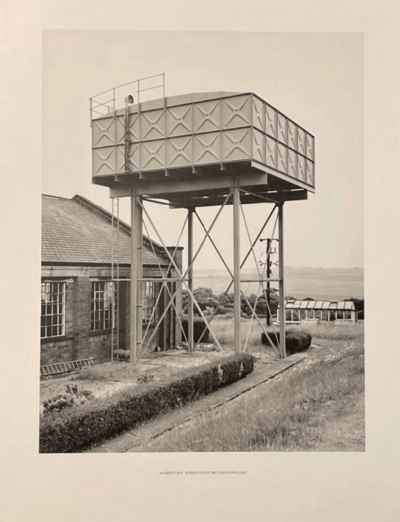
Wasserturm Kirkhamgate by Bernd and Hilla Becher, created in 1974, is an offset lithograph measuring 52 x 40 cm, and a unique work within their broader typological series on industrial architecture. This black-and-white photograph captures a water tower near Leeds, England, standing on spindly support legs with its stark, geometric form rendered with clinical precision. Known for their systematic documentation of utilitarian structures, the Bechers elevate anonymous industrial forms to objects of sculptural beauty. Their work is central to conceptual photography and influenced generations of artists with its rigorous, objective style. This particular print is hand-signed and dated by the artists.
Artwork Copyright © Bernd & Hilla BecherBernd and Hilla Becher (Germany, 1931–2007; 1934–2015) were pioneering photographers known for their typological studies of industrial architecture. Their stark black-and-white images of water towers, factories, and silos captured structural precision and uniformity. Founders of the Düsseldorf School of Photography, their work profoundly influenced generations of artists and shaped the visual language of modern photography.
Artwork Copyright © Bernd & Hilla BecherWasserturm Kirkhamgate, 1974
Form
Medium
Size
- Inches
- Centimeters
Edition
Price
- USD
- EUR
- GBP
- CHF
- Authenticity Guaranteed
- Insured Shipping
- Online Since 2005
●Inventory 16266
●Signed
●Comes with gallery invoice and certificate
●Sell Us a Similar Artwork. Learn more.
Offset Lithograph; Hand signed and dated.
Wasserturm Kirkhamgate by Bernd and Hilla Becher, created in 1974, is an offset lithograph measuring 52 x 40 cm, and a unique work within their broader typological series on industrial architecture. This black-and-white photograph captures a water tower near Leeds, England, standing on spindly support legs with its stark, geometric form rendered with clinical precision. Known for their systematic documentation of utilitarian structures, the Bechers elevate anonymous industrial forms to objects of sculptural beauty. Their work is central to conceptual photography and influenced generations of artists with its rigorous, objective style. This particular print is hand-signed and dated by the artists.
Artwork Copyright © Bernd & Hilla BecherBernd and Hilla Becher (Germany, 1931–2007; 1934–2015) were pioneering photographers known for their typological studies of industrial architecture. Their stark black-and-white images of water towers, factories, and silos captured structural precision and uniformity. Founders of the Düsseldorf School of Photography, their work profoundly influenced generations of artists and shaped the visual language of modern photography.
Artwork Copyright © Bernd & Hilla Becher- Recently Added
- Price (Low-High)
- Price (High-Low)
- Year (Low-High)
- Year (High-Low)
Bernd & Hilla Becher
Wasserturm Kirkhamgate, 1974
Photography
Offset Print
GBP 4,200

Bernd & Hilla Becher
Fördertürme, 2006
Limited Edition Print
Digital Print on paper
Currently Not Available
Related Artists




Artwork by Paul Van Hoeydonck
What is Space Art?
Space Art is an artistic genre that depicts the cosmic elements of the universe, including celestial bodies, interstellar space, and space exploration. It began in 1865 with the first science-based illustrations by A. de Neuville and Emile Bayard in Jules Verne’s novel From the Earth to the Moon. Space Art has since evolved to include various forms of visual art inspired by astronomical discoveries and the human imagination, playing a key role in visualizing the wonders of space.


Bernd & Hilla Becher
Wasserturm Kirkhamgate, 1974
52 x 40 cm


