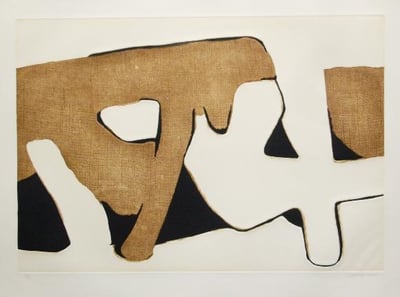
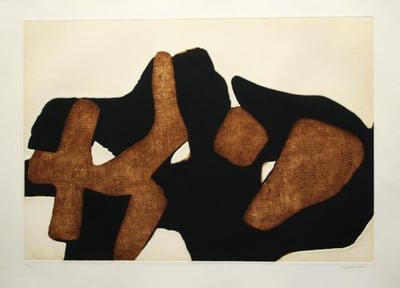
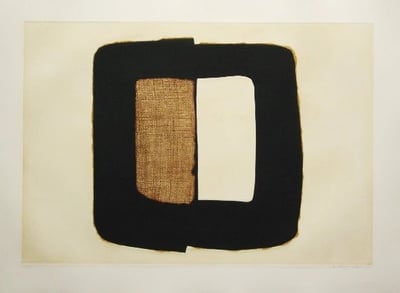
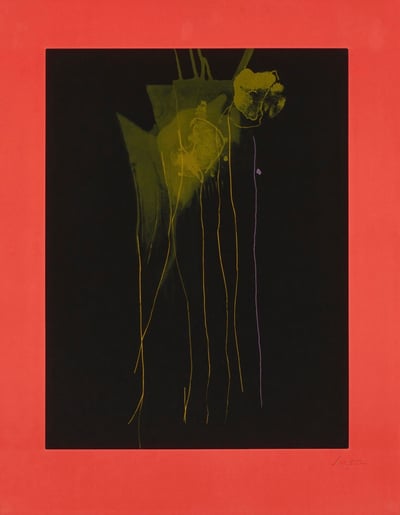
Etching and aquatint on Gvarro paper. Plate size: 62 x 44 cm.
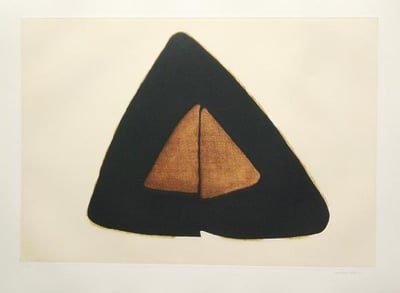
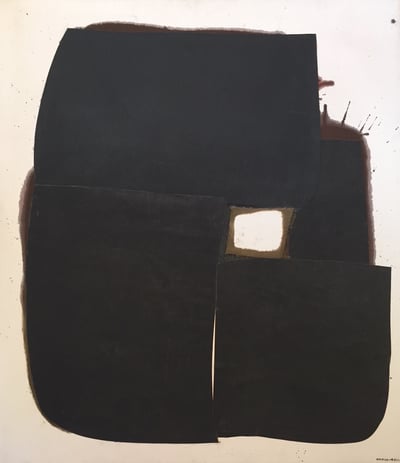
Composition VIII by Conrad Marca-Relli, a 1977 etching and aquatint, exemplifies his mastery of abstract forms and minimalist expression. The artwork presents a bold triangular shape filled with rich, dark tones, with an inner triangle in a contrasting, warm hue. The soft gradation and textured finish suggest depth, evoking a sense of structure and containment within simplicity. Marca-Relli’s focus on form and color over detail creates a contemplative piece that invites viewers to interpret its geometric simplicity and reflect on balance and space. This work highlights his exploration of abstract form in a restrained yet evocative manner.
Conrad Marca-Relli (USA, 1913–2000) was a pioneering Abstract Expressionist known for his bold, large-scale collages. Using materials like canvas and fabric, his works often explored the interplay between form and space, combining painterly elements with sculptural textures. A significant figure in post-war art, he helped shape the Abstract Expressionist movement alongside contemporaries like Jackson Pollock.
Etching and AquatintEtching and aquatint are printmaking techniques. In aquatint, the printing plate is etched with a pattern of tiny pits and cracks to create a wide range of tonal gradations. This technique allows artists to replicate the broad, flat tones found in watercolor paintings and ink washes.
Etching and aquatint on Gvarro paper. Plate size: 62 x 44 cm.
Composition VIII by Conrad Marca-Relli, a 1977 etching and aquatint, exemplifies his mastery of abstract forms and minimalist expression. The artwork presents a bold triangular shape filled with rich, dark tones, with an inner triangle in a contrasting, warm hue. The soft gradation and textured finish suggest depth, evoking a sense of structure and containment within simplicity. Marca-Relli’s focus on form and color over detail creates a contemplative piece that invites viewers to interpret its geometric simplicity and reflect on balance and space. This work highlights his exploration of abstract form in a restrained yet evocative manner.
Conrad Marca-Relli (USA, 1913–2000) was a pioneering Abstract Expressionist known for his bold, large-scale collages. Using materials like canvas and fabric, his works often explored the interplay between form and space, combining painterly elements with sculptural textures. A significant figure in post-war art, he helped shape the Abstract Expressionist movement alongside contemporaries like Jackson Pollock.
You get a linear quality from collage that is more rapid than the swiftest drawn
line.
- Conrad Marca-Relli
Conrad Marca-Relli was an American-born painter, who was a part of the abstract expressionist movement. Conrad Marca-Relli often painted cityscapes, still life's, and circus themes. He was friends with famous American artist Jackson Pollock. Art critics often compare Marca-Relli's work to that of noted Italian painter Giorgio de Chirico. Conrad Marca-Relli’s first exhibition came in 1948 and took place in New York City. His work has been exhibited across the United States, Canada and Europe. Marca-Relli's public collections can be seen in a number of different museums, including New York City's Museum of Modern Art (MoMA), the Solomon R. Guggenheim Museum and the Whitney American Museum of Art; the Carnegie Institute in Pittsburgh, Pennsylvania; and the National Gallery of Art and the Smithsonian American Art Museum, both in Washington D.C. Conrad Marca-Relli was a member of the Downtown Group, a collection of artists who worked in lower Manhattan.He was also a World War II veteran and held Professorships at Yale University and the University of California at Berkeley. Marca-Relli died in the year 2000 in Parma, Italy at age 87.
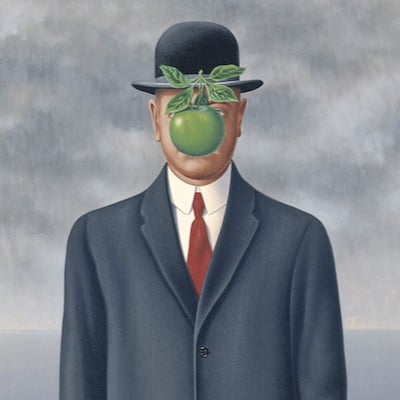
Surrealism began in the 1920s as an art and literary movement with the goal of revealing the unconscious mind and unleashing the imagination by exploring unusual and dream-like imagery. Influenced by Sigmund Freud’s theories of psychoanalysis, Surrealist artists and writers sought to bring the unconscious into rational life, blurring the lines between reality and dreams. The movement aimed to challenge conventional perceptions and express the irrational aspects of the human experience.