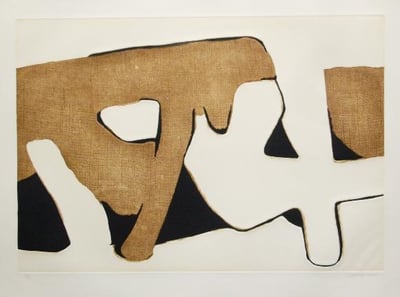
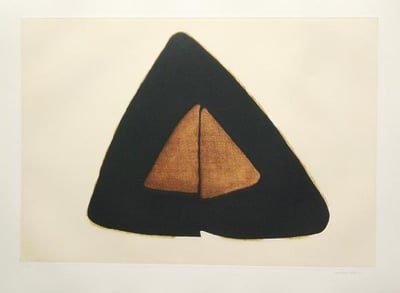
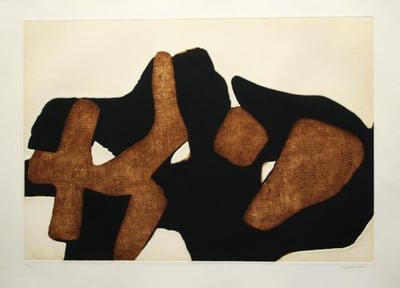
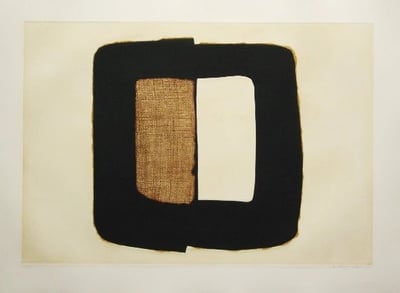
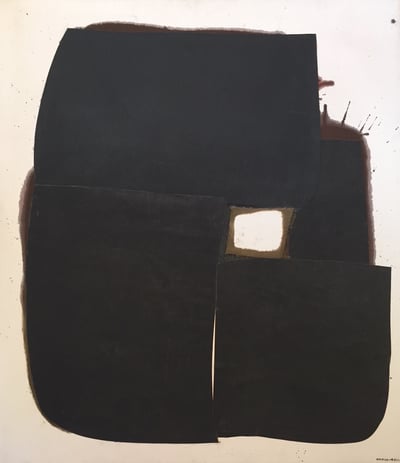
F-M-2-67 by Conrad Marca-Relli is an abstract mixed media piece from 1967, showcasing the artist's signature technique of collage combined with paint on canvas. The composition is dominated by irregular, overlapping black forms, arranged in a way that creates both tension and harmony within the space. Marca-Relli’s choice of dark, muted colors, contrasted by small areas of raw canvas, introduces depth and a sculptural quality to the flat surface. The subtle texture and layered shapes evoke a sense of architectural structure, while still maintaining a sense of abstraction. Measuring 91.4 cm by 81.3 cm, this work reflects Marca-Relli’s exploration of form, space, and the relationship between positive and negative space, typical of his mid-20th century work.
Conrad Marca-Relli (USA, 1913–2000) was a pioneering Abstract Expressionist known for his bold, large-scale collages. Using materials like canvas and fabric, his works often explored the interplay between form and space, combining painterly elements with sculptural textures. A significant figure in post-war art, he helped shape the Abstract Expressionist movement alongside contemporaries like Jackson Pollock.
Mixed MediaMixed media refers to artwork that incorporates more than one medium within a single piece. Unlike multimedia art, which combines distinct forms of visual art and often includes elements like sound, video, or digital media, mixed media focuses on combining traditional art materials, such as paint, ink, and collage. Mixed media art allows artists to achieve a wide range of effects and textures by layering and blending different materials.
F-M-2-67 by Conrad Marca-Relli is an abstract mixed media piece from 1967, showcasing the artist's signature technique of collage combined with paint on canvas. The composition is dominated by irregular, overlapping black forms, arranged in a way that creates both tension and harmony within the space. Marca-Relli’s choice of dark, muted colors, contrasted by small areas of raw canvas, introduces depth and a sculptural quality to the flat surface. The subtle texture and layered shapes evoke a sense of architectural structure, while still maintaining a sense of abstraction. Measuring 91.4 cm by 81.3 cm, this work reflects Marca-Relli’s exploration of form, space, and the relationship between positive and negative space, typical of his mid-20th century work.
Conrad Marca-Relli (USA, 1913–2000) was a pioneering Abstract Expressionist known for his bold, large-scale collages. Using materials like canvas and fabric, his works often explored the interplay between form and space, combining painterly elements with sculptural textures. A significant figure in post-war art, he helped shape the Abstract Expressionist movement alongside contemporaries like Jackson Pollock.
You get a linear quality from collage that is more rapid than the swiftest drawn
line.
- Conrad Marca-Relli
Conrad Marca-Relli was an American-born painter, who was a part of the abstract expressionist movement. Conrad Marca-Relli often painted cityscapes, still life's, and circus themes. He was friends with famous American artist Jackson Pollock. Art critics often compare Marca-Relli's work to that of noted Italian painter Giorgio de Chirico. Conrad Marca-Relli’s first exhibition came in 1948 and took place in New York City. His work has been exhibited across the United States, Canada and Europe. Marca-Relli's public collections can be seen in a number of different museums, including New York City's Museum of Modern Art (MoMA), the Solomon R. Guggenheim Museum and the Whitney American Museum of Art; the Carnegie Institute in Pittsburgh, Pennsylvania; and the National Gallery of Art and the Smithsonian American Art Museum, both in Washington D.C. Conrad Marca-Relli was a member of the Downtown Group, a collection of artists who worked in lower Manhattan.He was also a World War II veteran and held Professorships at Yale University and the University of California at Berkeley. Marca-Relli died in the year 2000 in Parma, Italy at age 87.
Abstract Expressionism is an art movement that emerged in the United States during the 1940s and 1950s. Characterized by large, abstract canvases, the movement emphasized spontaneous, expressive brushwork and the use of color and form to convey emotion rather than represent reality. Artists like Jackson Pollock, Mark Rothko, and Willem de Kooning are key figures in this movement. Abstract Expressionism marked a shift in the art world, making New York City a center of the international art scene.