Photo gravure with chine colle? - 2 plates of 78 x 58,5 cm. - Printed on Waranbashi of 63 gr. and Somerset Satin, 410 gr. of 112 x 88,5 cm.
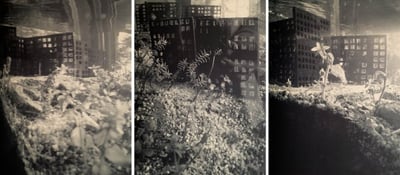
Aquarium II, 2 by Cristina Iglesias is a photogravure print from 2011 that combines intricate photographic detail with an evocative, almost surreal landscape. The image depicts what appears to be miniature architectural structures resembling high-rise buildings, set within a natural environment of soil, small plants, and delicate foliage. The juxtaposition of rigid, urban forms with organic, living elements creates a thought-provoking scene that blurs the line between constructed environments and natural ecosystems. Printed on delicate Waranbashi and Somerset Satin paper, this work uses a subtle monochromatic palette, enhancing the sense of depth and texture. Iglesias' photogravure invites viewers to reflect on the interplay between urbanization and nature, capturing an imaginary world where both coexist.
Cristina Iglesias (Spain, 1956) is a Spanish installation artist and sculptor known for creating immersive environments that blend architecture, literature, and site-specific influences. Utilizing materials like steel, water, glass, and bronze, she constructs spaces that challenge the boundaries between interior and exterior, nature and artifice. Notable works include 'Forgotten Streams' at Bloomberg Headquarters in London and 'Tres Aguas' in Toledo, Spain.
Photogravure Photogravure is a high-quality printing process that involves etching a photograph onto a copper plate. The plate is inked and pressed onto paper, producing fine art prints with detailed, soft tones and rich textures. Developed in the 19th century, photogravure is renowned for its ability to create art reproductions with exceptional depth and subtlety.
Photo gravure with chine colle? - 2 plates of 78 x 58,5 cm. - Printed on Waranbashi of 63 gr. and Somerset Satin, 410 gr. of 112 x 88,5 cm.
Aquarium II, 2 by Cristina Iglesias is a photogravure print from 2011 that combines intricate photographic detail with an evocative, almost surreal landscape. The image depicts what appears to be miniature architectural structures resembling high-rise buildings, set within a natural environment of soil, small plants, and delicate foliage. The juxtaposition of rigid, urban forms with organic, living elements creates a thought-provoking scene that blurs the line between constructed environments and natural ecosystems. Printed on delicate Waranbashi and Somerset Satin paper, this work uses a subtle monochromatic palette, enhancing the sense of depth and texture. Iglesias' photogravure invites viewers to reflect on the interplay between urbanization and nature, capturing an imaginary world where both coexist.
Cristina Iglesias (Spain, 1956) is a Spanish installation artist and sculptor known for creating immersive environments that blend architecture, literature, and site-specific influences. Utilizing materials like steel, water, glass, and bronze, she constructs spaces that challenge the boundaries between interior and exterior, nature and artifice. Notable works include 'Forgotten Streams' at Bloomberg Headquarters in London and 'Tres Aguas' in Toledo, Spain.
Working with memory is inevitable. Mine is often very intertwined, and it always helps me to find a thread. But there is also history, and not just the history of art.
- Cristina Iglesias
Cristina Iglesias is mainly an installation artist and sculptor based out of Spain. She works through mediums such as steel, glass, bronze, and even water. She consistently works in collaboration with architectural ideas and techniques. Many of her pieces are not only pieces of art, sometimes even suggesting a stronger message, but they are also public spaces. She has created benches for patrons in art galleries that are also a sculpture. One of Cristina Iglesias' most famous pieces of art is her underwater sculpture in Baja, California. Known for adapting to changes in maintenance, Iglesias welcomes the weathering of her sculptures. The underwater work has since become a reef and a home for wildlife of the water. Overall, she places an emphasis on environmental issues and factors that create the question of the impact our society has on out earth. (Artist website)
Surrealism began in the 1920s as an art and literary movement with the goal of revealing the unconscious mind and unleashing the imagination by exploring unusual and dream-like imagery. Influenced by Sigmund Freud’s theories of psychoanalysis, Surrealist artists and writers sought to bring the unconscious into rational life, blurring the lines between reality and dreams. The movement aimed to challenge conventional perceptions and express the irrational aspects of the human experience.