

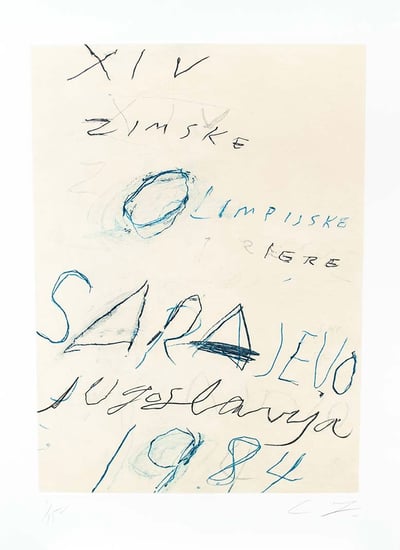
Original etching, aquatint and lithograph on Arches paper. Signed and numbered. Published by Visconti Art Spectrum, Vienna for the Art and Sports portfolio.
This evocative mixed-media print by Cy Twombly — combining etching, aquatint, and lithograph — presents the artist's characteristic gestural calligraphic marks in a composition created for the 1984 Sarajevo Winter Olympics. Twombly's distinctive scrawled lines and scratched notations float across the surface with the spontaneity of graffiti and the refinement of classical drawing. Published by Visconti Art Spectrum for the Art and Sports portfolio, this hand-signed work represents one of the most celebrated contributions to the Olympic art programme and captures Twombly's unique position between European and American artistic traditions.
Artwork Copyright © Cy TwomblyCy Twombly (USA, 1928–2011) was a celebrated painter and sculptor known for his abstract, calligraphic style. His works combined gestural marks, poetic references, and layered textures. Twombly’s monumental paintings and sculptures often explored themes of history, mythology, and memory, leaving a profound impact on 20th-century art.
Artwork Copyright © Cy TwomblySarajevo, 1984
Form
Medium
Size
- Inches
- Centimeters
Edition
Price
- Authenticity Guaranteed
- Insured Shipping
- Online Since 2005
●Inventory 17212
●Signed
●Comes with gallery invoice and certificate
●Sell Us a Similar Artwork. Learn more.
Original etching, aquatint and lithograph on Arches paper. Signed and numbered. Published by Visconti Art Spectrum, Vienna for the Art and Sports portfolio.
This evocative mixed-media print by Cy Twombly — combining etching, aquatint, and lithograph — presents the artist's characteristic gestural calligraphic marks in a composition created for the 1984 Sarajevo Winter Olympics. Twombly's distinctive scrawled lines and scratched notations float across the surface with the spontaneity of graffiti and the refinement of classical drawing. Published by Visconti Art Spectrum for the Art and Sports portfolio, this hand-signed work represents one of the most celebrated contributions to the Olympic art programme and captures Twombly's unique position between European and American artistic traditions.
Artwork Copyright © Cy TwomblyCy Twombly (USA, 1928–2011) was a celebrated painter and sculptor known for his abstract, calligraphic style. His works combined gestural marks, poetic references, and layered textures. Twombly’s monumental paintings and sculptures often explored themes of history, mythology, and memory, leaving a profound impact on 20th-century art.
Artwork Copyright © Cy Twombly- Recently Added
- Price (Low-High)
- Price (High-Low)
- Year (Low-High)
- Year (High-Low)
Cy Twombly
Sarajevo, 1984
Limited Edition Print
Mixed Media
Inquire For Price

Cy Twombly
Studio Lexington, 2008
Limited Edition Print
Drypoint
EUR 4,800
Related Artists


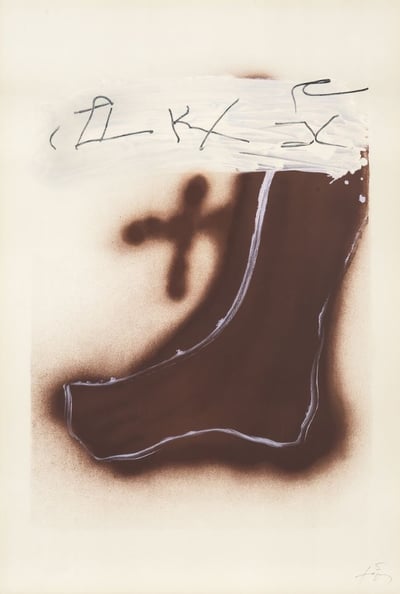


Artwork by Helen Frankenthaler
What is lyrical abstraction ?
Lyrical abstraction is a descriptive term characterizing a type of abstract painting closely related to Abstract Expressionism, in use from the 1940s to the present. The term can also describe two distinct but related trends in post-World War II modernist painting. This art movement originated in Paris, France, after the war, emphasizing personal expression, spontaneity, and the emotional use of color and form.


Cy Twombly
Sarajevo, 1984
75 x 55 cm


