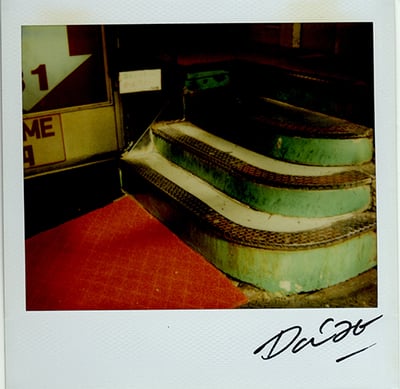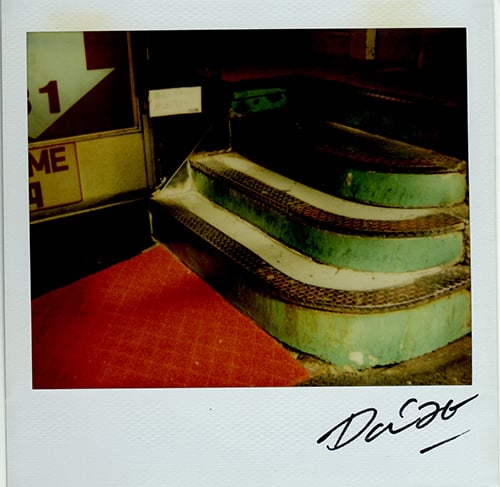
Worn concrete steps, stained to a mineral green, descend toward a floor of faded red carpet inside what appears to be a pachinko parlor or amusement hall. Fragmentary signage — numbers, the word GAME — hints at pursuits both mechanical and compulsive. Moriyama finds in this threshold a compression of urban entropy: peeling surfaces, chemical discoloration, the residue of countless anonymous visitors. The Polaroid medium itself participates in this slow dissolution, its dyes shifting and softening over time, mirroring the very decay the image documents with quiet, unsentimental precision.
Daido Moriyama (Japan, 1938) is a trailblazing Japanese photographer known for his gritty, high-contrast black-and-white street photography. Influenced by post-war realism and the Provoke movement, his work captures the raw energy of urban life. Moriyama often uses a compact camera and grainy film to create a spontaneous, immersive aesthetic.
Polaroid A Polaroid print is an instant photograph produced using a Polaroid camera, which develops the image immediately after exposure. The camera's internal processing allows the photograph to develop and appear within minutes. The term Polaroid is also used more generally to refer to instant photographs and films produced by similar technologies.
Worn concrete steps, stained to a mineral green, descend toward a floor of faded red carpet inside what appears to be a pachinko parlor or amusement hall. Fragmentary signage — numbers, the word GAME — hints at pursuits both mechanical and compulsive. Moriyama finds in this threshold a compression of urban entropy: peeling surfaces, chemical discoloration, the residue of countless anonymous visitors. The Polaroid medium itself participates in this slow dissolution, its dyes shifting and softening over time, mirroring the very decay the image documents with quiet, unsentimental precision.
Daido Moriyama (Japan, 1938) is a trailblazing Japanese photographer known for his gritty, high-contrast black-and-white street photography. Influenced by post-war realism and the Provoke movement, his work captures the raw energy of urban life. Moriyama often uses a compact camera and grainy film to create a spontaneous, immersive aesthetic.
Taking Polaroid photos was when I felt the most excited and alive.
- Daido Moriyama
Daido Moriyama (b. 1938 Japan) is a pioneering figure in post-war Japanese Photography, known for his raw, grainy, and high-contrast black-and-white images. Working primarily in urban environments, Moriyama captures fleeting moments of everyday life, often exploring themes of memory, decay, and the fragmented nature of reality. He emerged during the 1960s with the Provoke movement, which challenged traditional photographic norms and embraced a more subjective, impressionistic style. His use of a handheld camera and quick shooting methods contributes to a sense of immediacy and disorientation in his work. Deeply influenced by both American street photography and Japanese avant-garde art, Moriyama’s practice questions the reliability of images and embraces imperfection. His impact on contemporary Photography is significant, with a legacy that bridges East and West, tradition and rebellion. (Artist Website)
Contemporary art refers to avant-garde or innovative art created in the recent past or present day. The exact starting point of contemporary art varies depending on the institution, often tied to the founding year of museums or galleries that showcase the style. Contemporary art is characterized by its focus on current ideas, diverse media, and the exploration of new concepts and techniques.