
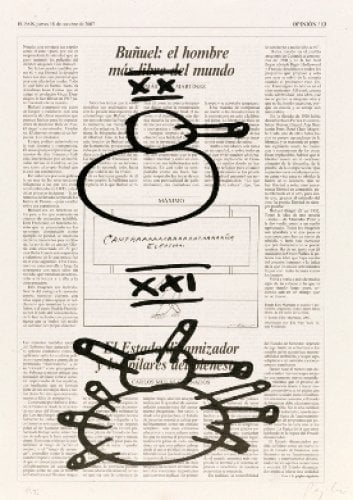
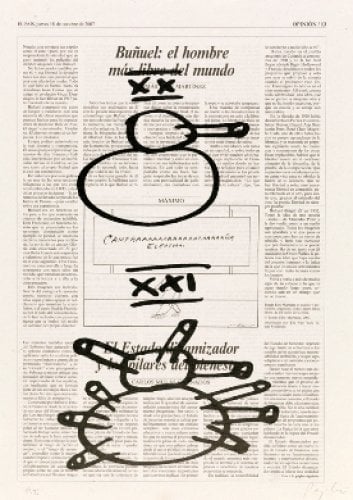
// El País by Dan Perjovschi is a 2007 limited edition lithograph that merges drawing with printed text to create a visually striking commentary on media, society, and politics. Perjovschi’s bold black linework overlays a Spanish newspaper page, featuring spontaneous, almost childlike sketches and symbols. These abstract forms appear to mock or question the surrounding text, which discusses themes of freedom and power. His minimalistic, humorous doodles serve as a critique of contemporary issues, using simple imagery to challenge and subvert the serious tone of the newsprint beneath. Measuring 41 cm by 29 cm, this piece reflects Perjovschi’s distinctive approach to social commentary, making complex ideas accessible through visual irony and satire.
Artwork Copyright © Dan PerjovschiDan Perjovschi (Romania, 1961) is a conceptual artist known for his satirical drawings and installations addressing social and political issues. Using markers or chalk, he creates spontaneous, graffiti-like works directly on walls, often in museums or public spaces. His art merges humor and critique, offering sharp commentary on contemporary global events.
Artwork Copyright © Dan PerjovschiEl País, 2007
Form
Medium
Size
- Inches
- Centimeters
Edition
Price
- USD
- EUR
- GBP
- CHF
- Authenticity Guaranteed
- Insured Shipping
- Online Since 2005
●Inventory 6662
●Signed
●Comes with gallery invoice and certificate
●Sell Us a Similar Artwork. Learn more.
// El País by Dan Perjovschi is a 2007 limited edition lithograph that merges drawing with printed text to create a visually striking commentary on media, society, and politics. Perjovschi’s bold black linework overlays a Spanish newspaper page, featuring spontaneous, almost childlike sketches and symbols. These abstract forms appear to mock or question the surrounding text, which discusses themes of freedom and power. His minimalistic, humorous doodles serve as a critique of contemporary issues, using simple imagery to challenge and subvert the serious tone of the newsprint beneath. Measuring 41 cm by 29 cm, this piece reflects Perjovschi’s distinctive approach to social commentary, making complex ideas accessible through visual irony and satire.
Artwork Copyright © Dan PerjovschiDan Perjovschi (Romania, 1961) is a conceptual artist known for his satirical drawings and installations addressing social and political issues. Using markers or chalk, he creates spontaneous, graffiti-like works directly on walls, often in museums or public spaces. His art merges humor and critique, offering sharp commentary on contemporary global events.
Artwork Copyright © Dan Perjovschi- Recently Added
- Price (Low-High)
- Price (High-Low)
- Year (Low-High)
- Year (High-Low)
Dan Perjovschi
El País, 2007
Limited Edition Print
Lithograph
EUR 500

Dan Perjovschi
Calendar 2007, 2007
Limited Edition Print
Mixed Media
EUR 1,200
Related Artists

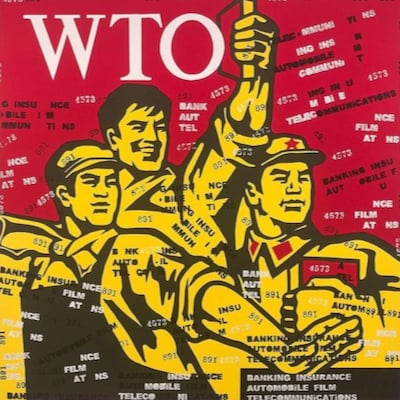
Artwork by Wang Guangyi
What is Political Pop?
Political Pop was an art movement that emerged in China during the 1980s, blending the Pop Art style of Western countries with the socialist realism of China. This movement arose during a time of rapid social and political change in China, as artists sought to create works that questioned and critiqued these cultural shifts. Political Pop often juxtaposed iconic images from Chinese propaganda with Western consumer culture, highlighting the tensions between tradition and modernization.

Dan Perjovschi
El País, 2007
41 x 29 cm


