

What is Political Pop?
- Show All
- Established
- Discoveries
- Show All
Artworks Related to Political pop

Yue Minjun
Untitled (Smile-ism No.25), 2006
Limited Edition Print
Lithograph
USD 6,500

Zhang Dali
AK-47, 2009
Limited Edition Print
Screen-print
Currently Not Available

Yin Jun
Crying Series - Brothers, 2013
Painting
Oil on canvas
USD 28,000

Yue Minjun
The Three Musketeers, 2019-2022
Limited Edition Print
Screen-print
USD 2,300

Yue Minjun
Untitled (Smile-ism No. 9), 2006
Limited Edition Print
Lithograph
USD 3,750

Huang Yan
Chinese Shanshui Tattoo, 1999
Photography
Photograph
EUR 3,670

Liu Bolin
Hide in the city n 37, 2007
Photography
Photograph
EUR 15,400
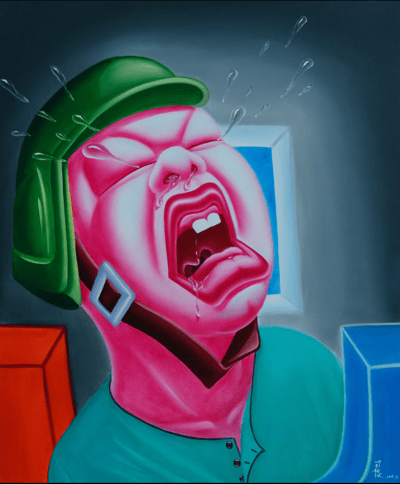
Yin Jun
Crying Boy, 2013
Painting
Oil on canvas
USD 18,900

Wang Guangyi
Face of the believer, 2003
Limited Edition Print
Lithograph
Currently Not Available
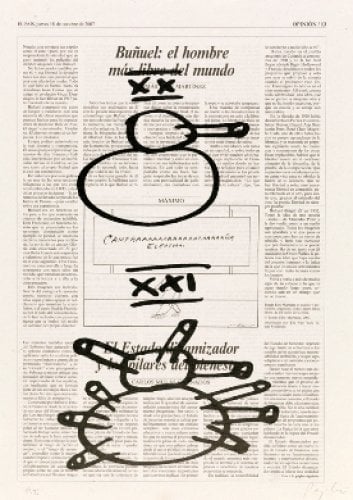
Dan Perjovschi
El País, 2007
Limited Edition Print
Lithograph
EUR 500

Huang Yan
Face tattoo , 2005
Photography
Photograph
USD 16,000

Huang Yan
Landscape
Photography
Lambda print
EUR 10,150

Chris Ofili
Untitled
Limited Edition Print
Etching
Currently Not Available

Dan Perjovschi
Calendar 2007, 2007
Limited Edition Print
Mixed Media
EUR 1,200

Yin Jun
Crying Series - Swimming , 2012
Painting
Oil on canvas
EUR 14,250
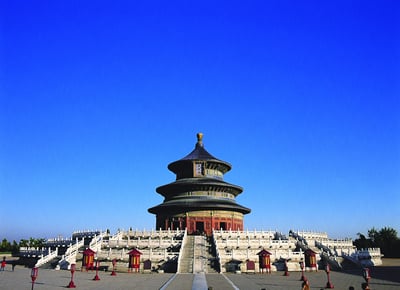
Huang Yan
Bird Tiantan No.1, 2006
Photography
Photograph
USD 4,850
Related Articles




New Topographics is a term coined in 1975 by curator William Jenkins to describe a group of photographers whose work focused on formal black-and-white images of urban and industrial landscapes. Jenkins initially described their aesthetic as banal, but the photographers themselves argued that their compositions were as significant as those of natural landscapes, emphasizing the beauty in everyday, man-made environments.
Attribute can function as both a noun and a verb. As a noun, it refers to an object, symbol, or animal commonly associated with a specific person, often used in art to identify figures, such as a lion with St. Mark. As a verb, it means to assign a work of art to a particular artist, usually based on stylistic analysis or other evidence, such as attributing a painting to an artist based on its technique and composition.

Grupo Frente was a movement founded in 1954 in Brazil by teaching artist Ivan Serpa. The movement included many students from the Rio de Janeiro Museum of Modern Art and sought to reject the nationalism and figuration present in the modernist forms of Brazilian painting. Grupo Frente emphasized experimentation and abstraction, aiming to explore new artistic possibilities beyond traditional constraints.
Can't find your Answer?
Thank you! Your question has been sent — we'll get back to you shortly.
