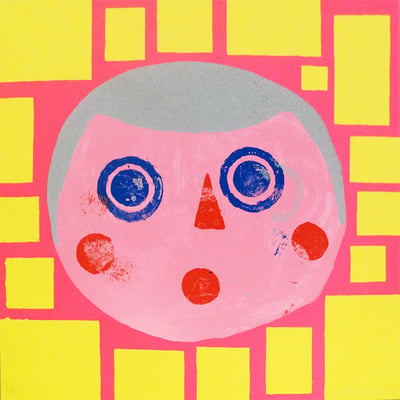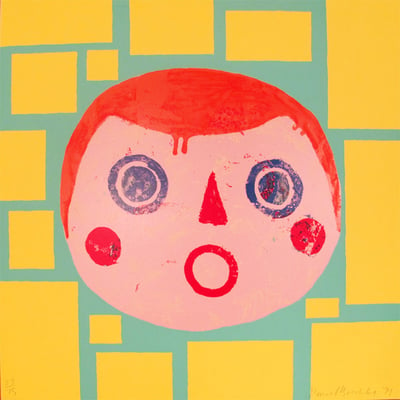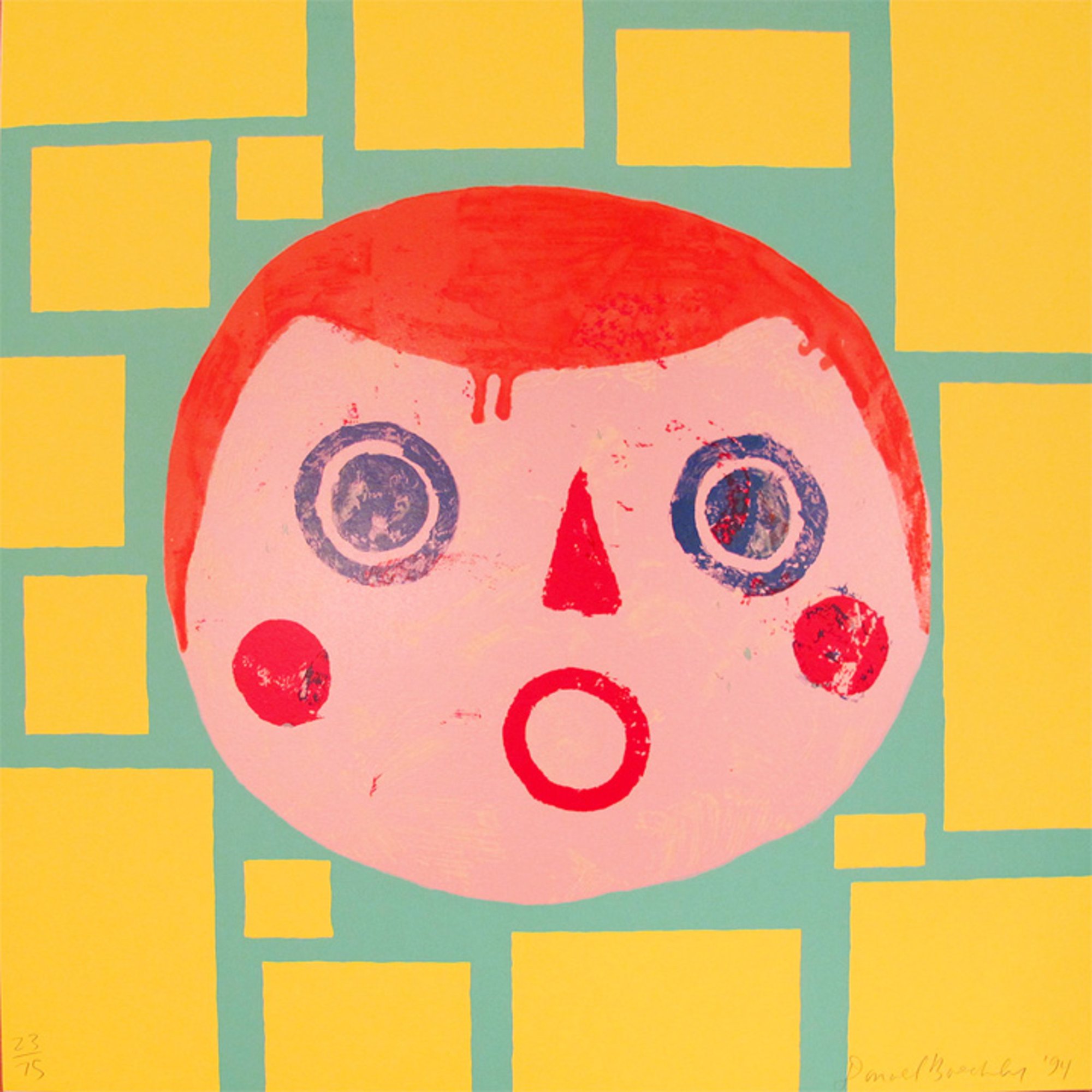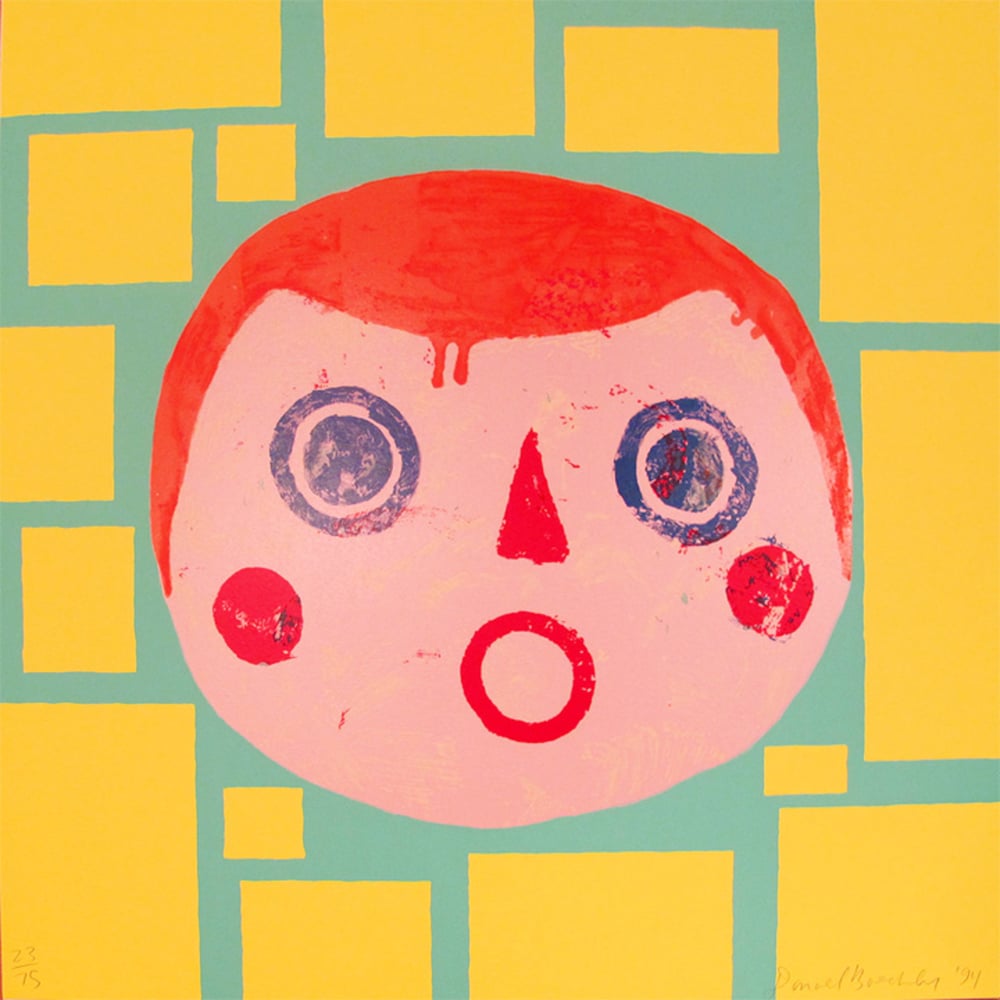
// Coney Island I by Donald Baechler is a screen-print from 1994 that showcases his characteristic blend of simplicity and whimsy. The print features a stylized, circular face with wide, blue eyes and a small red nose, set against a bright yellow and turquoise geometric background. The expressive facial features, paired with bold and contrasting colors, evoke a sense of playful nostalgia reminiscent of classic amusement park or carnival imagery, tying into the theme of Coney Island. Baechler’s use of childlike forms and minimal details emphasizes his exploration of memory, culture, and innocence, transforming familiar motifs into visually engaging and thought-provoking compositions.
Donald Baechler (USA, 1956–2022) was a celebrated painter and sculptor known for his bold, graphic imagery that fused Pop Art, folk art, and childlike simplicity. His works often featured recurring motifs like flowers, globes, and silhouettes, creating a playful yet introspective visual language. Baechler’s art earned international acclaim for its vibrant, accessible, and thought-provoking qualities.
Screen-print Screen printing is a technique where ink is transferred through a mesh onto a substrate, with areas blocked by a stencil to prevent ink from passing through. This method, also known as serigraphy or silkscreen printing, is commonly used to produce prints on posters, T-shirts, vinyl, stickers, wood, and other materials. The process is a type of stencil printing, allowing for vibrant, detailed designs on various surfaces.
// Coney Island I by Donald Baechler is a screen-print from 1994 that showcases his characteristic blend of simplicity and whimsy. The print features a stylized, circular face with wide, blue eyes and a small red nose, set against a bright yellow and turquoise geometric background. The expressive facial features, paired with bold and contrasting colors, evoke a sense of playful nostalgia reminiscent of classic amusement park or carnival imagery, tying into the theme of Coney Island. Baechler’s use of childlike forms and minimal details emphasizes his exploration of memory, culture, and innocence, transforming familiar motifs into visually engaging and thought-provoking compositions.
Donald Baechler (USA, 1956–2022) was a celebrated painter and sculptor known for his bold, graphic imagery that fused Pop Art, folk art, and childlike simplicity. His works often featured recurring motifs like flowers, globes, and silhouettes, creating a playful yet introspective visual language. Baechler’s art earned international acclaim for its vibrant, accessible, and thought-provoking qualities.
I like to edit, subtract, reduce things to their essence.
- Donald Baechler
The paintings, prints, sculptures and mixed media compositions of Donald Baechler reflect his great interest in pop culture. He is described as a second-generation Pop artist and has developed his own unique style of art, based on balance, line and form. Baechler was educated at Maryland Institute College of Art in Baltimore, Cooper Union, New York and the State Academy of Fine Arts in Frankfurt am Main, Germany. His early paintings were created deliberately to look as if they had been drawn by a child. Most of his works are about nostalgia for childhood and things associated with that time in our lives. Baechler has expanded this theme by creating mixed media compositions that give the illusion of being personal and cultural histories. He has his own personal collection of pop images and kitsch objects, which is continuously growing, and uses items from this vast collection in his art, combining popular culture with his personal style of large scale painting. For his sculptures he also makes use of a variety of materials. Some of his flowers and plants, cast in bronze, are more than 5 feet tall. Since he was discovered by Tony Shafrazi, an art dealer who has also represented contemporary artists such as Keith Haring and Jean-Michel Basquiat, works by Donald Baechler have been purchased by influential art collectors and major art institutions around the world. (Artist website)
Sometimes known as Figurativism, figurative art refers to sculptures and paintings that are clearly or specifically derived from real objects, making them representational. The term figurative art is often used in contrast to abstract art. However, since the emergence of abstract art, figurative art has come to describe any form of modern art that has strong references to the real world or actual situations.