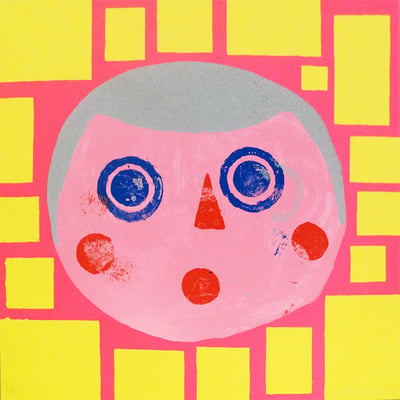
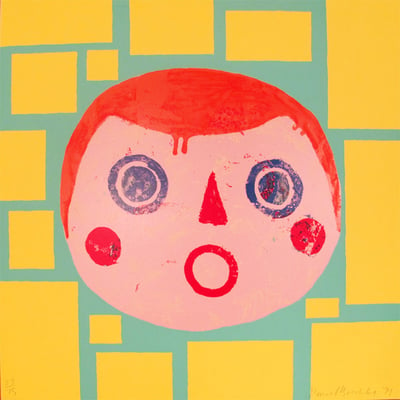
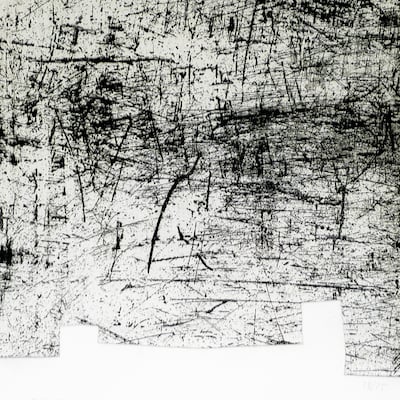
// Family I by Donald Baechler, an etching created in 1986, combines simple, almost childlike linework with abstract geometric forms. This limited edition print juxtaposes a rudimentary figure—drawn in bold, unrefined lines—with dark, solid rectangles and squares scattered across the background. The figure, with its exaggerated features and carefree stance, contrasts sharply against the formal rigidity of the shapes, evoking a playful yet introspective quality. Baechler’s work often explores themes of memory and nostalgia, and Family I presents a whimsical, almost naive interpretation that invites the viewer to reflect on family and identity.
Donald Baechler (USA, 1956–2022) was a celebrated painter and sculptor known for his bold, graphic imagery that fused Pop Art, folk art, and childlike simplicity. His works often featured recurring motifs like flowers, globes, and silhouettes, creating a playful yet introspective visual language. Baechler’s art earned international acclaim for its vibrant, accessible, and thought-provoking qualities.
EtchingEtching is a technique where a design is created on a metal surface by using a strong acid or mordant to eat away the unprotected parts of the metal, leaving the desired pattern in relief (intaglio). In modern art and manufacturing, different chemicals may be used depending on the material being etched.
// Family I by Donald Baechler, an etching created in 1986, combines simple, almost childlike linework with abstract geometric forms. This limited edition print juxtaposes a rudimentary figure—drawn in bold, unrefined lines—with dark, solid rectangles and squares scattered across the background. The figure, with its exaggerated features and carefree stance, contrasts sharply against the formal rigidity of the shapes, evoking a playful yet introspective quality. Baechler’s work often explores themes of memory and nostalgia, and Family I presents a whimsical, almost naive interpretation that invites the viewer to reflect on family and identity.
Donald Baechler (USA, 1956–2022) was a celebrated painter and sculptor known for his bold, graphic imagery that fused Pop Art, folk art, and childlike simplicity. His works often featured recurring motifs like flowers, globes, and silhouettes, creating a playful yet introspective visual language. Baechler’s art earned international acclaim for its vibrant, accessible, and thought-provoking qualities.
I like to edit, subtract, reduce things to their essence.
- Donald Baechler
The paintings, prints, sculptures and mixed media compositions of Donald Baechler reflect his great interest in pop culture. He is described as a second-generation Pop artist and has developed his own unique style of art, based on balance, line and form. Baechler was educated at Maryland Institute College of Art in Baltimore, Cooper Union, New York and the State Academy of Fine Arts in Frankfurt am Main, Germany. His early paintings were created deliberately to look as if they had been drawn by a child. Most of his works are about nostalgia for childhood and things associated with that time in our lives. Baechler has expanded this theme by creating mixed media compositions that give the illusion of being personal and cultural histories. He has his own personal collection of pop images and kitsch objects, which is continuously growing, and uses items from this vast collection in his art, combining popular culture with his personal style of large scale painting. For his sculptures he also makes use of a variety of materials. Some of his flowers and plants, cast in bronze, are more than 5 feet tall. Since he was discovered by Tony Shafrazi, an art dealer who has also represented contemporary artists such as Keith Haring and Jean-Michel Basquiat, works by Donald Baechler have been purchased by influential art collectors and major art institutions around the world. (Artist website)
Abstract art uses form, shape, line, and color to create a visual experience without attempting to represent external reality. The composition exists independently of the world's visual references, focusing on expressing ideas and emotions through non-representational means.