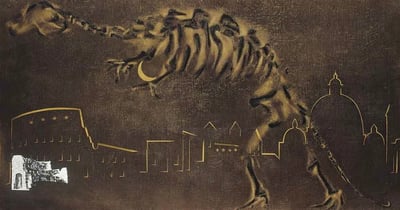
Uomini (1989) by Enzo Cucchi is a monumental etching and aquatint that embodies the artist’s distinct blend of neo-expressionism and symbolism. Measuring an imposing 270 x 75 cm, the work features a ghostly human figure rendered in earthy, atmospheric tones that evoke ancient cave paintings or spiritual apparitions. The elongated form stands upright, its outline glowing faintly against a textured background, with a luminous white area suggesting an internal light or vital force at the figure’s center. Surrounding specks of white hint at cosmic or mystical elements, reinforcing Cucchi’s recurring themes of transcendence, the body, and the metaphysical. The figure’s raw, almost primal execution and towering scale lend it a haunting presence, bridging the mythic and the contemporary. This print is part of an edition of 60, showcasing Cucchi’s ability to channel narrative, emotion, and mystery through pared-down, evocative form.
Enzo Cucchi (Italy, 1949) is a prominent figure in the Transavanguardia movement, known for his expressive and symbolic paintings. Drawing on Italian history, mythology, and literature, his works are characterized by vivid colors, dramatic compositions, and dreamlike imagery. Cucchi's art bridges tradition and modernity, earning him international acclaim.
Etching and AquatintEtching and aquatint are printmaking techniques. In aquatint, the printing plate is etched with a pattern of tiny pits and cracks to create a wide range of tonal gradations. This technique allows artists to replicate the broad, flat tones found in watercolor paintings and ink washes.
Uomini (1989) by Enzo Cucchi is a monumental etching and aquatint that embodies the artist’s distinct blend of neo-expressionism and symbolism. Measuring an imposing 270 x 75 cm, the work features a ghostly human figure rendered in earthy, atmospheric tones that evoke ancient cave paintings or spiritual apparitions. The elongated form stands upright, its outline glowing faintly against a textured background, with a luminous white area suggesting an internal light or vital force at the figure’s center. Surrounding specks of white hint at cosmic or mystical elements, reinforcing Cucchi’s recurring themes of transcendence, the body, and the metaphysical. The figure’s raw, almost primal execution and towering scale lend it a haunting presence, bridging the mythic and the contemporary. This print is part of an edition of 60, showcasing Cucchi’s ability to channel narrative, emotion, and mystery through pared-down, evocative form.
Enzo Cucchi (Italy, 1949) is a prominent figure in the Transavanguardia movement, known for his expressive and symbolic paintings. Drawing on Italian history, mythology, and literature, his works are characterized by vivid colors, dramatic compositions, and dreamlike imagery. Cucchi's art bridges tradition and modernity, earning him international acclaim.
Painting recognises no customs. Children do not know gender. Art hates painters.
- Enzo Cucchi
A central figure of the Italian Transavanguardia movement, alongside Mimmo Paladino and Francesco Clemente, Enzo Cucchi is an artist whose works encompass a Neo-Expressionistic style and breathe fresh air into symbolism and figurative drawing. A lot of Cucchi’s creations resemble ancient cave-paintings with their textured surfaces and spontaneous charcoal lines; a lot of his imagery also employs such primitive tools and motifs as fire, livestock and eyes, with imagery blurring the lines between faces and landscapes - Ghiaccio...Bollente is one among many works to exemplify this. Cucchi has noted that emotion is the most important facet of his creativity; he stated: “Everything has to be emotional. Every single sign you make with your hands, your skills, the stuff you draw… Every movement you make should be done emotionally lit.”
Contemporary art refers to avant-garde or innovative art created in the recent past or present day. The exact starting point of contemporary art varies depending on the institution, often tied to the founding year of museums or galleries that showcase the style. Contemporary art is characterized by its focus on current ideas, diverse media, and the exploration of new concepts and techniques.