

Woodcut in colors on Kozo paper
- Signed and numbered
- Published / Printed by Crown Point Press, San Francisco / Shi-un-do Print Shop, Kyoto
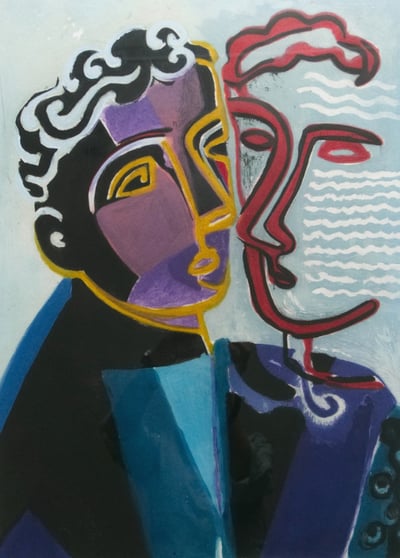
Francesco Clemente's I (Met.pg., 50) (1982) is a vibrant woodcut on Kozo paper, reflecting the artist's interest in exploring the human face and emotional expression. The portrait features a figure with vividly colored facial accents—red, green, and blue—set against a soft, warm-toned background. The subject's intense gaze and abstracted features draw the viewer in, creating a sense of introspection and emotional complexity. The bold use of color, particularly in the warm yellows surrounding the face, contrasts with the more muted background, emphasizing the figure’s presence. Clemente’s work often focuses on themes of identity and transformation, and this piece exemplifies his exploration of the human psyche through expressive portraiture.
Artwork Copyright © Francesco ClementeFrancesco Clemente (Italy, 1952) is a leading contemporary artist associated with the Transavanguardia movement. His works, characterized by vivid colors and dreamlike imagery, explore themes of identity, spirituality, and the human experience. Drawing from diverse influences, including Indian mysticism and Italian fresco traditions, Clemente’s art is celebrated worldwide.
Artwork Copyright © Francesco ClementeI (Met.pg., 50), 1982
Form
Medium
Size
- Inches
- Centimeters
Edition
Price
Available works →
- Authenticity Guaranteed
- Insured Shipping
- Online Since 2005
●
●Inventory 13442
●Signed
●Comes with gallery invoice and certificate
●Sell Us a Similar Artwork. Learn more.
Woodcut in colors on Kozo paper
- Signed and numbered
- Published / Printed by Crown Point Press, San Francisco / Shi-un-do Print Shop, Kyoto
Francesco Clemente's I (Met.pg., 50) (1982) is a vibrant woodcut on Kozo paper, reflecting the artist's interest in exploring the human face and emotional expression. The portrait features a figure with vividly colored facial accents—red, green, and blue—set against a soft, warm-toned background. The subject's intense gaze and abstracted features draw the viewer in, creating a sense of introspection and emotional complexity. The bold use of color, particularly in the warm yellows surrounding the face, contrasts with the more muted background, emphasizing the figure’s presence. Clemente’s work often focuses on themes of identity and transformation, and this piece exemplifies his exploration of the human psyche through expressive portraiture.
Artwork Copyright © Francesco ClementeFrancesco Clemente (Italy, 1952) is a leading contemporary artist associated with the Transavanguardia movement. His works, characterized by vivid colors and dreamlike imagery, explore themes of identity, spirituality, and the human experience. Drawing from diverse influences, including Indian mysticism and Italian fresco traditions, Clemente’s art is celebrated worldwide.
Artwork Copyright © Francesco Clemente- Recently Added
- Price (Low-High)
- Price (High-Low)
- Year (Low-High)
- Year (High-Low)

Francesco Clemente
Untitled Self Portrait, 1993
Limited Edition Print
Inkjet print
USD 4,650

Francesco Clemente
Reconciliazione, 1986
Limited Edition Print
Mixed Media
Currently Not Available
Available works by Francesco Clemente
See all →Francesco Clemente
Untitled Self Portrait, 1993
Limited Edition Print
Inkjet print
USD 4,650
Related Artists


Artwork by Alex Katz
What is figurative art?
Sometimes known as Figurativism, figurative art refers to sculptures and paintings that are clearly or specifically derived from real objects, making them representational. The term figurative art is often used in contrast to abstract art. However, since the emergence of abstract art, figurative art has come to describe any form of modern art that has strong references to the real world or actual situations.


