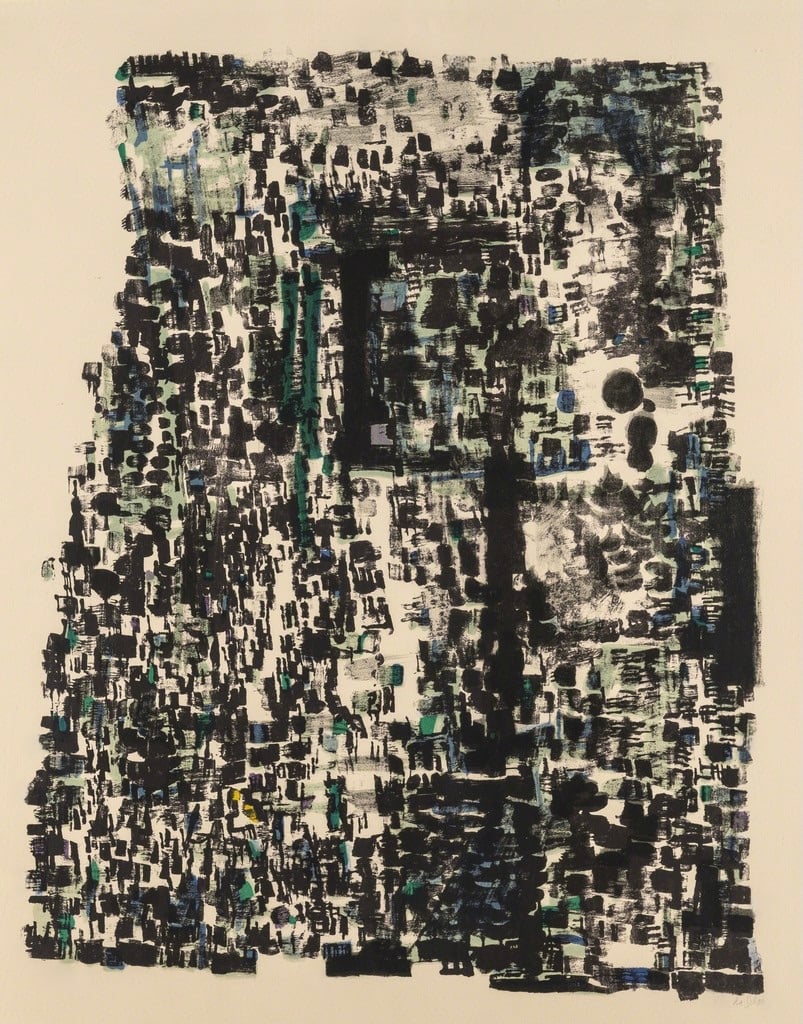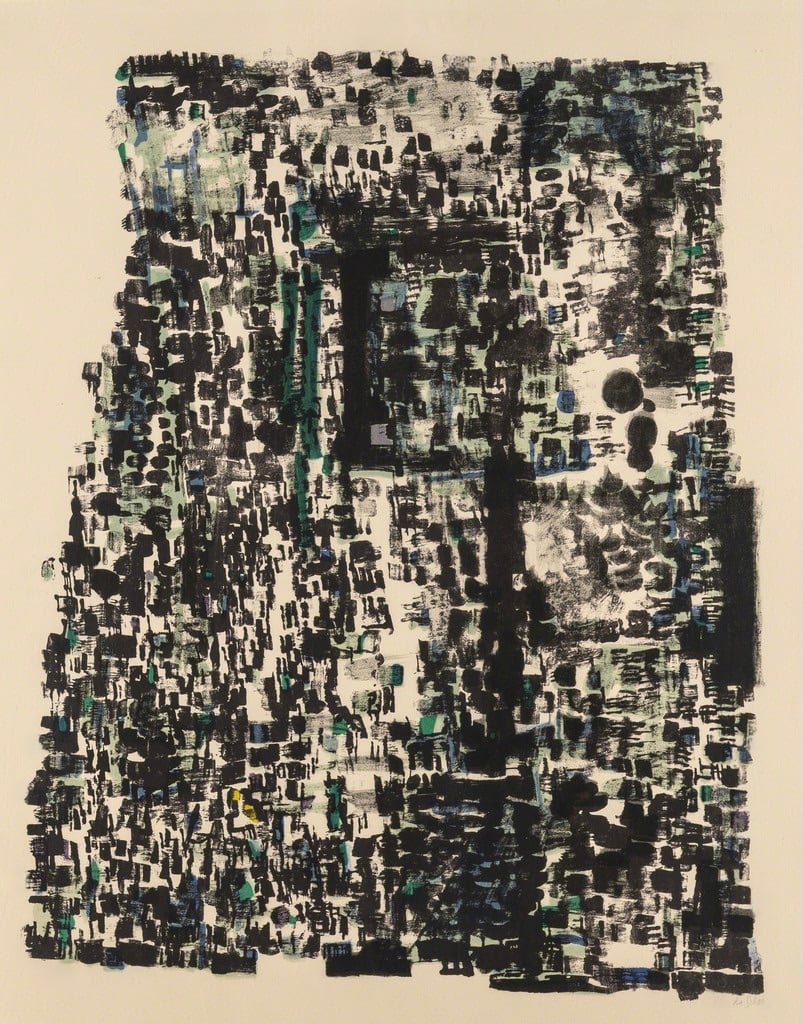
Helena Vieira da Silva's Grottes is a captivating lithograph from 1971, created in her characteristic abstract and textural style. The piece is printed in colors on Arches paper, utilizing a palette dominated by deep blacks, greens, and subtle hints of blue and yellow. The composition evokes the complexity and depth of a dense, maze-like space, resembling caves or architectural structures, consistent with Vieira da Silva’s fascination with labyrinthine environments. The layering and overlapping of brushstrokes create a sense of movement and spatial ambiguity, inviting viewers to explore the intricate details within the piece. This limited edition print, measuring 76 x 56 cm, is an exceptional example of Vieira da Silva's exploration of space and perspective, capturing the viewer’s attention through its depth and dynamism.
Helena Vieira da Silva (Portugal, 1908–1992) was a prominent abstract painter associated with lyrical abstraction. Her dense, labyrinthine compositions often evoke architectural spaces and shifting perspectives. Based in Paris, she fused geometric structures with poetic ambiguity, establishing herself as a major figure in 20th-century European art.
Lithograph Lithography is a printing method based on the principle that water and oil do not mix. It can be used to print artwork or text onto paper or other suitable materials. Traditionally, an image was drawn with wax, fat, or oil onto a lithographic limestone surface or plate. Today, metal plates and other surfaces are also used in lithographic printing.
Helena Vieira da Silva's Grottes is a captivating lithograph from 1971, created in her characteristic abstract and textural style. The piece is printed in colors on Arches paper, utilizing a palette dominated by deep blacks, greens, and subtle hints of blue and yellow. The composition evokes the complexity and depth of a dense, maze-like space, resembling caves or architectural structures, consistent with Vieira da Silva’s fascination with labyrinthine environments. The layering and overlapping of brushstrokes create a sense of movement and spatial ambiguity, inviting viewers to explore the intricate details within the piece. This limited edition print, measuring 76 x 56 cm, is an exceptional example of Vieira da Silva's exploration of space and perspective, capturing the viewer’s attention through its depth and dynamism.
Helena Vieira da Silva (Portugal, 1908–1992) was a prominent abstract painter associated with lyrical abstraction. Her dense, labyrinthine compositions often evoke architectural spaces and shifting perspectives. Based in Paris, she fused geometric structures with poetic ambiguity, establishing herself as a major figure in 20th-century European art.
When I paint a landscape or a seascape, I’m not very sure it’s a landscape or a seascape. It’s a thought form rather than a realistic form.
- Helena Vieira da Silva
Helena Vieira da Silva (b. 1908 Portugal, d. 1992 France) was a Portuguese-French painter and one of the most prominent figures in thelyrical abstractionmovement. Her work is characterized by intricate, maze-like compositions that explore space, movement, and perception. Vieira da Silva's paintings often feature dense networks of lines and forms, creating a sense of depth and rhythm that invites viewers into a complex, almost architectural world. Influenced by Cubism and Abstract Expressionism, her art reflects a deep engagement with the dynamics of space and structure. Throughout her career, Vieira da Silva received widespread recognition, and her works are held in major collections around the world, including the Musée National d'Art Moderne in Paris and the Tate Modern in London.
Abstract art uses form, shape, line, and color to create a visual experience without attempting to represent external reality. The composition exists independently of the world's visual references, focusing on expressing ideas and emotions through non-representational means.