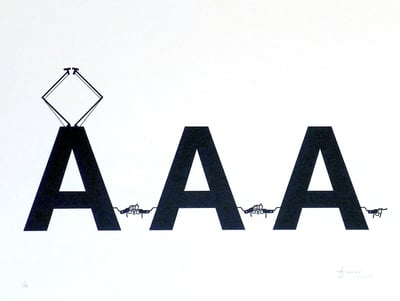
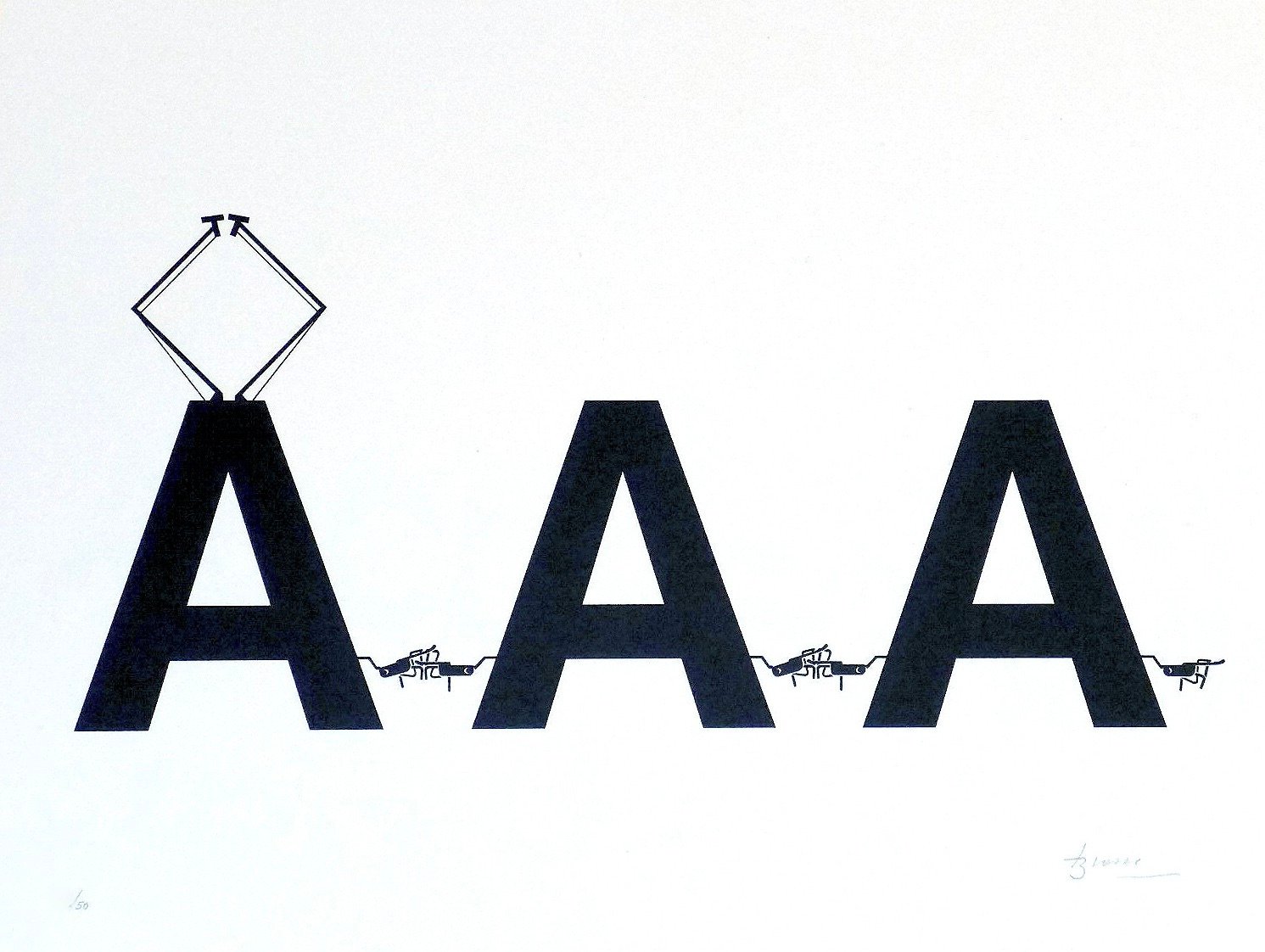
// Joan Brossa's Comboi (1989) is a witty and playful lithograph that uses typographic elements to convey a visual narrative. The image consists of three large, bold As, each linked by tiny hand-drawn hands pointing at each other, while a small abstract figure stands atop the first A. The minimalist design and use of type as imagery are signature elements of Brossa's work in visual poetry, where language and image converge. This piece suggests ideas of connection, direction, and perhaps a critique of conformity, as the letters form a uniform line that emphasizes structure and unity, while the pointing hands add a layer of interaction and humor.
Joan Brossa (Spain, 1919–1998) was a Catalan poet, visual artist, and playwright known for his innovative fusion of language and imagery. A pioneer of visual poetry and a key figure in avant-garde art, Brossa’s work encompassed theater, installation, and concrete poetry, exploring themes of identity, politics, and cultural heritage.
LithographLithography is a printing method based on the principle that water and oil do not mix. It can be used to print artwork or text onto paper or other suitable materials. Traditionally, an image was drawn with wax, fat, or oil onto a lithographic limestone surface or plate. Today, metal plates and other surfaces are also used in lithographic printing.
Size
Inches
Centimeters
38 X 50 cm
Edition
Edition of 50
Price
USD
EUR
GBP
CHF
1,000EUR
?
+ VAT/import Duties (if applicable)
Authenticity Guaranteed
Insured Shipping
Online Since 2005
Share
●Inventory 2788
●Signed
●Comes with gallery invoice and certificate
●Any questions?
// Joan Brossa's Comboi (1989) is a witty and playful lithograph that uses typographic elements to convey a visual narrative. The image consists of three large, bold As, each linked by tiny hand-drawn hands pointing at each other, while a small abstract figure stands atop the first A. The minimalist design and use of type as imagery are signature elements of Brossa's work in visual poetry, where language and image converge. This piece suggests ideas of connection, direction, and perhaps a critique of conformity, as the letters form a uniform line that emphasizes structure and unity, while the pointing hands add a layer of interaction and humor.
Joan Brossa (Spain, 1919–1998) was a Catalan poet, visual artist, and playwright known for his innovative fusion of language and imagery. A pioneer of visual poetry and a key figure in avant-garde art, Brossa’s work encompassed theater, installation, and concrete poetry, exploring themes of identity, politics, and cultural heritage.
These verses, like a score, are nothing but a group of signs to decipher. The reader of the poem is an executor.
- Joan Brossa
Spanish artist Joan Brossa was an artist known for works that combined poetry and visual art. He was also known to dabble in graphic design and on occasion would act as playwright from time to time. Typically considered a Dada artist, Brossa was also known for producing works that were more of a surrealist or futurist persuasion while often playing with comical or cynical flavors at the same time. Brossa's main goal with most of his work was to find a way to fuse Catalan poetry with visual art, making his pieces often referred to as "poem objects." One of Joan Brossa's earliest claims to fame is the founding of the art movement Dau al Set which translates to "the seventh face of the die" in 1948, which was later accompanied with a magazine of the same name. The avant-garde movement involved other artists such as Juan Eduardo Cirlot, Antoni Tapies and Modest Cuixart. Their goal was to emphasize the important influences that both the conscious and unconscious can have on art, as well acting as opponents to the restriction of formal art forms and movements. Much of Joan Brossa's two dimensional visual art involved playing with letters and their appearances or incorporating words into some kind of imagery. Sculptures often toyed with the appearance of letters and how they form a word, or by heavily altering normal objects and obscuring their original intended purpose. One famous piece of public work is Barcino (the ancient Roman spelling of Barcelona, where Joan Brossa was based) is located outside the Cathedral of Barcelona and consists of quirky depictions of letters to spell out Barcino. He also is responsible for the work Lying A with a fish which is on the outside of city hall of Mollet del Valles, which portrays a giant red A lying on its side. (Artist website)
Avant-garde refers to innovative and experimental ideas in the arts that challenge established norms and conventions. Originating from the French term for advance guard, it describes both the movement and the artists who push the boundaries of creativity, often exploring new techniques, forms, and concepts. The avant-garde has been a driving force in various art movements throughout history, such as Dadaism, Surrealism, and Abstract Expressionism, continually reshaping the landscape of art and culture.