Lithograph on paper
- Published by Brooke Alexander Editions
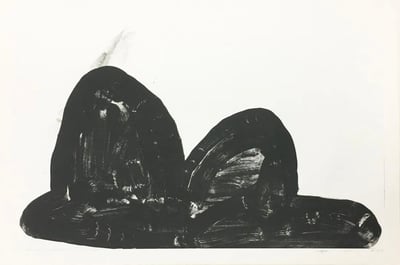
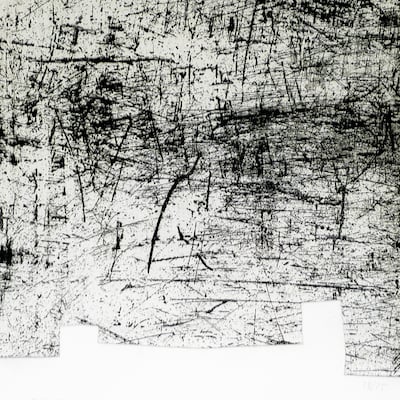
Joel Shapiro’s Untitled (1) (1979) is a lithograph that explores the potential of abstract form through expressive brushwork and monochromatic contrast. The central shape, bold and organic, is rendered in thick black strokes, creating a dynamic, almost sculptural presence against a soft gray background. The sweeping lines and layered textures evoke a sense of motion and weight, embodying Shapiro’s interest in the tension between form and emptiness. This minimalist composition, published by Brooke Alexander Editions, demonstrates Shapiro’s focus on abstraction, where the interplay of positive and negative space becomes central to the viewer's experience. Measuring 37 x 42 cm, this lithograph was produced in a limited edition of 30, with 10 additional artist proofs.
Joel Shapiro (United States, 1941) is a sculptor renowned for his dynamic works composed of simple rectangular shapes. His art, often classified as Minimalist, explores the relationship between form and space, creating pieces that convey movement and balance. Shapiro's sculptures are featured in major international collections, including the Museum of Modern Art in New York and the Tate Gallery in London.
Lithograph Lithography is a printing method based on the principle that water and oil do not mix. It can be used to print artwork or text onto paper or other suitable materials. Traditionally, an image was drawn with wax, fat, or oil onto a lithographic limestone surface or plate. Today, metal plates and other surfaces are also used in lithographic printing.
Lithograph on paper
- Published by Brooke Alexander Editions
Joel Shapiro’s Untitled (1) (1979) is a lithograph that explores the potential of abstract form through expressive brushwork and monochromatic contrast. The central shape, bold and organic, is rendered in thick black strokes, creating a dynamic, almost sculptural presence against a soft gray background. The sweeping lines and layered textures evoke a sense of motion and weight, embodying Shapiro’s interest in the tension between form and emptiness. This minimalist composition, published by Brooke Alexander Editions, demonstrates Shapiro’s focus on abstraction, where the interplay of positive and negative space becomes central to the viewer's experience. Measuring 37 x 42 cm, this lithograph was produced in a limited edition of 30, with 10 additional artist proofs.
Joel Shapiro (United States, 1941) is a sculptor renowned for his dynamic works composed of simple rectangular shapes. His art, often classified as Minimalist, explores the relationship between form and space, creating pieces that convey movement and balance. Shapiro's sculptures are featured in major international collections, including the Museum of Modern Art in New York and the Tate Gallery in London.
I was apprehensive at first, but looking back at the complete body of work has been a positive experience.
- Joel Shapiro
Joel Shapiro, the contemporary New York born sculptor, has spent several decades in developing a career which is notable for his unique understanding of space, shape and colour. His concepts embodied in numerous small or large-scale creations, have awakened the artistic world to the power of dynamic displays, many of which are kept in prized museum collections or are exhibited proudly around the work.
Loved as an artwork creator and respected as an innovator, Joel Shapiro, had experimented with bronze as well as with natural or painted wood in bold and imaginative way, producing the distinctively angular shapes of his sculptures and crafting their instantly recognizable look - simultaneously raw-boned and energetic.
Joel Shapiro’s installations – unframed, in natural or bright colors, are sometimes positioned off the surface of the floors or walls, configured in a way that projects them in the air vigorously and with a confident sense of movement. Shapiro plays with the simplicity of geometric outlines to create his imagery of figures balanced on their edges, almost never firmly attached to the ground. One of his Joel Shapiro’s famous works, Loss and Regeneration, a two-part bronze installation in the US Holocaust Memorial Museum, communicates powerfully the destruction of family lives via the cubic form of a house turned almost upside down on its roof. A tall, soaring figure positioned some distance away from the house connects the image of fall with one of rebirth – a formidable sculptural dialogue in the visual style Shapiro has developed and mastered so perfectly.
Abstract art uses form, shape, line, and color to create a visual experience without attempting to represent external reality. The composition exists independently of the world's visual references, focusing on expressing ideas and emotions through non-representational means.