


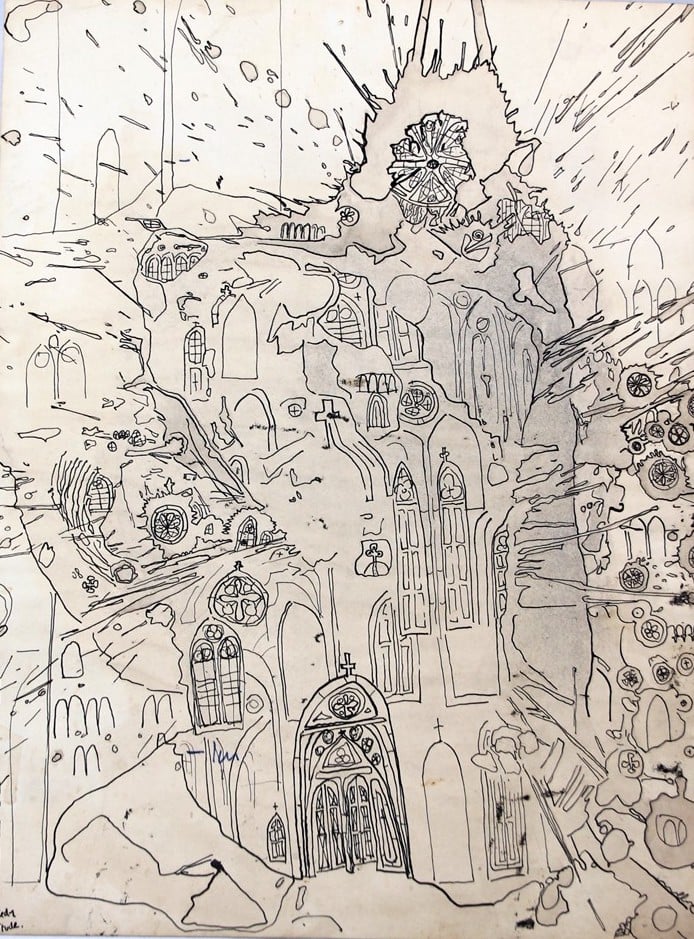
// Étude by John Armleder is a detailed ink drawing from 1966 that immerses viewers in a labyrinthine structure filled with intricate architectural elements. The artwork features a complex arrangement of Gothic-inspired windows, arches, and ornate details, giving it a surreal, cathedral-like atmosphere. Lines converge and diverge, guiding the eye through a fragmented and dynamic space that appears both familiar and otherworldly. The piece reflects Armleder's early exploration of form and structure, emphasizing the meticulous line work that suggests both architectural precision and a dream-like disintegration. This study in black ink combines meticulous detail with abstract spatial layering, inviting contemplation of structure, decay, and transformation.
Artwork Copyright © John ArmlederJohn Armleder (Switzerland, 1948) is a versatile artist known for blending painting, sculpture, and installation in his conceptual and aesthetic explorations. A member of the Fluxus movement, his work often merges art and life, drawing on influences like Minimalism and Pop Art. Armleder’s distinctive style and eclectic approach have cemented his legacy in contemporary art.
Artwork Copyright © John ArmlederÉtude, 1966
Form
Medium
Size
- Inches
- Centimeters
Edition
Price
- USD
- EUR
- GBP
- CHF
- Authenticity Guaranteed
- Insured Shipping
- Online Since 2005
●Inventory 7031
●Hand Signed
●Comes with gallery invoice and certificate
●Any questions?
// Étude by John Armleder is a detailed ink drawing from 1966 that immerses viewers in a labyrinthine structure filled with intricate architectural elements. The artwork features a complex arrangement of Gothic-inspired windows, arches, and ornate details, giving it a surreal, cathedral-like atmosphere. Lines converge and diverge, guiding the eye through a fragmented and dynamic space that appears both familiar and otherworldly. The piece reflects Armleder's early exploration of form and structure, emphasizing the meticulous line work that suggests both architectural precision and a dream-like disintegration. This study in black ink combines meticulous detail with abstract spatial layering, inviting contemplation of structure, decay, and transformation.
Artwork Copyright © John ArmlederJohn Armleder (Switzerland, 1948) is a versatile artist known for blending painting, sculpture, and installation in his conceptual and aesthetic explorations. A member of the Fluxus movement, his work often merges art and life, drawing on influences like Minimalism and Pop Art. Armleder’s distinctive style and eclectic approach have cemented his legacy in contemporary art.
Artwork Copyright © John Armleder- Recently Added
- Price (Low-High)
- Price (High-Low)
- Year (Low-High)
- Year (High-Low)

John Armleder
Gold Fish, 2016
Tapestry
Tapestry
EUR 1,400

John Armleder
Silver Fish, 2016
Tapestry
Tapestry
EUR 1,400

John Armleder
Étude, 1966
Drawing / Watercolor
Ink
EUR 4,000
Related Artists



Artwork by Agnes Martin
What is minimalism?
Minimalism is a style in music and visual arts characterized by pared-down designs and simplicity. It began in Western art after World War II, gaining prominence particularly in American visual arts. Minimalism draws heavily on aspects of modernism and is often viewed as a reaction against Abstract Expressionism, as well as a precursor to post-minimal art practices. Prominent minimalist artists include Agnes Martin, Donald Judd, Robert Morris, Frank Stella, and Dan Flavin.

John Armleder
Étude, 1966
32 x 24 cm


