

// The Book of Landscapes I by Juan Uslé, created in 1987, is a mixed media work combining drawing and watercolor, measuring 43.2 x 28 cm. The piece showcases a worn, parchment-like paper with handwritten notations and a dark, inky form at its center. The delicate, almost fragile quality of the material, paired with the abstract and gestural nature of the ink mark, evokes a sense of nostalgia and introspection. Uslé's work often explores themes of memory and time, and this piece reflects those interests by merging textual elements with expressive, painterly forms, inviting the viewer into a contemplative space.
Artwork Copyright © Juan UsleJuan Uslé (Spain, 1954) is a contemporary painter known for his abstract works that blend rhythmic patterns with vibrant colors. His series 'Soñé que revelabas' reflects his nocturnal painting sessions, capturing the pulse of his heartbeat. Uslé divides his time between New York and Saro, Cantabria, infusing his art with diverse cultural influences.
Artwork Copyright © Juan UsleThe Book of Landscapes I, 1987
Form
Medium
Size
- Inches
- Centimeters
Edition
Price
- Authenticity Guaranteed
- Insured Shipping
- Online Since 2005
●Inventory 9814
●Signed
●Comes with gallery invoice and certificate
●Sell Us a Similar Artwork. Learn more.
// The Book of Landscapes I by Juan Uslé, created in 1987, is a mixed media work combining drawing and watercolor, measuring 43.2 x 28 cm. The piece showcases a worn, parchment-like paper with handwritten notations and a dark, inky form at its center. The delicate, almost fragile quality of the material, paired with the abstract and gestural nature of the ink mark, evokes a sense of nostalgia and introspection. Uslé's work often explores themes of memory and time, and this piece reflects those interests by merging textual elements with expressive, painterly forms, inviting the viewer into a contemplative space.
Artwork Copyright © Juan UsleJuan Uslé (Spain, 1954) is a contemporary painter known for his abstract works that blend rhythmic patterns with vibrant colors. His series 'Soñé que revelabas' reflects his nocturnal painting sessions, capturing the pulse of his heartbeat. Uslé divides his time between New York and Saro, Cantabria, infusing his art with diverse cultural influences.
Artwork Copyright © Juan Usle- Recently Added
- Price (Low-High)
- Price (High-Low)
- Year (Low-High)
- Year (High-Low)

Juan Usle
The Book of Landscapes II, 1987
Drawing / Watercolor
Mixed Media
Inquire For Price

Juan Usle
The Book of Landscapes I, 1987
Drawing / Watercolor
Mixed Media
Inquire For Price
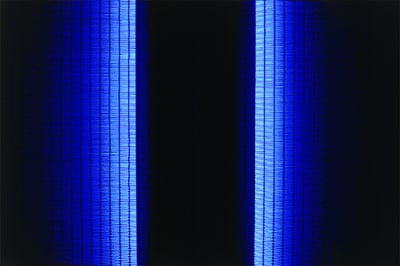
Juan Usle
Umbral -Dusseldörf, 2001
Photography
Mixed Media
Currently Not Available
Related Artists

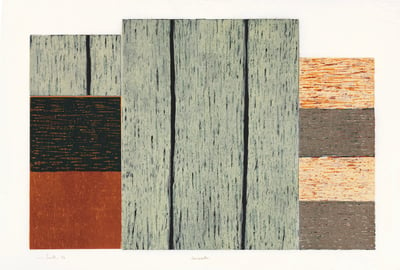

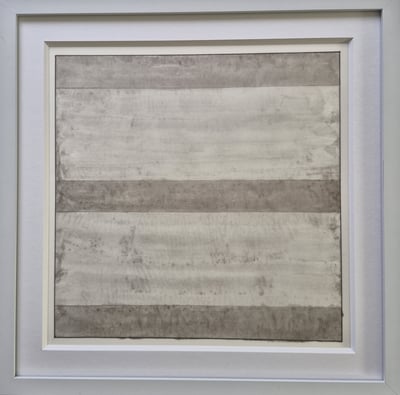
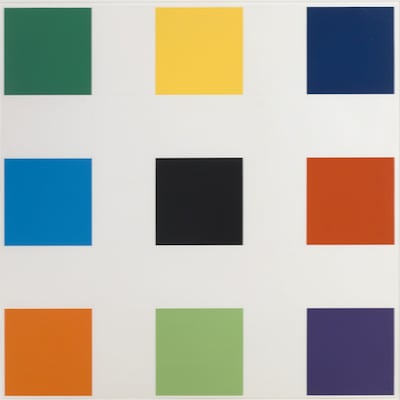
Artwork by Ellsworth Kelly
What is Hard Edge Art?
Hard Edge art is a style of abstract painting that became popular in the 1960s. It features areas of color separated by crisp, sharp edges that are painted with geometric precision. The term hard-edge painting was coined by art critic Jules Langsner to describe this approach, which contrasts with the softer, more fluid forms of other abstract styles.

Juan Usle
The Book of Landscapes I, 1987
43.2 x 28 cm


