

drawing on paper
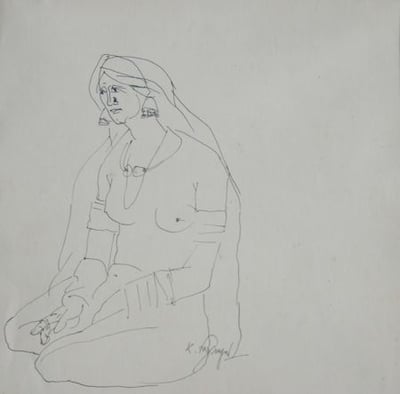
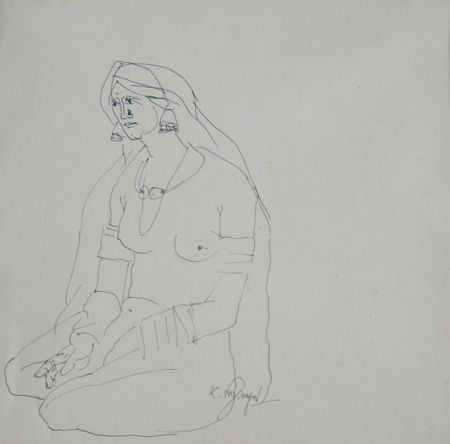
This untitled drawing by Laxma Goud, created around the 1970s, captures a seated woman in a traditional Indian posture with minimalistic and expressive line work. The artist uses simple yet evocative lines to depict the woman’s form, adorned with jewelry such as earrings and a necklace, along with traditional attire that includes a veil over her head. Goud’s style here is marked by his sensitivity to rural Indian life and the beauty of indigenous features, emphasizing a natural, unembellished representation of femininity. The gentle, introspective pose of the figure invites viewers to connect with her quiet dignity and cultural rootedness. Goud’s work frequently explores themes of identity and tradition, and this piece encapsulates his talent for evoking character through subtle line work and minimal detail.
Artwork Copyright © Laxma GoudK. Laxma Goud (India, 1940) is an Indian painter, printmaker, and draughtsman celebrated for his depictions of rural life and exploration of human sexuality. Working across mediums like etching, gouache, pastel, sculpture, and glass painting, he blends traditional and contemporary styles. Goud's art often portrays the vibrancy and eroticism inherent in village culture, challenging societal norms.
Artwork Copyright © Laxma GoudUntitled (lady), +- 1970
Form
Medium
Size
- Inches
- Centimeters
Edition
Price
- USD
- EUR
- GBP
- CHF
- Authenticity Guaranteed
- Insured Shipping
- Online Since 2005
●Inventory 1425
●Signed
●Comes with gallery invoice and certificate
●Any questions?
drawing on paper
This untitled drawing by Laxma Goud, created around the 1970s, captures a seated woman in a traditional Indian posture with minimalistic and expressive line work. The artist uses simple yet evocative lines to depict the woman’s form, adorned with jewelry such as earrings and a necklace, along with traditional attire that includes a veil over her head. Goud’s style here is marked by his sensitivity to rural Indian life and the beauty of indigenous features, emphasizing a natural, unembellished representation of femininity. The gentle, introspective pose of the figure invites viewers to connect with her quiet dignity and cultural rootedness. Goud’s work frequently explores themes of identity and tradition, and this piece encapsulates his talent for evoking character through subtle line work and minimal detail.
Artwork Copyright © Laxma GoudK. Laxma Goud (India, 1940) is an Indian painter, printmaker, and draughtsman celebrated for his depictions of rural life and exploration of human sexuality. Working across mediums like etching, gouache, pastel, sculpture, and glass painting, he blends traditional and contemporary styles. Goud's art often portrays the vibrancy and eroticism inherent in village culture, challenging societal norms.
Artwork Copyright © Laxma Goud- Recently Added
- Price (Low-High)
- Price (High-Low)
- Year (Low-High)
- Year (High-Low)
Laxma Goud
Untitled (lady), +- 1970
Drawing / Watercolor
Mixed Media
USD 2,500
Laxma Goud
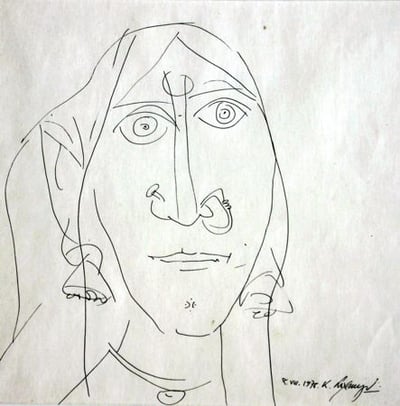
Lady, 1976
Drawing / Watercolor
East Indian ink
EUR 3,000
Related Artists

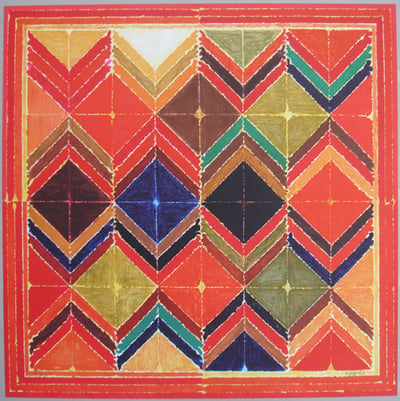

Artwork by SH Raza
What is Contemporary art from India?
Contemporary art from India dates from 1985 to the present, marking the post-liberalization era. During this period, artists have felt free to create independently of traditional Hindu or social conventions. They often incorporate distinctly Indian materials and objects in their work, reflecting a blend of modern ideas and cultural heritage.
Laxma Goud
Untitled (lady), +- 1970
24 x 24 cm


