

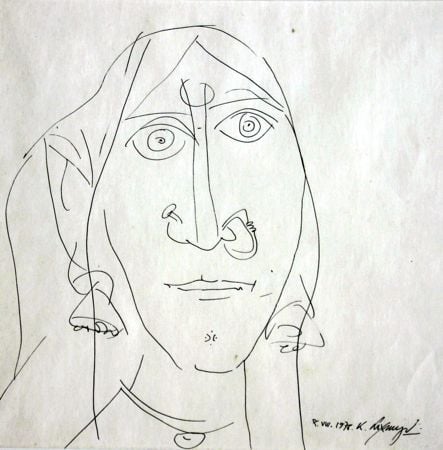
// Lady by Laxma Goud, created in 1976, is a delicate ink drawing that captures the essence of traditional Indian aesthetics through minimalist lines. Using East Indian ink, Goud portrays a woman's face with exaggerated features such as large, expressive eyes, a prominent nose, and distinct traditional jewelry, including earrings and a nose ring. The simple, fluid line work highlights Goud’s skill in conveying personality and emotion with minimal detail. This portrait reflects his exploration of rural Indian identity and the beauty of indigenous features, emphasizing a raw, unfiltered representation of femininity. Goud’s work often examines cultural roots, combining sensitivity with a modern, abstract approach that invites viewers to appreciate both individual and cultural identity.
Artwork Copyright © Laxma GoudK. Laxma Goud (India, 1940) is an Indian painter, printmaker, and draughtsman celebrated for his depictions of rural life and exploration of human sexuality. Working across mediums like etching, gouache, pastel, sculpture, and glass painting, he blends traditional and contemporary styles. Goud's art often portrays the vibrancy and eroticism inherent in village culture, challenging societal norms.
Artwork Copyright © Laxma GoudLady, 1976
Form
Medium
Size
- Inches
- Centimeters
Edition
Price
- USD
- EUR
- GBP
- CHF
- Authenticity Guaranteed
- Insured Shipping
- Online Since 2005
●Inventory 1418
●Signed
●Comes with gallery invoice and certificate
●Any questions?
// Lady by Laxma Goud, created in 1976, is a delicate ink drawing that captures the essence of traditional Indian aesthetics through minimalist lines. Using East Indian ink, Goud portrays a woman's face with exaggerated features such as large, expressive eyes, a prominent nose, and distinct traditional jewelry, including earrings and a nose ring. The simple, fluid line work highlights Goud’s skill in conveying personality and emotion with minimal detail. This portrait reflects his exploration of rural Indian identity and the beauty of indigenous features, emphasizing a raw, unfiltered representation of femininity. Goud’s work often examines cultural roots, combining sensitivity with a modern, abstract approach that invites viewers to appreciate both individual and cultural identity.
Artwork Copyright © Laxma GoudK. Laxma Goud (India, 1940) is an Indian painter, printmaker, and draughtsman celebrated for his depictions of rural life and exploration of human sexuality. Working across mediums like etching, gouache, pastel, sculpture, and glass painting, he blends traditional and contemporary styles. Goud's art often portrays the vibrancy and eroticism inherent in village culture, challenging societal norms.
Artwork Copyright © Laxma Goud- Recently Added
- Price (Low-High)
- Price (High-Low)
- Year (Low-High)
- Year (High-Low)
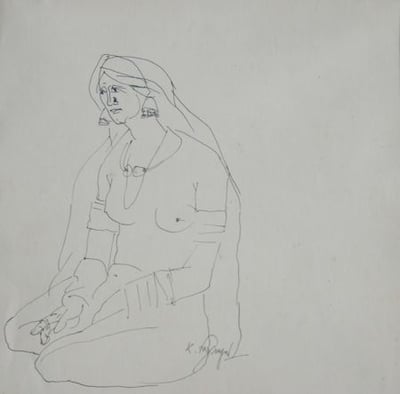
Laxma Goud
Untitled (lady), +- 1970
Drawing / Watercolor
Mixed Media
USD 2,500
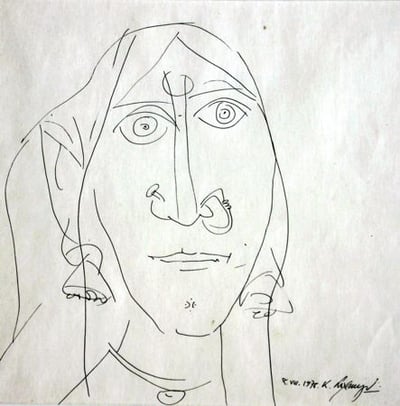
Laxma Goud
Lady, 1976
Drawing / Watercolor
East Indian ink
EUR 3,000
Related Artists



Artwork by Miles Aldridge
What is contemporary art?
Contemporary art refers to avant-garde or innovative art created in the recent past or present day. The exact starting point of contemporary art varies depending on the institution, often tied to the founding year of museums or galleries that showcase the style. Contemporary art is characterized by its focus on current ideas, diverse media, and the exploration of new concepts and techniques.

Laxma Goud
Lady, 1976
24 x 24 cm


