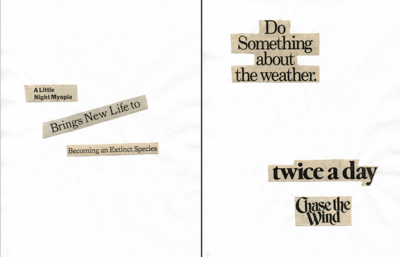
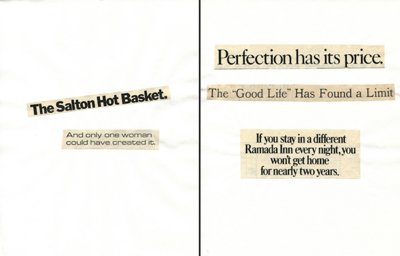
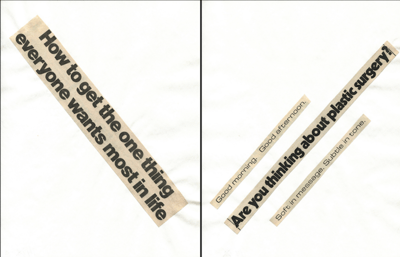
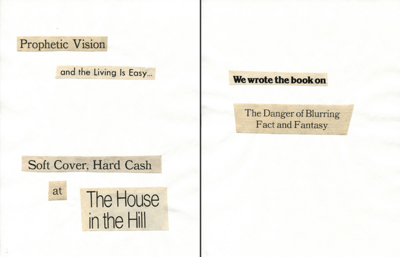
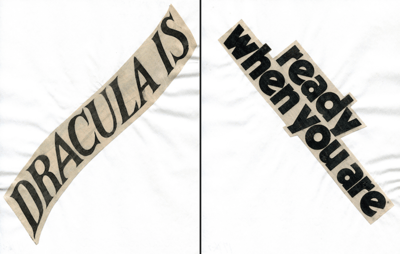
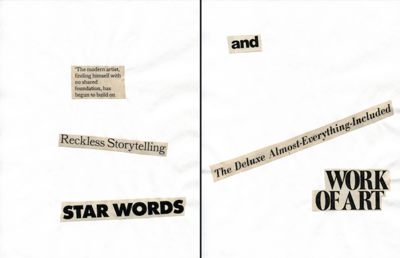
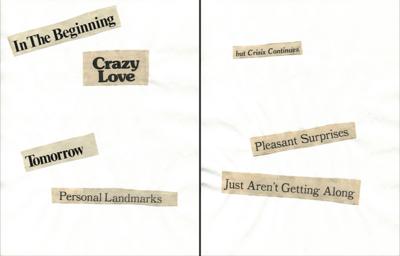
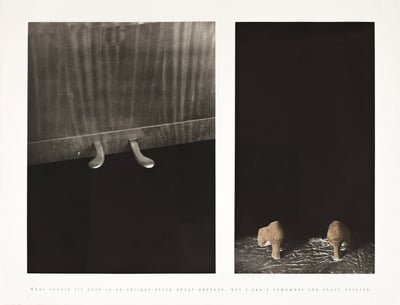
Letterpress printing dipthych on Japanese paper, cut-out, collage on laid paper, each sheet hand signed, numbered and dated by the artist.
Cutting Out CONYT 5 by Lorraine O'Grady is a mixed-media diptych created from 1977 to 2017. This limited edition print (12 + 1 AP) utilizes letterpress printing on delicate Japanese paper, with each piece featuring hand-cut collaged text fragments arranged on laid paper. The selected text snippets, such as How to get the one thing everyone wants most in life and Are you thinking about plastic surgery? offer a thought-provoking reflection on societal expectations, desires, and the subtle ways in which messaging shapes perception. The sparse arrangement of phrases and the minimalistic aesthetic allow each statement to resonate individually, amplifying the underlying commentary on consumerism and self-image.
Lorraine O'Grady (United States, 1934) is a conceptual and performance artist whose work examines Black female identity and cultural hybridity. Notable for her performance persona Mlle Bourgeoise Noire, she critiques racial and gender exclusion in the art world. O'Grady's influential pieces have been featured in major exhibitions, including a 2021 retrospective at the Brooklyn Museum.
Mixed MediaMixed media refers to artwork that incorporates more than one medium within a single piece. Unlike multimedia art, which combines distinct forms of visual art and often includes elements like sound, video, or digital media, mixed media focuses on combining traditional art materials, such as paint, ink, and collage. Mixed media art allows artists to achieve a wide range of effects and textures by layering and blending different materials.
Letterpress printing dipthych on Japanese paper, cut-out, collage on laid paper, each sheet hand signed, numbered and dated by the artist.
Cutting Out CONYT 5 by Lorraine O'Grady is a mixed-media diptych created from 1977 to 2017. This limited edition print (12 + 1 AP) utilizes letterpress printing on delicate Japanese paper, with each piece featuring hand-cut collaged text fragments arranged on laid paper. The selected text snippets, such as How to get the one thing everyone wants most in life and Are you thinking about plastic surgery? offer a thought-provoking reflection on societal expectations, desires, and the subtle ways in which messaging shapes perception. The sparse arrangement of phrases and the minimalistic aesthetic allow each statement to resonate individually, amplifying the underlying commentary on consumerism and self-image.
Lorraine O'Grady (United States, 1934) is a conceptual and performance artist whose work examines Black female identity and cultural hybridity. Notable for her performance persona Mlle Bourgeoise Noire, she critiques racial and gender exclusion in the art world. O'Grady's influential pieces have been featured in major exhibitions, including a 2021 retrospective at the Brooklyn Museum.
To name ourselves rather than be named we must first see ourselves.
- Lorraine O'Grady
Lorraine O'Grady (b. 1934 USA) is an influential American conceptual artist and critic known for her pioneering work that addresses issues of race, gender, and identity. O'Grady's practice spans performance, installation, and photography, and she is best known for her performances and projects that challenge the exclusion of Black women from the mainstream art world. One of her most iconic works, Mlle Bourgeoise Noire (1980–83), involved O'Grady assuming the persona of a beauty queen, dressed in a gown made of 180 pairs of white gloves, to critique racism and sexism within the art world. Her performances often engage directly with audiences, blending activism with art to provoke dialogue and reflection on societal norms and structures. O'Grady’s work is deeply rooted in her experiences as a Black woman, and her art continues to inspire discussions about the intersections of race, gender, and power in contemporary society. She has exhibited widely and remains a significant figure in the discourse on identity and representation in art. (Artist website)
Feminist art refers to the art that emerged from the feminist art movement during the 1960s and 1970s. It developed with the intention of critiquing 20th-century gender ideals and challenging the traditional canon of art history. Feminist art seeks to create a dialogue between the artwork and the viewer through a feminist lens, often addressing issues of gender, identity, and social justic