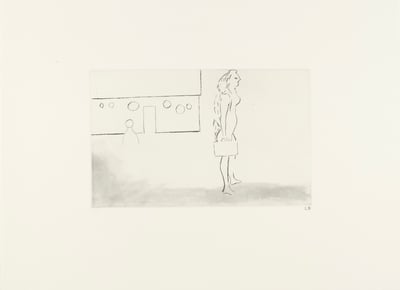
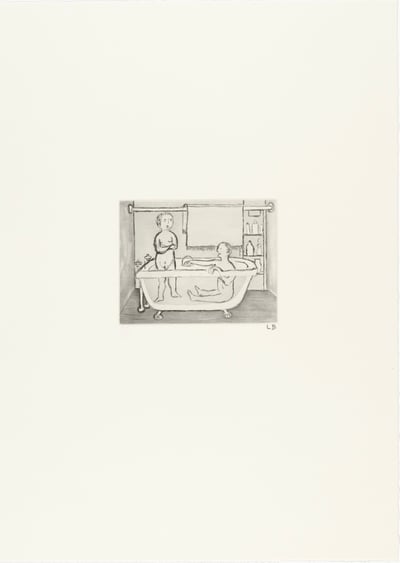
Image: 13 15/16 x 9 15/16 in (35.4 x 25.2 cm).
Sheet: 22 7/16 x 15 1/16 in (57 x 38.3 cm).
Published by Peter Blum Edition, New York
Printed by Harlan & Weaver, New York.
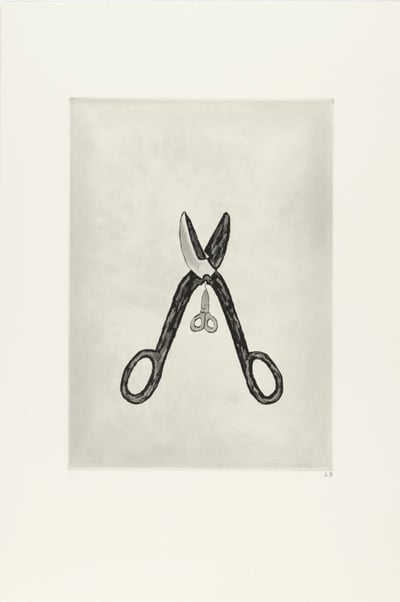
A pair of large, crossed scissors grip a smaller pair at their intersection, rendered with graphic clarity against the bare sheet. This iconic image — at once domestic tool and weapon, protective and threatening — opens Bourgeois's celebrated Autobiographical Series of 1994. The scissors motif recurs throughout her oeuvre as a symbol of severance, mending, and the complex power dynamics of family life. Published by Peter Blum Edition and printed by Harlan & Weaver, this first print in the series is among the most recognisable and collected works on paper by one of the twentieth century's towering artistic figures.
Louise Bourgeois (France/USA, 1911–2010) was a groundbreaking artist celebrated for her emotionally charged sculptures, installations, and drawings. Her works, often exploring themes of memory, identity, and family, include the iconic spider sculptures symbolizing protection and fragility. Bourgeois's legacy profoundly influenced contemporary art, especially feminist and psychoanalytic perspectives.
EtchingEtching is a technique where a design is created on a metal surface by using a strong acid or mordant to eat away the unprotected parts of the metal, leaving the desired pattern in relief (intaglio). In modern art and manufacturing, different chemicals may be used depending on the material being etched.
Image: 13 15/16 x 9 15/16 in (35.4 x 25.2 cm).
Sheet: 22 7/16 x 15 1/16 in (57 x 38.3 cm).
Published by Peter Blum Edition, New York
Printed by Harlan & Weaver, New York.
A pair of large, crossed scissors grip a smaller pair at their intersection, rendered with graphic clarity against the bare sheet. This iconic image — at once domestic tool and weapon, protective and threatening — opens Bourgeois's celebrated Autobiographical Series of 1994. The scissors motif recurs throughout her oeuvre as a symbol of severance, mending, and the complex power dynamics of family life. Published by Peter Blum Edition and printed by Harlan & Weaver, this first print in the series is among the most recognisable and collected works on paper by one of the twentieth century's towering artistic figures.
Louise Bourgeois (France/USA, 1911–2010) was a groundbreaking artist celebrated for her emotionally charged sculptures, installations, and drawings. Her works, often exploring themes of memory, identity, and family, include the iconic spider sculptures symbolizing protection and fragility. Bourgeois's legacy profoundly influenced contemporary art, especially feminist and psychoanalytic perspectives.
My art is a form of restoration in terms of my feelings to myself and to others.
- Louise Bourgeois
Louise J. Bourgeois was a French-American artist and sculptor. She was extremely influential in modern and contemporary art and she became publicly recognized as the founder of the confessional art movement.
She studied art at several reputable schools including Academie de la Grande Chaumiere, Ecole du Louvre, and Ecole des Beaux-Arts. After marrying her American husband, Robert Goldwater, and moving to New York City, Louise Bourgeois turned her focus to sculpture. During this time, her artistic creations would often exude themes of loneliness, anxiety, and betrayal.
She often used junkyard scraps and driftwood that she would then carve into upright wood sculptures. Bourgeois would cover the impurities of the wood with paint and then use nails to create holes and scratches in the piece to articulate a certain emotion. One great example of her work is a piece entitled, “Sleeping Figure”. The piece depicts a war veteran who is unable to face the real world due to vulnerability.
In 1954, Bourgeois joined the American Abstract Artists Group. Her membership in the group was the catalyst for her making the transition from wood and upright structures to marble, bronze, and plaster. Bourgeois often rejected the idea that her art was feminist, however many of her works, such as Janus Fleuri (1968) proved that she wasn’t timid about celebrating the female body or using the female form in new ways. Later in life, Bourgeois added teaching to her resume as she obtain instructional positions at the several higher education institutions, including Cooper Union and the New York Studio School of Drawing, Painting, and Sculpture. She also taught for many years in the public school system in Great Neck, Long Island. One of her most recognizable pieces is a work called “The Destruction of Father.'' (Artist website)
Feminist art refers to the art that emerged from the feminist art movement during the 1960s and 1970s. It developed with the intention of critiquing 20th-century gender ideals and challenging the traditional canon of art history. Feminist art seeks to create a dialogue between the artwork and the viewer through a feminist lens, often addressing issues of gender, identity, and social justic