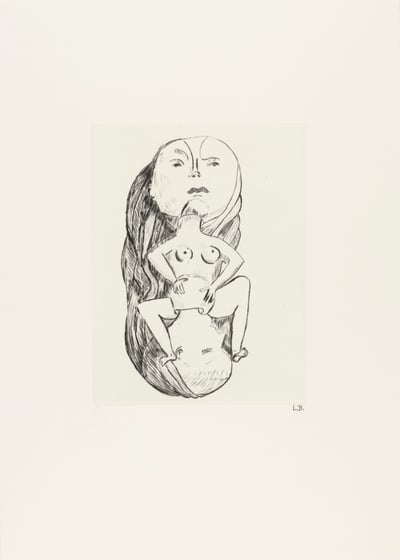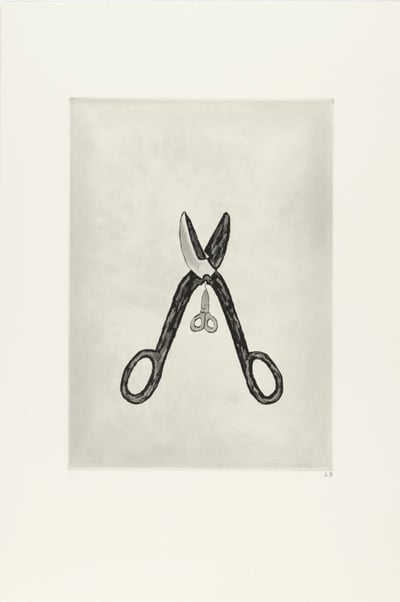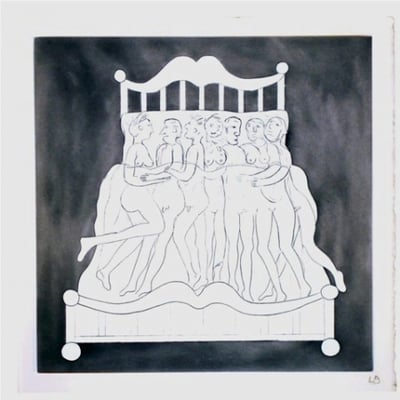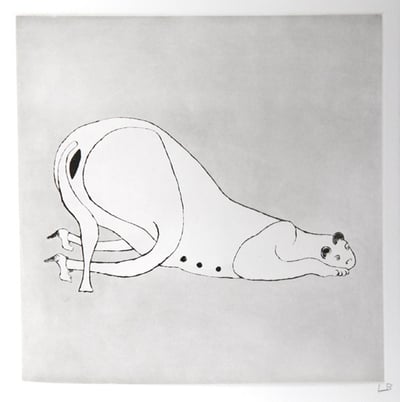
Colour lithograph on Rives wove paper.
Initialed in pencil and numbered.
Printed by SOLO Impression, Published by Artists Space, New York.
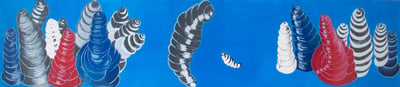
Jitterbug by Louise Bourgeois is a 1998 color lithograph printed on Rives wove paper. The composition features two elongated, spider-like figures drawn with fluid, gestural lines in red and blue. Their bodies radiate outward from small circular heads, creating a rhythmic pattern of limbs that appear to move across the sheet. Set against a background of printed musical staff lines, the figures evoke the motion of dance, suggesting the lively energy implied by the title. Bourgeois often explored themes of movement, relationships, and the human body through simplified forms. In this work, the overlapping figures create a sense of interaction and tension while maintaining a playful graphic clarity. The print was produced in an edition of 50 with additional artist’s proofs and is signed on the front.
Louise Bourgeois (France/USA, 1911–2010) was a groundbreaking artist celebrated for her emotionally charged sculptures, installations, and drawings. Her works, often exploring themes of memory, identity, and family, include the iconic spider sculptures symbolizing protection and fragility. Bourgeois's legacy profoundly influenced contemporary art, especially feminist and psychoanalytic perspectives.
Lithograph Lithography is a printing method based on the principle that water and oil do not mix. It can be used to print artwork or text onto paper or other suitable materials. Traditionally, an image was drawn with wax, fat, or oil onto a lithographic limestone surface or plate. Today, metal plates and other surfaces are also used in lithographic printing.
Colour lithograph on Rives wove paper.
Initialed in pencil and numbered.
Printed by SOLO Impression, Published by Artists Space, New York.
Jitterbug by Louise Bourgeois is a 1998 color lithograph printed on Rives wove paper. The composition features two elongated, spider-like figures drawn with fluid, gestural lines in red and blue. Their bodies radiate outward from small circular heads, creating a rhythmic pattern of limbs that appear to move across the sheet. Set against a background of printed musical staff lines, the figures evoke the motion of dance, suggesting the lively energy implied by the title. Bourgeois often explored themes of movement, relationships, and the human body through simplified forms. In this work, the overlapping figures create a sense of interaction and tension while maintaining a playful graphic clarity. The print was produced in an edition of 50 with additional artist’s proofs and is signed on the front.
Louise Bourgeois (France/USA, 1911–2010) was a groundbreaking artist celebrated for her emotionally charged sculptures, installations, and drawings. Her works, often exploring themes of memory, identity, and family, include the iconic spider sculptures symbolizing protection and fragility. Bourgeois's legacy profoundly influenced contemporary art, especially feminist and psychoanalytic perspectives.
My art is a form of restoration in terms of my feelings to myself and to others.
- Louise Bourgeois
Louise J. Bourgeois was a French-American artist and sculptor. She was extremely influential in modern and contemporary art and she became publicly recognized as the founder of the confessional art movement.
She studied art at several reputable schools including Academie de la Grande Chaumiere, Ecole du Louvre, and Ecole des Beaux-Arts. After marrying her American husband, Robert Goldwater, and moving to New York City, Louise Bourgeois turned her focus to sculpture. During this time, her artistic creations would often exude themes of loneliness, anxiety, and betrayal.
She often used junkyard scraps and driftwood that she would then carve into upright wood sculptures. Bourgeois would cover the impurities of the wood with paint and then use nails to create holes and scratches in the piece to articulate a certain emotion. One great example of her work is a piece entitled, “Sleeping Figure”. The piece depicts a war veteran who is unable to face the real world due to vulnerability.
In 1954, Bourgeois joined the American Abstract Artists Group. Her membership in the group was the catalyst for her making the transition from wood and upright structures to marble, bronze, and plaster. Bourgeois often rejected the idea that her art was feminist, however many of her works, such as Janus Fleuri (1968) proved that she wasn’t timid about celebrating the female body or using the female form in new ways. Later in life, Bourgeois added teaching to her resume as she obtain instructional positions at the several higher education institutions, including Cooper Union and the New York Studio School of Drawing, Painting, and Sculpture. She also taught for many years in the public school system in Great Neck, Long Island. One of her most recognizable pieces is a work called “The Destruction of Father.'' (Artist website)
Feminist art refers to the art that emerged from the feminist art movement during the 1960s and 1970s. It developed with the intention of critiquing 20th-century gender ideals and challenging the traditional canon of art history. Feminist art seeks to create a dialogue between the artwork and the viewer through a feminist lens, often addressing issues of gender, identity, and social justic