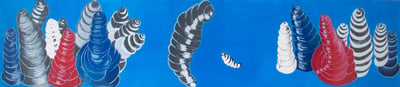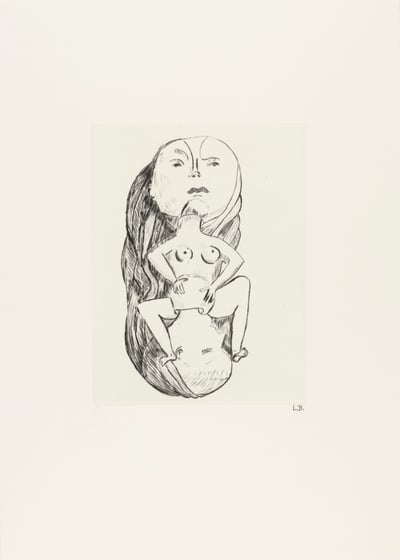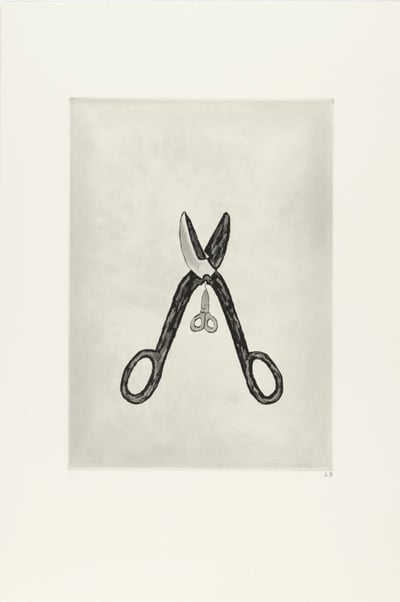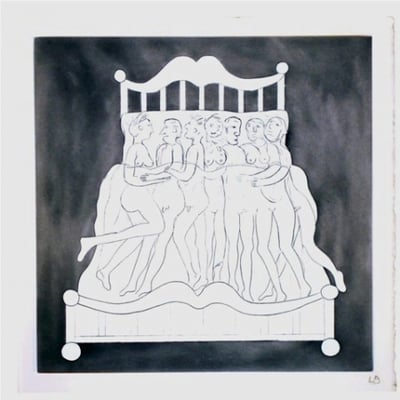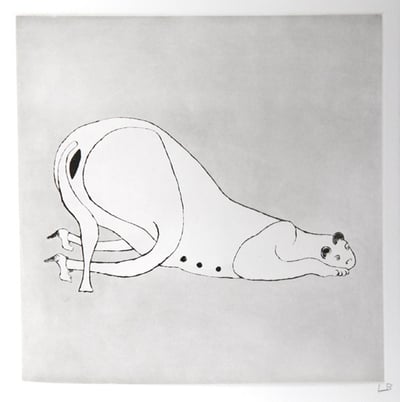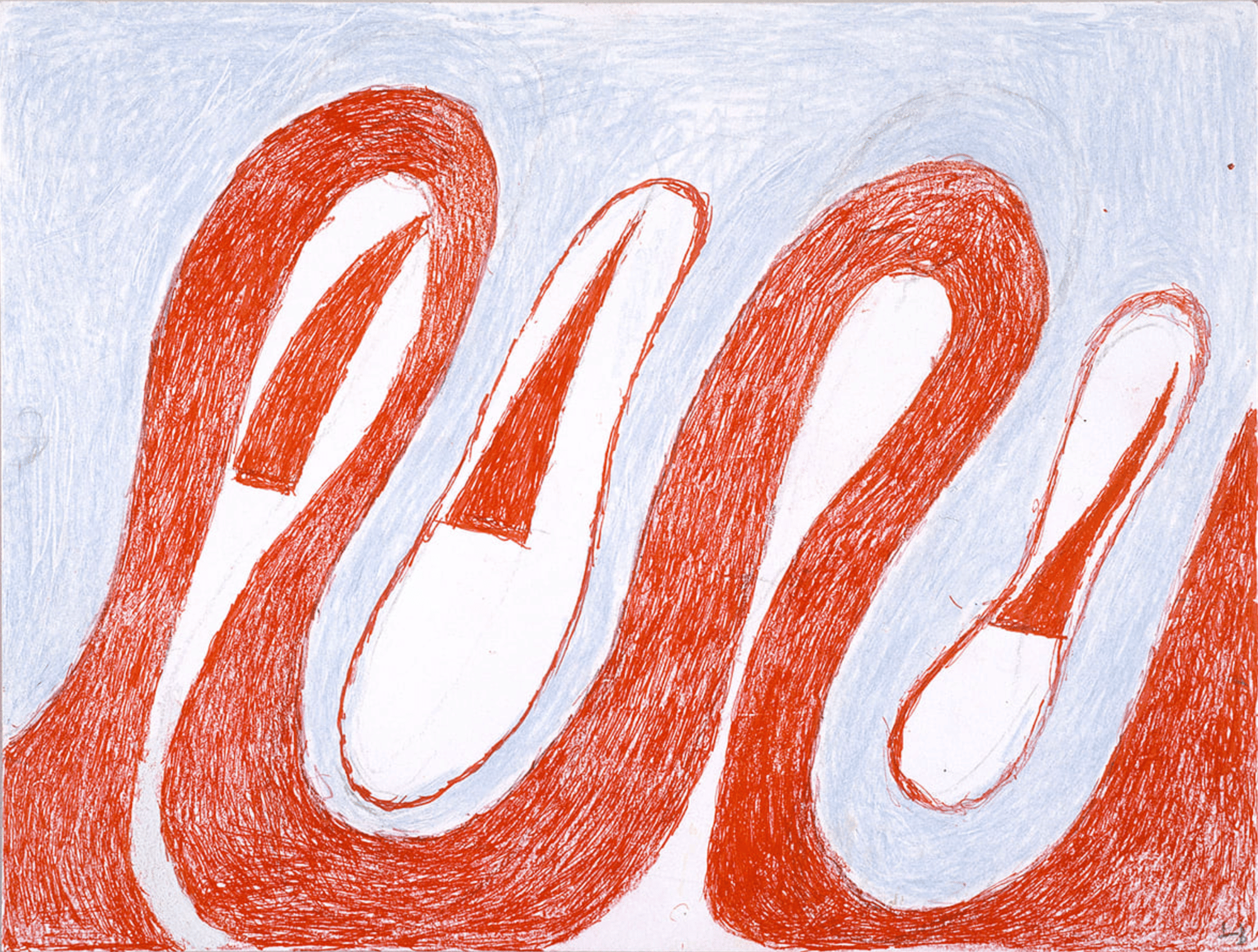
Crayon, ink and whiteout on paper.
Initiated lower right: LB.
Untitled (Undulating Ribbon) (1997) by Louise Bourgeois presents a rhythmic, serpentine form that winds across the paper in bold red and soft blue. The looping ribbon shape, drawn with crayon and ink and interrupted by areas of whiteout, suggests both movement and constraint. Its flowing path feels at once organic and controlled, echoing Bourgeois’s recurring exploration of the body, memory, and emotional states through abstract forms. The composition’s repetition and undulation create a meditative yet subtly tense visual experience, characteristic of her deeply personal and psychological approach to art.
Louise Bourgeois (France/USA, 1911–2010) was a groundbreaking artist celebrated for her emotionally charged sculptures, installations, and drawings. Her works, often exploring themes of memory, identity, and family, include the iconic spider sculptures symbolizing protection and fragility. Bourgeois's legacy profoundly influenced contemporary art, especially feminist and psychoanalytic perspectives.
Mixed MediaMixed media refers to artwork that incorporates more than one medium within a single piece. Unlike multimedia art, which combines distinct forms of visual art and often includes elements like sound, video, or digital media, mixed media focuses on combining traditional art materials, such as paint, ink, and collage. Mixed media art allows artists to achieve a wide range of effects and textures by layering and blending different materials.
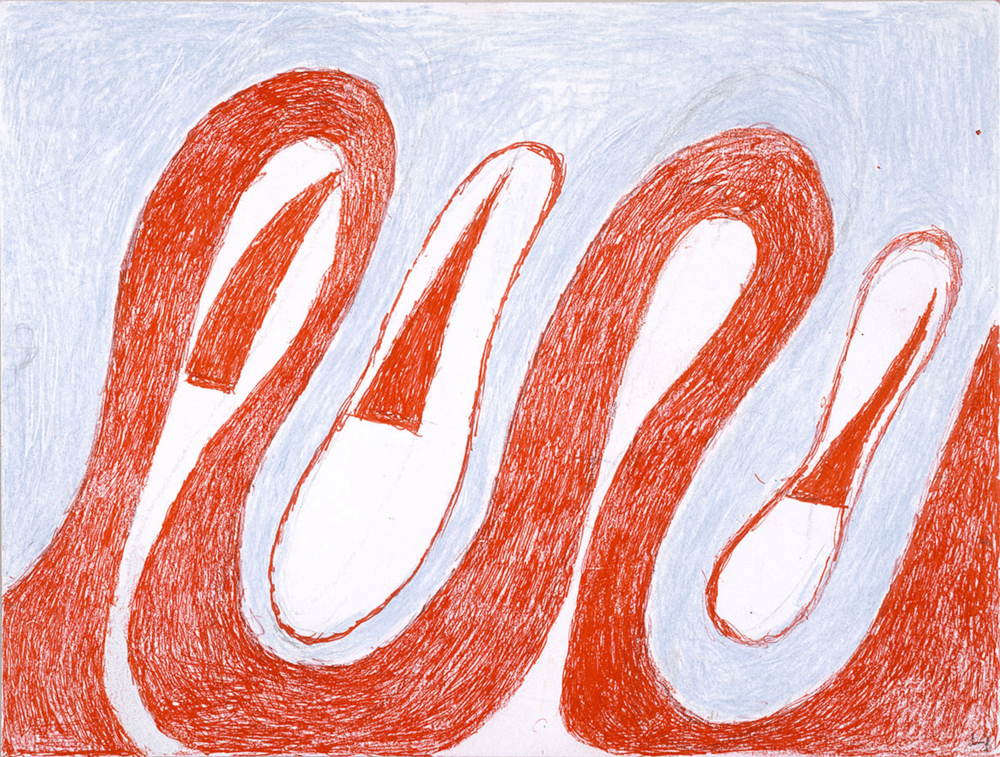
Crayon, ink and whiteout on paper.
Initiated lower right: LB.
Untitled (Undulating Ribbon) (1997) by Louise Bourgeois presents a rhythmic, serpentine form that winds across the paper in bold red and soft blue. The looping ribbon shape, drawn with crayon and ink and interrupted by areas of whiteout, suggests both movement and constraint. Its flowing path feels at once organic and controlled, echoing Bourgeois’s recurring exploration of the body, memory, and emotional states through abstract forms. The composition’s repetition and undulation create a meditative yet subtly tense visual experience, characteristic of her deeply personal and psychological approach to art.
Louise Bourgeois (France/USA, 1911–2010) was a groundbreaking artist celebrated for her emotionally charged sculptures, installations, and drawings. Her works, often exploring themes of memory, identity, and family, include the iconic spider sculptures symbolizing protection and fragility. Bourgeois's legacy profoundly influenced contemporary art, especially feminist and psychoanalytic perspectives.
My art is a form of restoration in terms of my feelings to myself and to others.
- Louise Bourgeois
Louise J. Bourgeois was a French-American artist and sculptor. She was extremely influential in modern and contemporary art and she became publicly recognized as the founder of the confessional art movement.
She studied art at several reputable schools including Academie de la Grande Chaumiere, Ecole du Louvre, and Ecole des Beaux-Arts. After marrying her American husband, Robert Goldwater, and moving to New York City, Louise Bourgeois turned her focus to sculpture. During this time, her artistic creations would often exude themes of loneliness, anxiety, and betrayal.
She often used junkyard scraps and driftwood that she would then carve into upright wood sculptures. Bourgeois would cover the impurities of the wood with paint and then use nails to create holes and scratches in the piece to articulate a certain emotion. One great example of her work is a piece entitled, “Sleeping Figure”. The piece depicts a war veteran who is unable to face the real world due to vulnerability.
In 1954, Bourgeois joined the American Abstract Artists Group. Her membership in the group was the catalyst for her making the transition from wood and upright structures to marble, bronze, and plaster. Bourgeois often rejected the idea that her art was feminist, however many of her works, such as Janus Fleuri (1968) proved that she wasn’t timid about celebrating the female body or using the female form in new ways. Later in life, Bourgeois added teaching to her resume as she obtain instructional positions at the several higher education institutions, including Cooper Union and the New York Studio School of Drawing, Painting, and Sculpture. She also taught for many years in the public school system in Great Neck, Long Island. One of her most recognizable pieces is a work called “The Destruction of Father.'' (Artist website)
American Abstract Artists (AAA) is an organization founded in New York City in 1936 to promote abstract art and its appreciation in the United States. At a time when abstract art faced strong opposition from critics, the AAA provided crucial exhibition opportunities for abstract artists, helping to foster the growth and acceptance of the movement.