
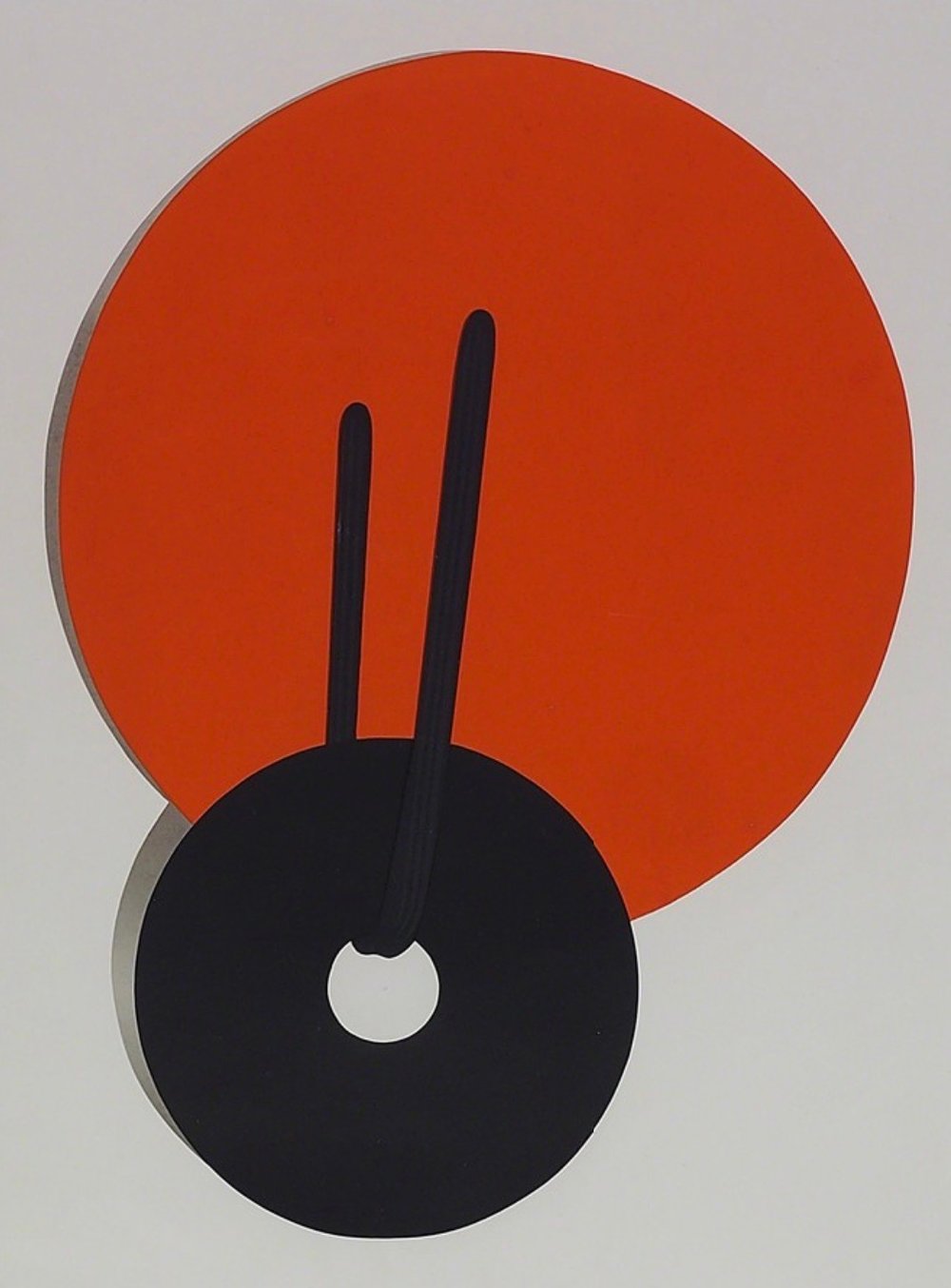
// Untitled by Lygia Pape, created in 1994, is a striking limited edition serigraph that exemplifies the artist’s affinity for geometric abstraction. The composition centers around two interlocking shapes: a large, vibrant orange circle and a smaller, solid black ring below it. Two elongated black lines bridge the two shapes, subtly suggesting a connection between them. The artwork reflects Pape’s interest in Brazilian Neo-Concretism, which emphasizes a tactile, sensory experience of art beyond rigid formalism. With bold colors and minimalist forms, this piece invites contemplation of balance, simplicity, and spatial tension, hallmarks of Pape's influential style.
Artwork Copyright © Lygia PapeLygia Pape (Brazil, 1927–2004) was a pioneering artist in the Neo-Concrete movement, known for her innovative approach to abstraction. Her work spanned painting, sculpture, installation, and film, emphasizing sensory experiences and viewer participation. Iconic works like Book of Creation and Ttéia highlight her exploration of geometry, light, and space.
Artwork Copyright © Lygia PapeUntiltled, 1994
Form
Medium
Size
- Inches
- Centimeters
Edition
Price
Available works →
- Authenticity Guaranteed
- Insured Shipping
- Online Since 2005
●
●Inventory 6948
●Signed
●Comes with gallery invoice and certificate
●Sell Us a Similar Artwork. Learn more.
// Untitled by Lygia Pape, created in 1994, is a striking limited edition serigraph that exemplifies the artist’s affinity for geometric abstraction. The composition centers around two interlocking shapes: a large, vibrant orange circle and a smaller, solid black ring below it. Two elongated black lines bridge the two shapes, subtly suggesting a connection between them. The artwork reflects Pape’s interest in Brazilian Neo-Concretism, which emphasizes a tactile, sensory experience of art beyond rigid formalism. With bold colors and minimalist forms, this piece invites contemplation of balance, simplicity, and spatial tension, hallmarks of Pape's influential style.
Artwork Copyright © Lygia PapeLygia Pape (Brazil, 1927–2004) was a pioneering artist in the Neo-Concrete movement, known for her innovative approach to abstraction. Her work spanned painting, sculpture, installation, and film, emphasizing sensory experiences and viewer participation. Iconic works like Book of Creation and Ttéia highlight her exploration of geometry, light, and space.
Artwork Copyright © Lygia Pape- Recently Added
- Price (Low-High)
- Price (High-Low)
- Year (Low-High)
- Year (High-Low)
Lygia Pape
Untiltled, 1994
Limited Edition Print
Serigraph
Currently Not Available
Related Artists



Artwork by Francois Morellet
What is geometric abstract art?
Geometric abstraction is a form of abstract art that uses geometric shapes arranged in a non-illusionistic space (though not always) and combined into non-representational (non-objective) compositions. Based on years of artistic research, some artists have proposed that geometric abstraction offers a solution to modern challenges by rejecting traditional illusionistic practices in favor of clarity and simplicity.

Lygia Pape
Untiltled, 1994
70 x 50 cm


