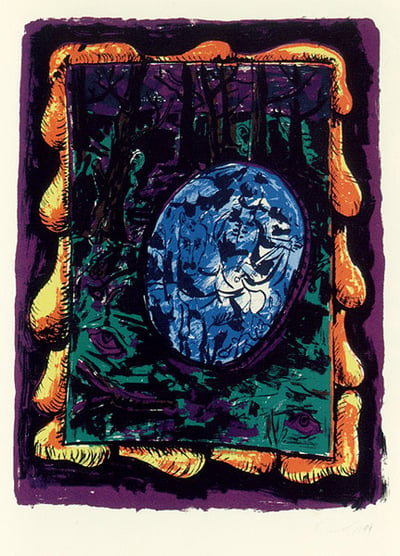
// Stillleben III by Markus Lüpertz is a vibrant and expressive lithograph that embodies the artist's characteristic blend of abstraction and figurative elements. Created between 1990 and 2000, this limited edition print bursts with intense colors—fiery reds, deep blues, and rich greens—combined with bold, gestural lines. The composition is complex and layered, featuring a skull, scattered paint strokes, and dynamic, overlapping shapes that evoke a sense of chaos and movement. Lüpertz’s approach to still life in this piece is unconventional, as he merges elements of symbolism and surrealism, creating a scene that feels both alive and decaying. Measuring 56 cm by 76 cm, Stillleben III invites viewers to interpret its rich iconography, offering a visceral experience that reflects on themes of mortality, transformation, and the subconscious.
Markus Lüpertz (Germany, 1941) is a painter, sculptor, and graphic artist known for his neo-expressionist style. His work often features suggestive power and archaic monumentality, exploring themes of German identity and mythology. Lüpertz has significantly influenced contemporary art and served as rector of the Kunstakademie Düsseldorf from 1988 to 2009.
Lithograph Lithography is a printing method based on the principle that water and oil do not mix. It can be used to print artwork or text onto paper or other suitable materials. Traditionally, an image was drawn with wax, fat, or oil onto a lithographic limestone surface or plate. Today, metal plates and other surfaces are also used in lithographic printing.
// Stillleben III by Markus Lüpertz is a vibrant and expressive lithograph that embodies the artist's characteristic blend of abstraction and figurative elements. Created between 1990 and 2000, this limited edition print bursts with intense colors—fiery reds, deep blues, and rich greens—combined with bold, gestural lines. The composition is complex and layered, featuring a skull, scattered paint strokes, and dynamic, overlapping shapes that evoke a sense of chaos and movement. Lüpertz’s approach to still life in this piece is unconventional, as he merges elements of symbolism and surrealism, creating a scene that feels both alive and decaying. Measuring 56 cm by 76 cm, Stillleben III invites viewers to interpret its rich iconography, offering a visceral experience that reflects on themes of mortality, transformation, and the subconscious.
Markus Lüpertz (Germany, 1941) is a painter, sculptor, and graphic artist known for his neo-expressionist style. His work often features suggestive power and archaic monumentality, exploring themes of German identity and mythology. Lüpertz has significantly influenced contemporary art and served as rector of the Kunstakademie Düsseldorf from 1988 to 2009.
Markus Lüpertz (b. 1941 Germany) is a prominent German painter, sculptor, and writer, widely recognized as a key figure in Neo-Expressionism. Lüpertz’s work is characterized by its bold, often provocative style, combining traditional techniques with a contemporary sensibility. His paintings frequently feature mythological, historical, and biblical themes, rendered in a style that oscillates between abstraction and figuration. Lüpertz is known for his use of intense colors, dramatic compositions, and a rough, tactile approach to paint application. Beyond painting, Lüpertz has also made significant contributions to sculpture, creating monumental works that explore similar themes of history and mythology. His art often reflects a deep engagement with German cultural identity, exploring complex and sometimes controversial aspects of the nation’s history. Lüpertz has held numerous exhibitions in major museums and galleries worldwide, and his influence extends beyond the visual arts into the realms of literature and education, making him a significant figure in contemporary European art.
Neue Wilden is the term German artists used for Neo-Expressionism. In the 1970s and 80s, expressive painting re-emerged in Germany, with artists embracing intense colors and broad brushstrokes. The movement grew in opposition to minimal and conceptual art, favoring a return to raw, emotional expression through bold and dynamic painting techniques.