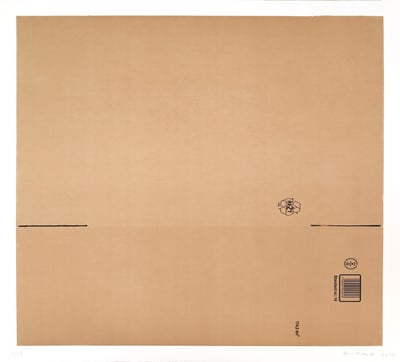
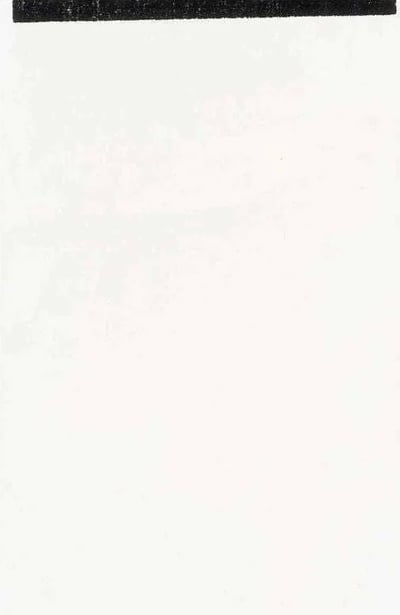
// Matias Faldbakken’s Box 2 from 2014 is a limited-edition lithograph that takes an everyday object—a flattened cardboard box—and transforms it into a subject of artistic inquiry. The print captures the structural details of the box, including printed symbols, barcodes, and fold lines, with minimalistic precision. Through this depiction, Faldbakken elevates the aesthetics of utilitarian packaging materials, inviting viewers to consider the themes of consumption, disposability, and the overlooked beauty in industrial design. By focusing on something as ordinary as a cardboard box, Faldbakken challenges perceptions of value and the role of mundane objects in contemporary life.
Matias Faldbakken (Norway, 1973) is a contemporary artist and author blending conceptual art with raw aesthetics. Known for his provocative installations and sculptures, he critiques consumerism, media, and cultural norms, often recontextualizing everyday objects into thought-provoking works.
LithographLithography is a printing method based on the principle that water and oil do not mix. It can be used to print artwork or text onto paper or other suitable materials. Traditionally, an image was drawn with wax, fat, or oil onto a lithographic limestone surface or plate. Today, metal plates and other surfaces are also used in lithographic printing.
Size
Inches
Centimeters
63 X 64 cm
Edition
Edition of 12
Price
USD
EUR
GBP
CHF
3,000EUR
?
+ VAT/import Duties (if applicable)
Authenticity Guaranteed
Insured Shipping
Online Since 2005
Share
●Inventory 2963
●Signed
●Comes with gallery invoice and certificate
●Any questions?
// Matias Faldbakken’s Box 2 from 2014 is a limited-edition lithograph that takes an everyday object—a flattened cardboard box—and transforms it into a subject of artistic inquiry. The print captures the structural details of the box, including printed symbols, barcodes, and fold lines, with minimalistic precision. Through this depiction, Faldbakken elevates the aesthetics of utilitarian packaging materials, inviting viewers to consider the themes of consumption, disposability, and the overlooked beauty in industrial design. By focusing on something as ordinary as a cardboard box, Faldbakken challenges perceptions of value and the role of mundane objects in contemporary life.
Matias Faldbakken (Norway, 1973) is a contemporary artist and author blending conceptual art with raw aesthetics. Known for his provocative installations and sculptures, he critiques consumerism, media, and cultural norms, often recontextualizing everyday objects into thought-provoking works.
I hate the fact that everything—any damn thing, any action, any protest, any obscenity—sooner or later turns into design.
- Matias Faldbakken
Matias Faldbakken (b. 1973 Denmark) is a Norwegian artist and writer known for his provocative and subversive approach to contemporary art and literature. Faldbakken’s work often explores themes of cultural disruption, social critique, and the breakdown of traditional norms. As an artist, he works across various media, including sculpture, installation, and painting, frequently incorporating found objects and everyday materials in ways that challenge their usual meanings and functions. His art is characterized by a raw, sometimes anarchic energy that confronts viewers with the contradictions and tensions of modern society. Faldbakken is also an accomplished novelist, writing under his own name and the pseudonym Abo Rasul. His novels, much like his visual art, are known for their dark humor, cynicism, and exploration of societal collapse. Faldbakken’s work has earned him a significant place in the international contemporary art scene, where he continues to push boundaries and provoke thought.
Minimalism is a style in music and visual arts characterized by pared-down designs and simplicity. It began in Western art after World War II, gaining prominence particularly in American visual arts. Minimalism draws heavily on aspects of modernism and is often viewed as a reaction against Abstract Expressionism, as well as a precursor to post-minimal art practices. Prominent minimalist artists include Agnes Martin, Donald Judd, Robert Morris, Frank Stella, and Dan Flavin.