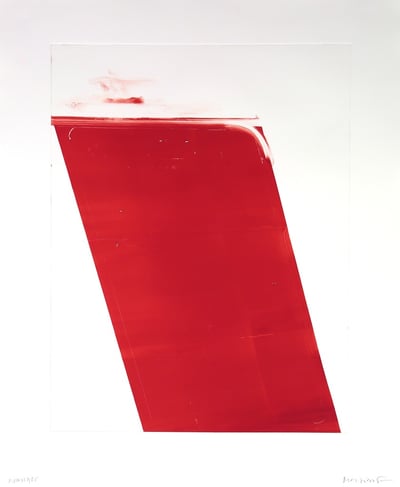
// Matias Faldbakken’s Hilux Variations 3 (2014) is a unique monotype print characterized by its bold use of color and minimalist abstraction. Dominated by a deep, intense red, the composition features subtle white and pinkish markings that introduce texture and depth, breaking the flatness of the color field. Sharp, angular lines cut across the rectangular form, adding a sense of movement and disruption. Faldbakken, known for his conceptual approach and exploration of materiality, uses this restrained yet striking piece to evoke a sense of tension and contrast. The work’s simplicity invites viewers to consider the interplay between color, form, and space.
Matias Faldbakken (Norway, 1973) is a contemporary artist and author blending conceptual art with raw aesthetics. Known for his provocative installations and sculptures, he critiques consumerism, media, and cultural norms, often recontextualizing everyday objects into thought-provoking works.
MonotypeMonotype is a printmaking technique where an image is painted or drawn on a nonabsorbent, smooth surface, traditionally an etching plate of copper, but now also acrylic, zinc, or glass. The image is then transferred to paper using a printing press, creating a unique print. The first pressing removes most of the ink, making it difficult to produce additional prints with the same richness, resulting in a one-of-a-kind artwork.
Size
Inches
Centimeters
64 X 49 cm
Edition
Edition of 1
Price
USD
EUR
GBP
CHF
5,000EUR
?
+ VAT/import Duties (if applicable)
Authenticity Guaranteed
Insured Shipping
Online Since 2005
Share
●Inventory 2921
●Signed
●Comes with gallery invoice and certificate
●Any questions?
// Matias Faldbakken’s Hilux Variations 3 (2014) is a unique monotype print characterized by its bold use of color and minimalist abstraction. Dominated by a deep, intense red, the composition features subtle white and pinkish markings that introduce texture and depth, breaking the flatness of the color field. Sharp, angular lines cut across the rectangular form, adding a sense of movement and disruption. Faldbakken, known for his conceptual approach and exploration of materiality, uses this restrained yet striking piece to evoke a sense of tension and contrast. The work’s simplicity invites viewers to consider the interplay between color, form, and space.
Matias Faldbakken (Norway, 1973) is a contemporary artist and author blending conceptual art with raw aesthetics. Known for his provocative installations and sculptures, he critiques consumerism, media, and cultural norms, often recontextualizing everyday objects into thought-provoking works.
I hate the fact that everything—any damn thing, any action, any protest, any obscenity—sooner or later turns into design.
- Matias Faldbakken
Matias Faldbakken (b. 1973 Denmark) is a Norwegian artist and writer known for his provocative and subversive approach to contemporary art and literature. Faldbakken’s work often explores themes of cultural disruption, social critique, and the breakdown of traditional norms. As an artist, he works across various media, including sculpture, installation, and painting, frequently incorporating found objects and everyday materials in ways that challenge their usual meanings and functions. His art is characterized by a raw, sometimes anarchic energy that confronts viewers with the contradictions and tensions of modern society. Faldbakken is also an accomplished novelist, writing under his own name and the pseudonym Abo Rasul. His novels, much like his visual art, are known for their dark humor, cynicism, and exploration of societal collapse. Faldbakken’s work has earned him a significant place in the international contemporary art scene, where he continues to push boundaries and provoke thought.
Appropriation in art involves using pre-existing images or objects with little or no modification. This technique has played a significant role across various art forms, including visual arts, music, performance, and literature. In visual arts, appropriation refers to the practice of adopting, sampling, recycling, or borrowing elements—or even entire forms—of existing visual culture, integrating them into new works to create meaning or critique.