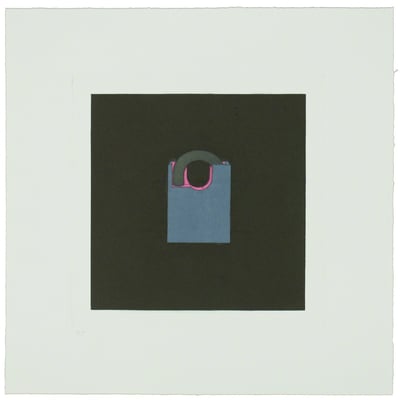
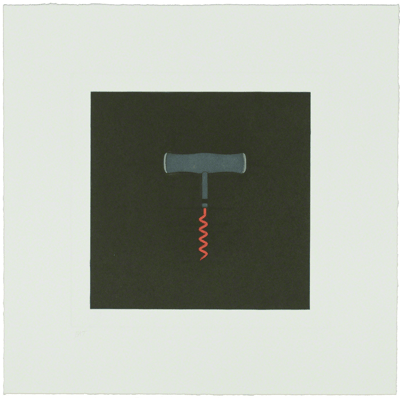
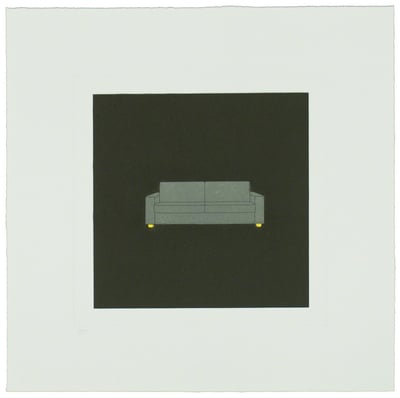
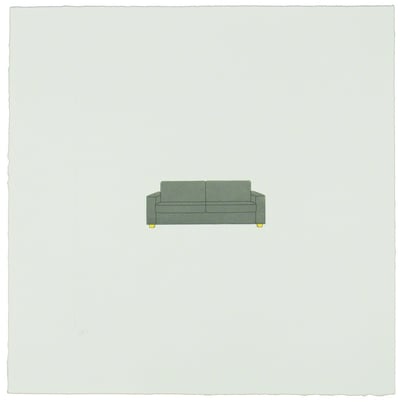
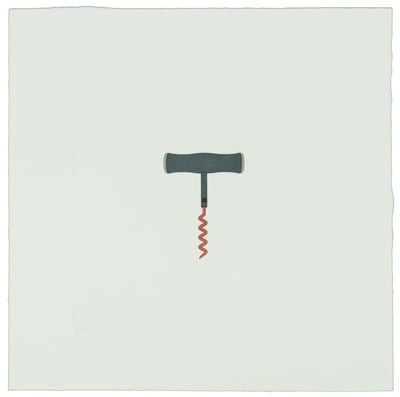
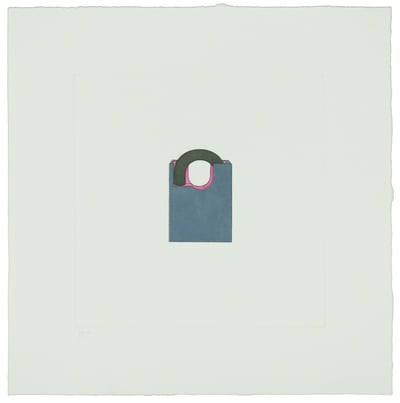
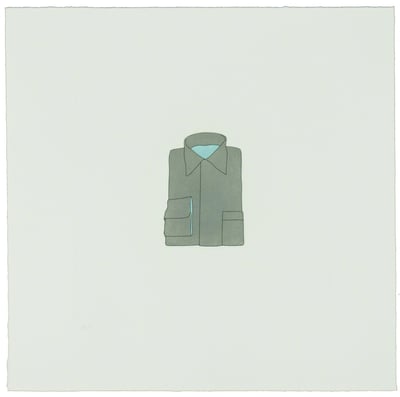
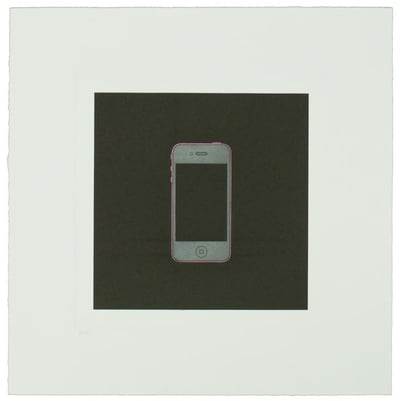
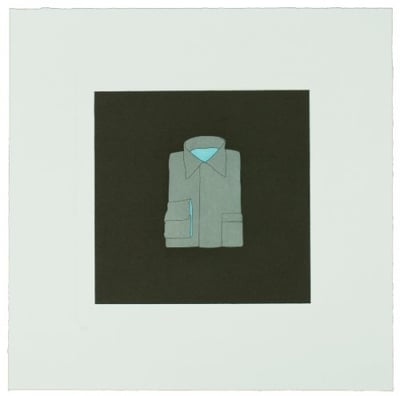
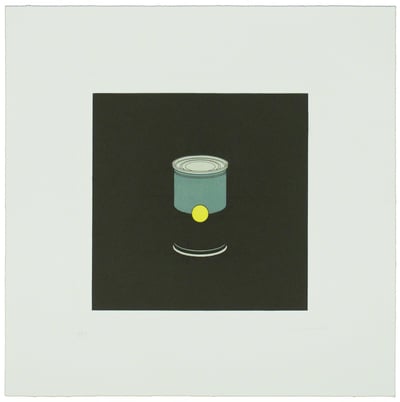
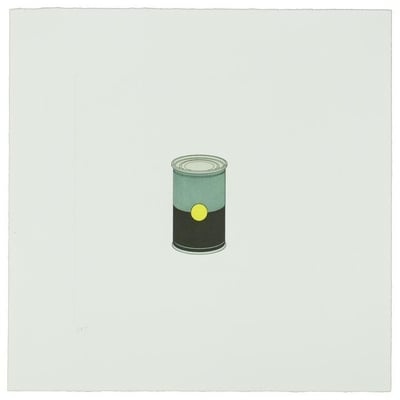
// Michael Craig-Martin's The Catalan Suite I - Soup Can (2013) is a limited edition etching that distills the iconic form of a soup can into a minimalist composition. Positioned centrally against a stark black background, the can is rendered with clean lines and subtle shading, accompanied by a single yellow dot beneath it and a curved line below, adding a playful, almost abstract quality to the representation. Craig-Martin, known for his use of everyday objects, transforms the banal into an emblem of modern life, stripping it of context and enhancing its symbolic power. This piece exemplifies Craig-Martin’s approach to elevating mundane objects through precise, graphic aesthetics.
Michael Craig-Martin (Ireland/UK, 1941) is a conceptual artist celebrated for his brightly colored, minimalist depictions of everyday objects. Often associated with the YBA movement, his work explores the intersection of form, perception, and context. A pioneering teacher, he influenced a generation of British artists, including Damien Hirst and Sarah Lucas.
EtchingEtching is a technique where a design is created on a metal surface by using a strong acid or mordant to eat away the unprotected parts of the metal, leaving the desired pattern in relief (intaglio). In modern art and manufacturing, different chemicals may be used depending on the material being etched.
// Michael Craig-Martin's The Catalan Suite I - Soup Can (2013) is a limited edition etching that distills the iconic form of a soup can into a minimalist composition. Positioned centrally against a stark black background, the can is rendered with clean lines and subtle shading, accompanied by a single yellow dot beneath it and a curved line below, adding a playful, almost abstract quality to the representation. Craig-Martin, known for his use of everyday objects, transforms the banal into an emblem of modern life, stripping it of context and enhancing its symbolic power. This piece exemplifies Craig-Martin’s approach to elevating mundane objects through precise, graphic aesthetics.
Michael Craig-Martin (Ireland/UK, 1941) is a conceptual artist celebrated for his brightly colored, minimalist depictions of everyday objects. Often associated with the YBA movement, his work explores the intersection of form, perception, and context. A pioneering teacher, he influenced a generation of British artists, including Damien Hirst and Sarah Lucas.
I am trying to present objects in the simplest way possible, and I don't want to supply too much context.
- Michael Craig-Martin
Michael Craig-Martin is an Irish artist who was born in Dublin. He received his formal arts education in universities in both Europe and the United States. Craig-Martin is a conceptual artist and his early works consisted of box-like constructions. His most famous conceptual piece, An Oak Tree, was considered quite controversial when it first appeared in 1973. Michael Craig-Martin has been employed as an artist since the mid 1960s and during this time he began to experiment with household objects in his artwork. As time progressed, he began to create line drawings, also utilizing his love of household objects. By the 1990s, Craig-Martin began to undertake painting as his primary medium. Michael Craig-Martin's works are shown worldwide and have garnered critical acclaim by art lovers. Craig-Martin is also credited as being an early influence for the Young British Artists, a group of young visual artists in London. Many members of this group were former pupils of Craig-Martin. (Artist website)
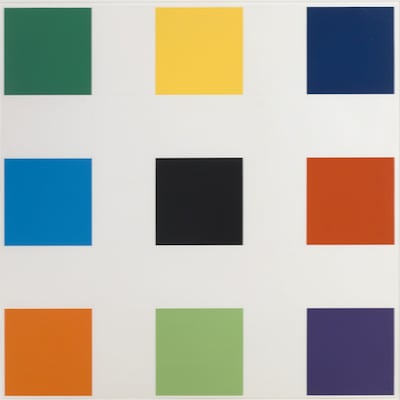
Hard Edge art is a style of abstract painting that became popular in the 1960s. It features areas of color separated by crisp, sharp edges that are painted with geometric precision. The term hard-edge painting was coined by art critic Jules Langsner to describe this approach, which contrasts with the softer, more fluid forms of other abstract styles.