Signed and dated 2000, numbered on 150 and stamped with the editor's mark
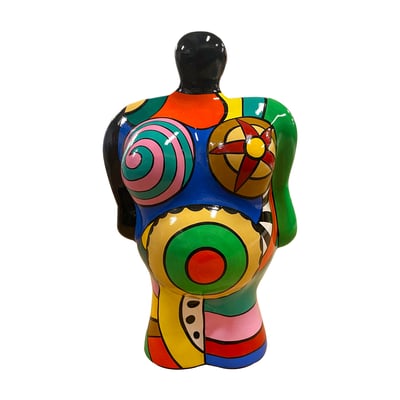
California Nana Vase, created in 2000 by Niki de Saint Phalle, is a vibrant resin sculpture that celebrates the joyful essence of femininity. Standing 34 cm tall, this piece is part of de Saint Phalle’s renowned Nana series, known for its colorful, curvaceous figures that symbolize empowerment and playfulness. The vase features a bold array of swirling patterns and bright colors, with exaggerated, rounded forms that convey warmth and vitality. The glossy resin finish enhances its vivid palette, making it a visually striking piece that embodies de Saint Phalle’s whimsical and celebratory approach to art.
Niki de Saint Phalle (France, 1930–2002) was a groundbreaking artist known for her vibrant, whimsical sculptures and feminist themes. A key figure in the Nouveau Réalisme movement, she is celebrated for her Nanas series—bold, colorful depictions of joyful, empowered women—and monumental public artworks like The Tarot Garden.
Resin Resin can be derived from both natural sources, such as pine sap, and synthetic processes. Natural resin comes from tree sap, while synthetic resin is a type of dense, easily molded plastic. Resin is commonly used in sculpture, and it can also enhance the vibrancy of paint colors.
Signed and dated 2000, numbered on 150 and stamped with the editor's mark
California Nana Vase, created in 2000 by Niki de Saint Phalle, is a vibrant resin sculpture that celebrates the joyful essence of femininity. Standing 34 cm tall, this piece is part of de Saint Phalle’s renowned Nana series, known for its colorful, curvaceous figures that symbolize empowerment and playfulness. The vase features a bold array of swirling patterns and bright colors, with exaggerated, rounded forms that convey warmth and vitality. The glossy resin finish enhances its vivid palette, making it a visually striking piece that embodies de Saint Phalle’s whimsical and celebratory approach to art.
Niki de Saint Phalle (France, 1930–2002) was a groundbreaking artist known for her vibrant, whimsical sculptures and feminist themes. A key figure in the Nouveau Réalisme movement, she is celebrated for her Nanas series—bold, colorful depictions of joyful, empowered women—and monumental public artworks like The Tarot Garden.
Painting calmed the chaos that shook my soul.
- Niki De Saint Phalle
French artist Niki de Saint Phalle is best known for her large, colorful sculptures of curvaceous women. Her work was often made in collaboration with her husband, Jean Tinguely, who incorporated mechanical, moving elements into her pieces. Niki de Saint Phalle’s love of colour came through in her painting as well as her sculpture, but her most famous piece has to be a series of sculptures for the fountain in Place Igor Stravinsky, Paris. The sculptures, which include a bird, an elephant and a heart, rotate continually and many spurt water. The fountain has the perfect backdrop as it is along one side of Centre Georges Pompidou, Paris's modern art museum. Niki de Saint Phalle is associated with nouveau realismé, meaning 'new realism', which began as a counterpoint to pop art. The exuberance of de Saint Phalle also bears witness to the work of Gaudi, who she regularly drew inspiration from. Nowhere is this more evident than in the glorious Tarot Garden, a sculpture park in Tuscany filled with giant figures. Each sculpture can be walked around, in and through, and is covered in mosaic tiles. One even became a temporary house for de Niki Saint Phalle during the Garden's construction. After her death in 2002, the Garden remains as the peak point in Niki de Saint Phalle's career. (Artist website)
Postmodernism is an art movement that emerged as a reaction against authority and traditional boundaries, seeking to blur the lines between art and everyday life. It aimed to bridge the gap between the cultural elite and the general public by embracing eclectic mixtures of earlier conventions and styles. Postmodernist art often challenges established norms and celebrates diversity, irony, and pastiche, making it a movement that reflects the complexities of contemporary culture.