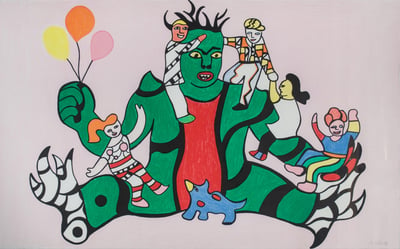
This joyful colour lithograph by Niki de Saint Phalle depicts a towering green monster with a red-patterned torso set against a vivid pink background, surrounded by playful children, colourful balloons, and exuberant decorative motifs. The work embodies Saint Phalle's signature fusion of childlike wonder and deep psychological resonance — her monsters are protective totems rather than figures of fear. Printed in her characteristic bold palette, this hand-signed edition captures the sculptural vitality that made Saint Phalle one of the most distinctive voices in postwar European art.
Niki de Saint Phalle (France, 1930–2002) was a groundbreaking artist known for her vibrant, whimsical sculptures and feminist themes. A key figure in the Nouveau Réalisme movement, she is celebrated for her Nanas series—bold, colorful depictions of joyful, empowered women—and monumental public artworks like The Tarot Garden.
Lithograph Lithography is a printing method based on the principle that water and oil do not mix. It can be used to print artwork or text onto paper or other suitable materials. Traditionally, an image was drawn with wax, fat, or oil onto a lithographic limestone surface or plate. Today, metal plates and other surfaces are also used in lithographic printing.
This joyful colour lithograph by Niki de Saint Phalle depicts a towering green monster with a red-patterned torso set against a vivid pink background, surrounded by playful children, colourful balloons, and exuberant decorative motifs. The work embodies Saint Phalle's signature fusion of childlike wonder and deep psychological resonance — her monsters are protective totems rather than figures of fear. Printed in her characteristic bold palette, this hand-signed edition captures the sculptural vitality that made Saint Phalle one of the most distinctive voices in postwar European art.
Niki de Saint Phalle (France, 1930–2002) was a groundbreaking artist known for her vibrant, whimsical sculptures and feminist themes. A key figure in the Nouveau Réalisme movement, she is celebrated for her Nanas series—bold, colorful depictions of joyful, empowered women—and monumental public artworks like The Tarot Garden.
Painting calmed the chaos that shook my soul.
- Niki De Saint Phalle
French artist Niki de Saint Phalle is best known for her large, colorful sculptures of curvaceous women. Her work was often made in collaboration with her husband, Jean Tinguely, who incorporated mechanical, moving elements into her pieces. Niki de Saint Phalle’s love of colour came through in her painting as well as her sculpture, but her most famous piece has to be a series of sculptures for the fountain in Place Igor Stravinsky, Paris. The sculptures, which include a bird, an elephant and a heart, rotate continually and many spurt water. The fountain has the perfect backdrop as it is along one side of Centre Georges Pompidou, Paris's modern art museum. Niki de Saint Phalle is associated with nouveau realismé, meaning 'new realism', which began as a counterpoint to pop art. The exuberance of de Saint Phalle also bears witness to the work of Gaudi, who she regularly drew inspiration from. Nowhere is this more evident than in the glorious Tarot Garden, a sculpture park in Tuscany filled with giant figures. Each sculpture can be walked around, in and through, and is covered in mosaic tiles. One even became a temporary house for de Niki Saint Phalle during the Garden's construction. After her death in 2002, the Garden remains as the peak point in Niki de Saint Phalle's career. (Artist website)
Feminist art refers to the art that emerged from the feminist art movement during the 1960s and 1970s. It developed with the intention of critiquing 20th-century gender ideals and challenging the traditional canon of art history. Feminist art seeks to create a dialogue between the artwork and the viewer through a feminist lens, often addressing issues of gender, identity, and social justic