Metal, plastic, foam and leather - Edition of 6 pieces (3 Solo & Pillon saddles, in 3 different colors + 3 Banana saddles in 3 different colors)
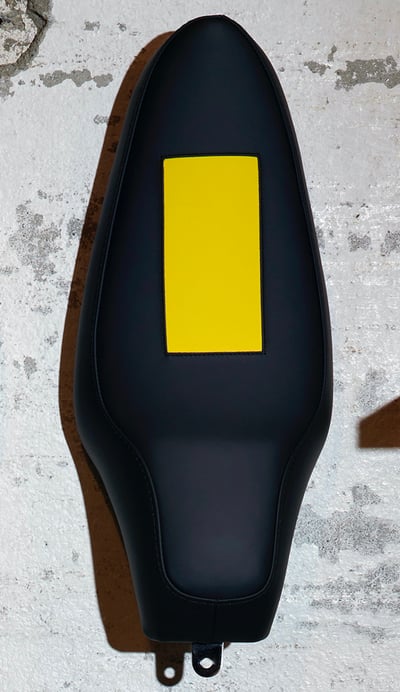
Banana Saddle (Red) by Olivier Mosset is a sculptural piece that transforms an everyday motorcycle saddle into a minimalist art object. Created in 2019 using metal, plastic, foam, and leather, the work presents a sleek black seat with a striking red rectangular insert at its center, drawing attention to its bold, graphic simplicity. Mounted against a textured wall, the piece merges functional design with Mosset's minimalist aesthetic, emphasizing form, color, and material over narrative. Part of a limited edition of six, each saddle in varying colors, Banana Saddle (Red) exemplifies Mosset's approach to reducing objects to their essential visual components, inviting contemplation on the boundaries between art and utilitarian design.
Olivier Mosset (Switzerland, 1944) is a key figure in contemporary art, renowned for his minimalist and conceptual approach. A founding member of the BMPT group, his works often challenge traditional notions of authorship and originality. Best known for his monochromatic canvases and repeated geometric forms, Mosset has profoundly influenced postmodern abstraction.
Mixed MediaMixed media refers to artwork that incorporates more than one medium within a single piece. Unlike multimedia art, which combines distinct forms of visual art and often includes elements like sound, video, or digital media, mixed media focuses on combining traditional art materials, such as paint, ink, and collage. Mixed media art allows artists to achieve a wide range of effects and textures by layering and blending different materials.
Metal, plastic, foam and leather - Edition of 6 pieces (3 Solo & Pillon saddles, in 3 different colors + 3 Banana saddles in 3 different colors)
Banana Saddle (Red) by Olivier Mosset is a sculptural piece that transforms an everyday motorcycle saddle into a minimalist art object. Created in 2019 using metal, plastic, foam, and leather, the work presents a sleek black seat with a striking red rectangular insert at its center, drawing attention to its bold, graphic simplicity. Mounted against a textured wall, the piece merges functional design with Mosset's minimalist aesthetic, emphasizing form, color, and material over narrative. Part of a limited edition of six, each saddle in varying colors, Banana Saddle (Red) exemplifies Mosset's approach to reducing objects to their essential visual components, inviting contemplation on the boundaries between art and utilitarian design.
Olivier Mosset (Switzerland, 1944) is a key figure in contemporary art, renowned for his minimalist and conceptual approach. A founding member of the BMPT group, his works often challenge traditional notions of authorship and originality. Best known for his monochromatic canvases and repeated geometric forms, Mosset has profoundly influenced postmodern abstraction.
For me, the idea is that paintings are paintings.
- Olivier Mosset
A founding member of the BMPT art group, Olivier Mosset is a visual artist renowned for his monochrome paintings. The BMPT group was comprised of Mosset, Toroni, Parmentier and Buren – as a collective, they argued that the finished art project itself was more important than its original authorship, and often implied that they had created each other’s works; asides from this ambiguity, Mosset received acclaim for the hundreds of Neo-expressionist monochrome paintings such as Caroline, as well as his work as a founding member of the New York Radical Painting group. Mosset also received recognition for his ice sculptures created later in his career – known as Toblerones, these sculptures referenced the Swiss anti-road blocks created and used during the second World War.
Site-Specific Art is a form of artwork created to exist in a particular location, with the artist considering the site as an integral part of the creative process. Robert Irwin was a key figure in promoting this art form in California. Site-Specific Art emerged as a reaction against modernist objects, which were often portable, commodified, and confined to museum spaces. In contrast, Site-Specific Art is inherently tied to its location, challenging the traditional notions of art as a transportable and marketable commodity.