
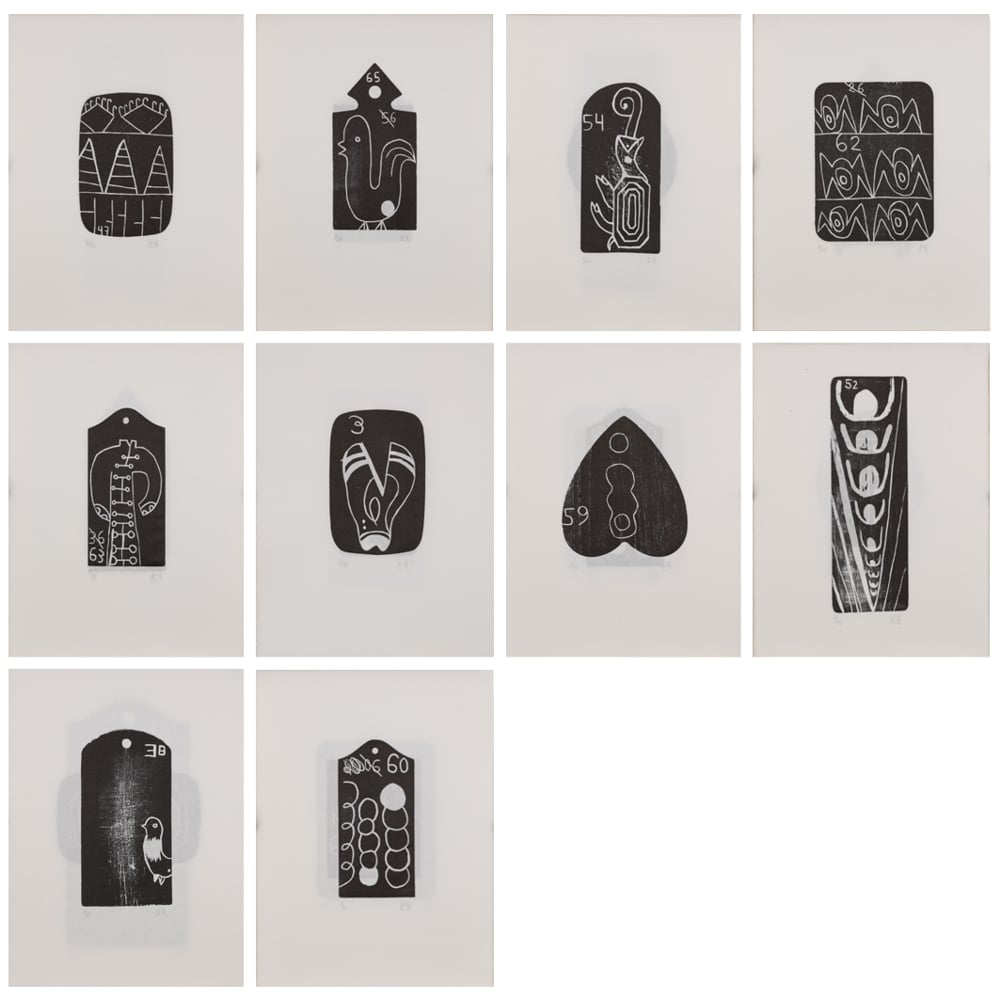
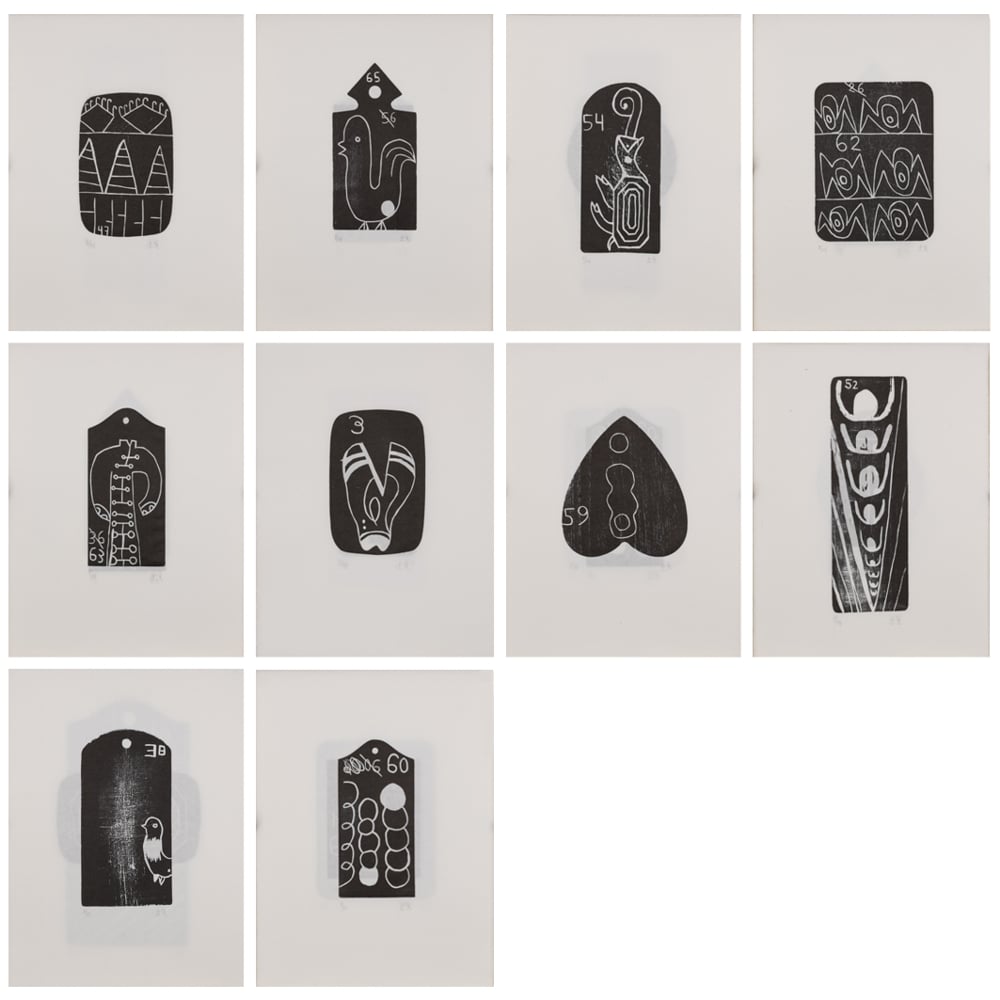
67 woodcuts on Japanese paper, each hand signed and numbered. NOTE: only a few of the prints of this portfolio are shown here.
Almanach by Tal R is a captivating collection of 67 woodcut prints created in 2015. Each print in this series displays distinct, abstract forms rendered in bold black and white on Japanese paper, emphasizing Tal R's exploration of symbolic and enigmatic shapes. The imagery features an assortment of stylized symbols, numbers, and patterns that evoke a sense of ritual or ancient artifact, each piece feeling like a mysterious sign or code. This limited edition series (18 + 3 artist proofs), with each print hand-signed and numbered by the artist, invites viewers to interpret the cryptic visuals, encouraging a personal journey through the language of symbols.
Artwork Copyright © Tal RTal R (Denmark, 1967) is an Israeli-born Danish artist renowned for his vibrant, eclectic works that blend painting, collage, sculpture, and printmaking. His art often incorporates elements from diverse sources, a method he describes as 'kolbojnik,' Hebrew for 'leftovers.' Tal R's distinctive style reflects a fusion of cultural influences and a playful exploration of form and color.
Artwork Copyright © Tal RAlmanach (67 prints), 2015
Form
Medium
Size
- Inches
- Centimeters
Edition
Price
- USD
- EUR
- GBP
- CHF
- Authenticity Guaranteed
- Insured Shipping
- Online Since 2005
●Inventory 5139
●Signed
●Comes with gallery invoice and certificate
●Sell Us a Similar Artwork. Learn more.
67 woodcuts on Japanese paper, each hand signed and numbered. NOTE: only a few of the prints of this portfolio are shown here.
Almanach by Tal R is a captivating collection of 67 woodcut prints created in 2015. Each print in this series displays distinct, abstract forms rendered in bold black and white on Japanese paper, emphasizing Tal R's exploration of symbolic and enigmatic shapes. The imagery features an assortment of stylized symbols, numbers, and patterns that evoke a sense of ritual or ancient artifact, each piece feeling like a mysterious sign or code. This limited edition series (18 + 3 artist proofs), with each print hand-signed and numbered by the artist, invites viewers to interpret the cryptic visuals, encouraging a personal journey through the language of symbols.
Artwork Copyright © Tal RTal R (Denmark, 1967) is an Israeli-born Danish artist renowned for his vibrant, eclectic works that blend painting, collage, sculpture, and printmaking. His art often incorporates elements from diverse sources, a method he describes as 'kolbojnik,' Hebrew for 'leftovers.' Tal R's distinctive style reflects a fusion of cultural influences and a playful exploration of form and color.
Artwork Copyright © Tal R- Recently Added
- Price (Low-High)
- Price (High-Low)
- Year (Low-High)
- Year (High-Low)
Tal R
Almanach (67 prints), 2015
Limited Edition Print
Woodcut
EUR 35,000

Tal R
Soya and Litschi, 2006
Sculpture / Object
Bronze
Currently Not Available
Related Artists

Artwork by Roger Raveel
What is new figuration?
Neo-Figurative Art is a collective term that refers to the revival of figurative art in America and Europe during the 1960s, following a period dominated by abstraction. Michel Ragon, a French art critic, argued that this resurgence of figuration occurred during a critical time of social and political upheaval in both regions.

Tal R
Almanach (67 prints), 2015
40 x 30 cm


