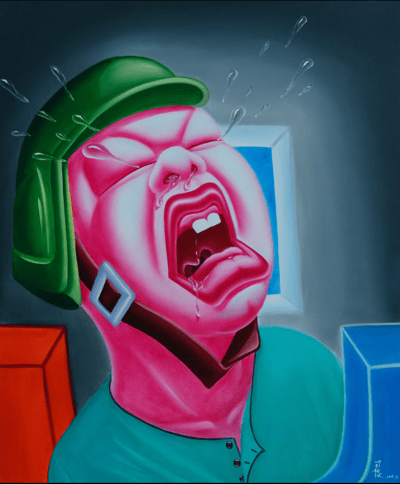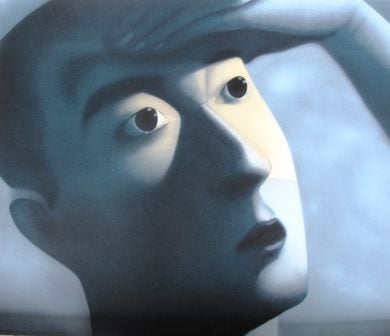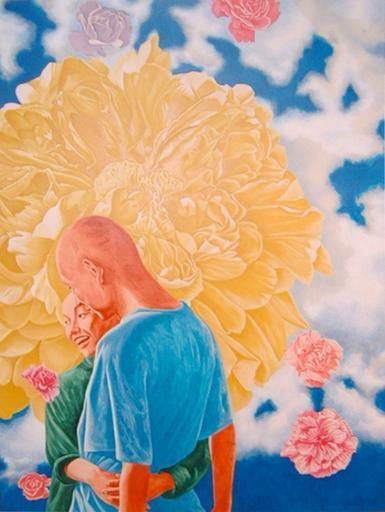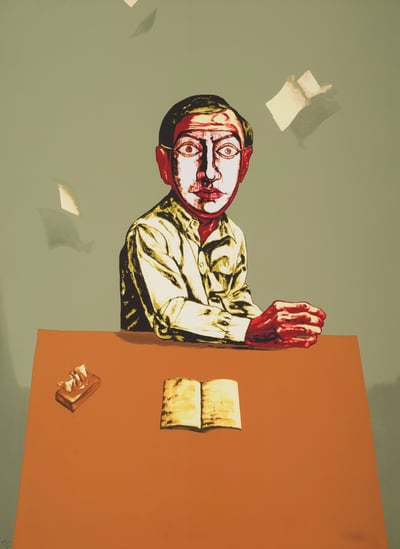
Yin Jun (China, 1974) is a contemporary artist known for vibrant, satirical paintings that critique consumerism and cultural shifts. His exaggerated, cartoon-like figures reflect the interplay of traditional Chinese art and Western pop culture. Yin’s work, often humorous and thought-provoking, highlights globalization’s impact on modern identity.
oil on canvasOil paint is a slow-drying type of paint made from pigment particles suspended in a drying oil, typically linseed oil. The viscosity of the paint can be adjusted by adding a solvent like turpentine, and varnish can be added to increase the glossiness of the dried paint film. Oil painting has been used since the 12th century in Europe, initially for decoration, but it was not widely adopted as a primary painting medium until the 15th century.
Yin Jun (China, 1974) is a contemporary artist known for vibrant, satirical paintings that critique consumerism and cultural shifts. His exaggerated, cartoon-like figures reflect the interplay of traditional Chinese art and Western pop culture. Yin’s work, often humorous and thought-provoking, highlights globalization’s impact on modern identity.
Yin Jun (b. 1974 China) is a Chinese contemporary artist known for his vibrant and satirical paintings that explore themes of consumerism, cultural identity, and the complexities of modern Chinese society. His work often features exaggerated, cartoon-like figures set against bold, colorful backgrounds, reflecting the influence of both traditional Chinese art and Western pop culture. Yin Jun’s paintings are characterized by their playful yet critical approach, often depicting everyday people in exaggerated, sometimes absurd situations that comment on the rapid changes and contradictions within Chinese society. His use of humor and irony invites viewers to reflect on the impact of globalization and the blending of Eastern and Western cultures. Yin Jun’s work has been exhibited internationally, and he is regarded as a significant voice in contemporary Chinese art, particularly in discussions about the intersection of tradition and modernity.
Pop Art is an art movement that began in Britain in 1955 and in the late 1950s in the U.S. It challenged traditional fine arts by incorporating imagery from popular culture, such as news, advertising, and comic books. Pop Art often isolates and recontextualizes materials, combining them with unrelated elements. The movement is more about the attitudes and ideas that inspired it than the specific art itself. Pop Art is seen as a reaction against the dominant ideas of Abstract Expressionism, bringing everyday consumer culture into the realm of fine art.