

34 color silkscreen print on BFK Rivers paper
Last Supper (Mask series) by Zeng Fanzhi is a compelling silkscreen print from 2002, part of his renowned Mask series. This 34-color silkscreen on BFK Rives paper reinterprets Leonardo da Vinci's The Last Supper with a striking contemporary twist. The figures, dressed in red scarves reminiscent of Chinese youth uniforms, wear identical expressionless masks, symbolizing conformity and anonymity in modern society. Their gestures and body language contrast with the stoic masks, adding an eerie tension to the composition. The background includes calligraphic elements, blending traditional Chinese art with Western religious iconography. Zeng’s work critiques social facades and the loss of individuality, creating a powerful and haunting commentary on identity and cultural expectations.
Artwork Copyright © Zeng FanzhiZeng Fanzhi (China, 1964) is a prominent contemporary artist known for his emotionally charged, large-scale paintings. Blending Expressionism with traditional Chinese elements, his works, such as the Mask Series, explore themes of identity, isolation, and modernity.
Artwork Copyright © Zeng FanzhiLast Supper (Mask series), 2002
Form
Medium
Size
- Inches
- Centimeters
Edition
Price
Available works →
- Authenticity Guaranteed
- Insured Shipping
- Online Since 2005
●
●Inventory 7231
●Hand Signed
●Comes with gallery invoice and certificate
●Sell Us a Similar Artwork. Learn more.
34 color silkscreen print on BFK Rivers paper
Last Supper (Mask series) by Zeng Fanzhi is a compelling silkscreen print from 2002, part of his renowned Mask series. This 34-color silkscreen on BFK Rives paper reinterprets Leonardo da Vinci's The Last Supper with a striking contemporary twist. The figures, dressed in red scarves reminiscent of Chinese youth uniforms, wear identical expressionless masks, symbolizing conformity and anonymity in modern society. Their gestures and body language contrast with the stoic masks, adding an eerie tension to the composition. The background includes calligraphic elements, blending traditional Chinese art with Western religious iconography. Zeng’s work critiques social facades and the loss of individuality, creating a powerful and haunting commentary on identity and cultural expectations.
Artwork Copyright © Zeng FanzhiZeng Fanzhi (China, 1964) is a prominent contemporary artist known for his emotionally charged, large-scale paintings. Blending Expressionism with traditional Chinese elements, his works, such as the Mask Series, explore themes of identity, isolation, and modernity.
Artwork Copyright © Zeng Fanzhi- Recently Added
- Price (Low-High)
- Price (High-Low)
- Year (Low-High)
- Year (High-Low)
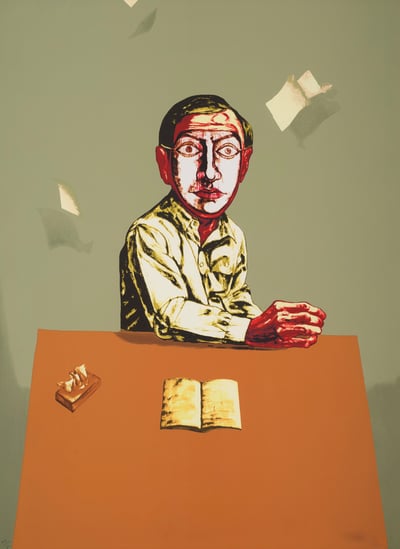
Zeng Fanzhi
Sitting Man, from Mask Series, 2006
Limited Edition Print
Lithograph
USD 5,990

Zeng Fanzhi
Last Supper (Mask series), 2002
Limited Edition Print
Silkscreen
Currently Not Available
Available works by Zeng Fanzhi
See all →Zeng Fanzhi
Sitting Man, from Mask Series, 2006
Limited Edition Print
Lithograph
USD 5,990
Related Artists


Artwork by Alex Katz
What is figurative art?
Sometimes known as Figurativism, figurative art refers to sculptures and paintings that are clearly or specifically derived from real objects, making them representational. The term figurative art is often used in contrast to abstract art. However, since the emergence of abstract art, figurative art has come to describe any form of modern art that has strong references to the real world or actual situations.


Zeng Fanzhi
Last Supper (Mask series), 2002
66 x 121 cm


